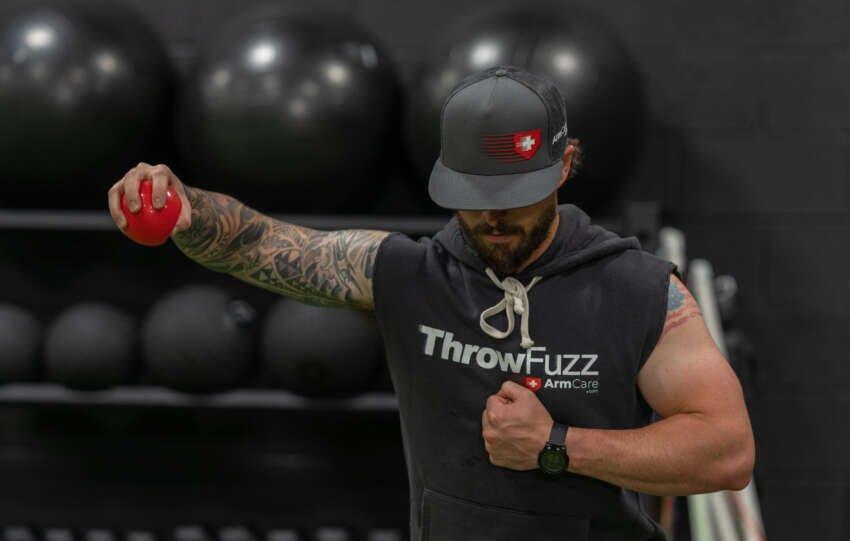
Velocity is associated with arm speed, which tends to be length-driven in today’s game. However, when it comes to health, you need to ensure a consistent arm position throughout this range, and yet again, why strength matters most!
At the intersection of arm position and arm speed is essentially power—we are talking about the multiplication of force and velocity.
Many players develop force, speed, and, therefore power, by using weighted balls. High arm speeds are achieved with lighter balls, and higher arm strength to decelerate layback is found using the heavier ball.
(The issue is that you let go of the ball, so deceleration strength is out the window past ball release. In past Strength in Numbers, we’ve talked about weighted ball holds and how fast they can achieve strength.)

When you select weighted baseballs, it’s important to know the force-velocity curve:
- The lighter you go with your ball, the faster the arm speed and the greater opportunity to throw at higher velocities.
- The heavier you go, the slower the arm speed and the greater the throwing arm force.
We need both, but we must progress this type of training safely. So, first of all, if the SVR (strength to velocity ratio) is less than 1.6, scrap run and guns altogether. Secondly, what happens if the athlete cannot throw strikes?
Command and Weighted Balls
Is throwing a weighted ball going to help improve command?
Well, the answer is obviously, NO!
By throwing to a wall with no targets, you make the throwing delivery more variable.
It essentially takes opportunities away from the athlete to be repeatable. And don’t forget the most significant predictor of pitching injuries is pitching! Therefore, when a player’s pitch efficiency rating plummets, their number of pitches per inning increases and risk of injury goes up.
Heavier balls reduce arm speed, lighter balls increase it, and baseballs stabilize it.
It’s important not to neglect arm position (the strength to maintain a position at a certain force) as you increase arm speed.
Move the Curve
Those who throw hardest are able to increase their power curve (the peak in the graph above).
In a nutshell, training needs to increase both force and velocity to push the curve upward and to the right. Moving the curve indicates that heavier loads can be thrown faster at lower relative strength levels to max strength.
When that happens, force and arm speed are optimized and you will keep athletes healthy by abiding by our velocity enhancement checklist.
The moral of the story here is that although arm speed relates to velocity, accuracy is premium, and for the two to meet we need to boost arm strength.
Additionally, gamify accuracy from the onset of the sport and improve Pitch Efficiency.
Fun games encourage and motivate athletes to focus on throwing to their intended targets.
I believe that every throw has a purpose, and every throw has a goal. If you are unsure about how to integrate gamified accuracy aspects into your practice plans for all athletes, reach out to me at Ryan@armcare.com and follow us on social media for some ideas to help improve accuracy.