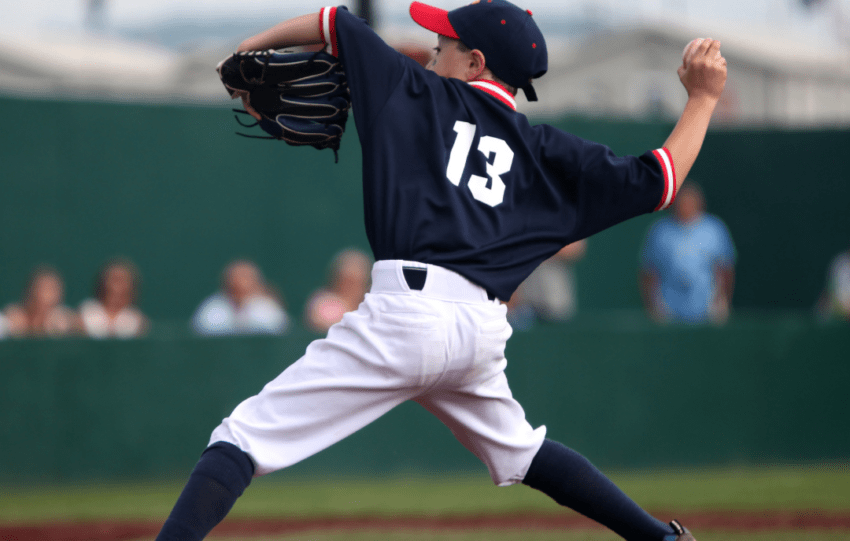
When you describe movement and quantify it, you have landed in kinematics land. In this article, we’ll break down the four biomechanical features of Kinematics and relate them to pitching.
Timing
This involves when things happen in the delivery that can be measured either in percent-time, total time, or associated with a discrete event such as peak knee height in the delivery or stride foot contact (known positions in the delivery as common time points)
- Example – You identify that your pitcher is taking 0.34 seconds longer from lifting the lead foot until the lead foot contacts the ground after peak knee height
- Application – Greater time in lead foot lift until foot contact reduces body speed going into the lead leg block and can make the athlete more rotational.
- Expected Results – This player may show a reduction in accuracy and velocity and a longer arm path due to extra time in the air before foot contact. The athlete may also experience arm pain and reduced arm strength.
Position
This involves where body segments are in 3D space or describing joint angles
- Example – You find out an athlete’s stride length is 80% of their body height which was 85% body height in length, or the lead knee position is flexed at 50 degrees at foot contact from 45 degrees.
- Application – A reduction in stride length could indicate a loss of drive leg lower body power, and if the lead flexes more at foot contact, the athlete is losing lead leg blocking strength
- Expected Results – This player may lose velocity and accuracy
Velocity
This is the rate of change in position. For example, miles per hour is a velocity, indicating the distance traveled per unit of time. Biomechanics looks at linear movement in meters per second (m/s) and joint velocities as degrees per second.
- Example – You find out an athlete’s arm speed had decreased by 150 degrees per second.
- Application – A reduction in arm speed could impact spin rate and throwing velocity
- Expected Results – The player may become more hittable and throw more as they cannot put the ball past batters when needed and cannot establish the player’s fastball.
Acceleration
This is the rate of change in velocity. We often do not speak about acceleration in pitching biomechanics, but it is common in sprinting and speed-related assessments. In a nutshell, it’s the rate of how quickly athletes increase or decrease speed. What is important about acceleration is that it can be positive, indicating the “acceleration” component, as well as negative, which is the “deceleration” component, or how the body or segment slows down. Linear units for acceleration are meters per second squared (m/s2), and rotational acceleration is radians per second squared (rad/ s2), which is not really intuitive for even me, as you would think it would be calculated as degrees per second squared. What is amazing about acceleration is that it is integral to calculating force, as Force = Mass x Acceleration, and is a kinetic property (movement causation factor) that we will cover soon in Part II.
- Example – You find that your athlete’s torso deceleration is worse by 250 rad/s2 in stopping rotation before maximum layback of the throwing arm.
- Application – A reduced ability to decelerate the torso rotation could make the athlete over-rotate toward the glove and increase forces on the shoulder and elbow as the athlete cannot slow down the torse and square up to the plate at ball release.
- Expected Results – The player may miss the target high to the arm side and could cut the ball across the plate. The athlete may also experience greater arm strength loss because of greater muscular demands from the throwing arm to protect joints.