

Strength in Numbers #106
The Major League Baseball (MLB) Draft is an annual event that showcases the league’s brightest young talents and offers them an opportunity to embark on a professional baseball career.
Throughout the years, countless pitchers have emerged from the draft, making their mark on the game and becoming the cornerstone of successful teams.
In this article, we are going to delve into the history of the MLB Draft, highlighting the impact pitchers have had on the process and the sport and the great risks teams take in selecting 4-Year College Starters who do not present strong future WAR (Wins Above Replacement) metrics.
WAR is the ultimate measure indicating how pitchers contribute to wins versus all other pitchers who could replace them.
It is considered the single most important measure for qualifying money spent on players in free agency that can be increased amongst those who consistently use the ArmCare platform.
EARLY DAYS AND BIRTH OF THE DRAFT
The concept of a draft in professional sports originated in the early 20th century.
However, it was not until 1965 that the MLB implemented its first-ever draft. Oddly, this was also the first year researchers made a ground-breaking discovery in an article that pitching can cause abnormalities in the elbows of youth pitchers and started to bring awareness to the dangers of overuse.
Fast forward almost 60 years, and the research indicates that 4-Year College Starters may not be a wise choice in the first round, as their value diminishes over time due to fatigue, poor performance, and injuries.

Link: https://content.iospress.com/articles/journal-of-sports-analytics/jsa200586
NOLAN RYAN
Nolan Ryan is one of the most notable pitchers to emerge from the first MLB Draft. Drafted by the New York Mets in 1965, Ryan’s blazing fastball and dominant performances solidified his status as an elite pitcher.
Over his illustrious career, Ryan amassed an astonishing 5,714 strikeouts, a record that remains unmatched to this day. His success highlighted the significance of drafting and developing pitchers with exceptional raw talent. Still, most importantly, it was his high-performance habits that paved the way to a Hall of Fame induction.
Nolan Ryan embodied the importance of strength training, creating capacity for his throwing arm and a detailed approach to adjusting training and workloads that led to him pitching well into his 40s.

ODDS OF MAKING IT TO THE BIG SHOW IN THE MODERN ERA
The MLB Draft allows everyone to make it to the Major Leagues, but some rounds have a greater chance than others. The focus on players selected in the first 3 rounds is critical mass for teams.
Yet, there are some surprises in later rounds, such as Hall of Famer John Smoltz, who was drafted in the 22nd round, yet may not have been drafted by today’s standards which are limited to 20 rounds following COVID-19.
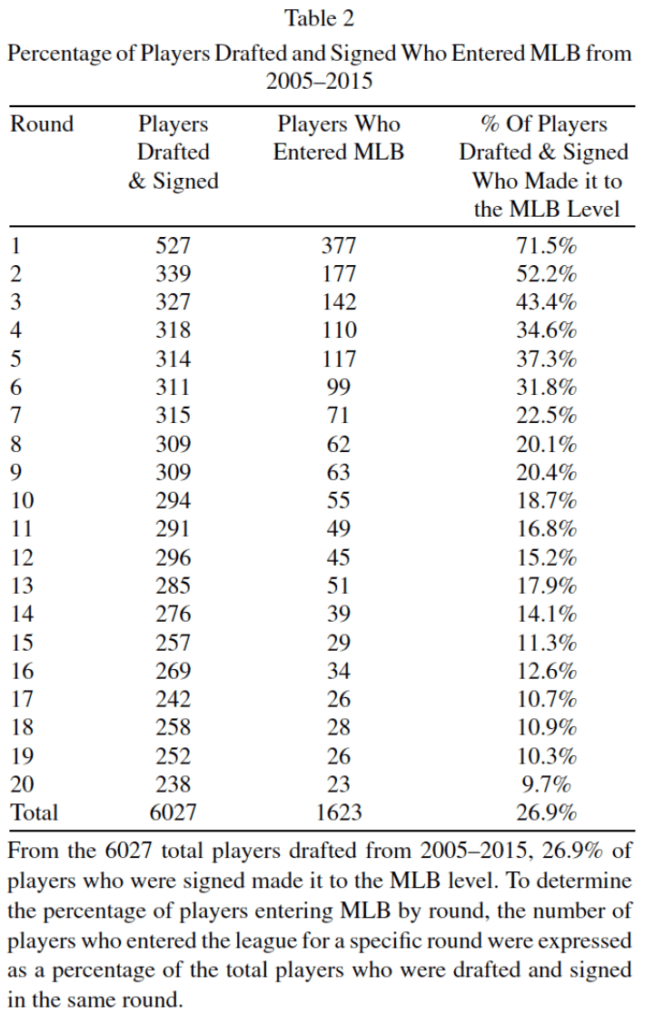
Link: https://content.iospress.com/articles/journal-of-sports-analytics/jsa200586
INCREASING FUTURE WAR FOR 4-YEAR COLLEGE STARTERS
In recent years, the MLB Draft has continued to evolve, with advancements in scouting, technology, and analytics playing a significant role. Teams now rely on comprehensive data analysis to identify high-potential pitching prospects and assess their chances of success at the professional level.
This modern approach has enabled organizations to make more informed decisions when selecting pitchers in the draft. Yet, no organization has a strong concept of throwing arm strength and range of motion analytics in scouting, and that is going to change.
On the podcast, we recently met up with Hurston Waldrep, a phenom college pitcher playing with the CWS finalist team – the University of Florida Gators.
Hurston allowed us to publicly talk about his arm care data which blows many of the highly touted arms in the draft out of the water. When I was scouting with the Angels, I studied the habits of pitchers, essentially scouting our questionnaires that were filled out by prospects.
Athletes with a high-level process, those who prioritize off-field competitive approaches and make their bodies their business, were starred amongst the crowd as pitchers with a greater chance to succeed at the MLB level and log more innings.
We also did not want to have to lay out a player development process at the MLB level, such as what happened in Stephen Strasburg’s case, as this hampers team win expectancy when a young, talented arm cannot go deep into the crucial innings of games. To simplify it, I scouted pitcher durability, and Hurston would be at the top of my list.
If you want to get into the details of how a 4-Year College Starter’s arm should function and the metrics that lead to high performance, you must listen to our podcast featuring Hurston, where we dive deep into his arm strength metrics that put him up with some of the strongest throwing arms at the Major League level.
If you are a player working hard and have the desire and vision to have an aspiring career in Major League baseball, make sure you develop high-performance habits, prioritize your athletic development and athletic wellness, and make your arm bulletproof by purchasing your own strength tester device and premium app.
We stand behind your improvements and guarantee your success through our Bulletproof Arm Guarantee. Prioritize Individualized ArmCare Training and Focus on Winning the WAR Against Injury and Poor Performance.
No pun intended.