Strength in Numbers #133
(Go here to read part 1 and here to read part 2).
While I was with the Angels, we drafted this player with a smooth delivery and all the qualities you would want in an athlete. He was young, meso-ectomorphic (long limbs, but can hold muscle mass), an explosive jumper, and an easy player to be around.
However, he had pain when he threw.
We decided to take an aggressive biomechanical approach to better his performance and health, and we summoned Eugene Bleecker and 108 Performance, arguably one of the best movement teachers in the world.
Eugene is hyper-intelligent, sees things differently, and can connect what the players feel and what is real, meaning the drills he selects have the players think about what they should do, and it comes together with actual change.
He uses biomechanics data and has great success making movement changes that stick.
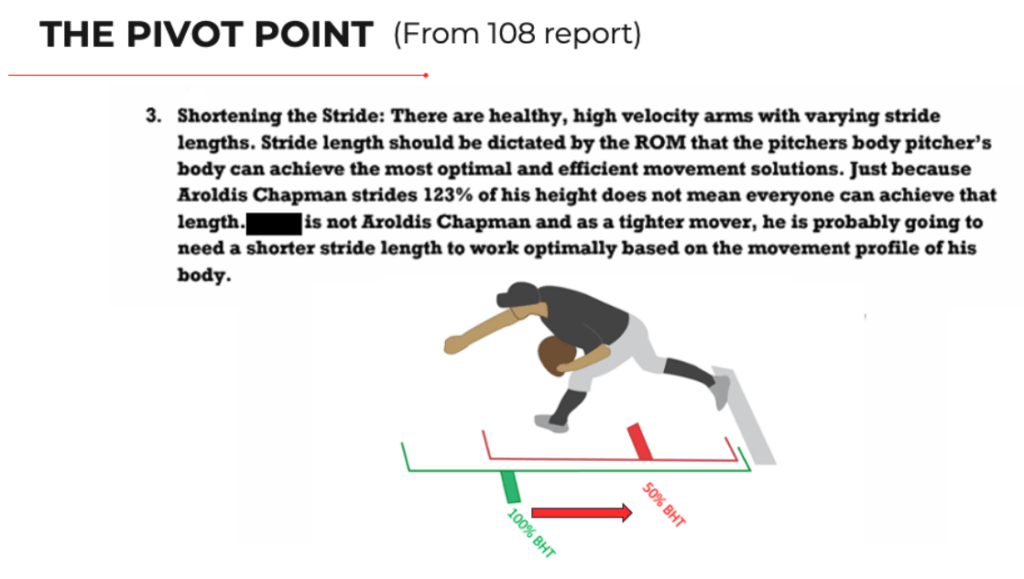
Eugene worked with this player all offseason. He got his body and arm in sequence and increased rotational versus linear components, making him more whippy. He also adjusted the player’s stride length, which resonated with me and my research.
Despite returning to us pain-free, he was weak and eventually had Tommy John Surgery only a short time after being reinstated.
It was through this experience that I realized strength matters most.
THE LIGHTBULB MOMENT
The year we took the biomechanical approach organization-wide with the Angels, we had the worst injury rate in Major League Baseball.
At the time, I was still publishing my dissertation research, where I identified that stride length changes could affect internal stress, metabolic profiles, cardiovascular strain, and self-reported exertion scores. However, in the 394 pages, I left out every aspect of physiology, leaving my entire dissertation focused on biomechanics.
You can access the entire article here.
I determined that shortened strides show less internal rotation fatigue and stress measures and greater loss in grip strength, which is a problem for your UCL.
(See part 2 on stress versus torque on how less resistance to tension-based stress significantly increases injury risk, and read the article showing grip strength loss and shortened strides here.)
When this player returned to the team, we tested his press strength, which was low compared to pitchers in the organization, and his grip was the weakest it had been.
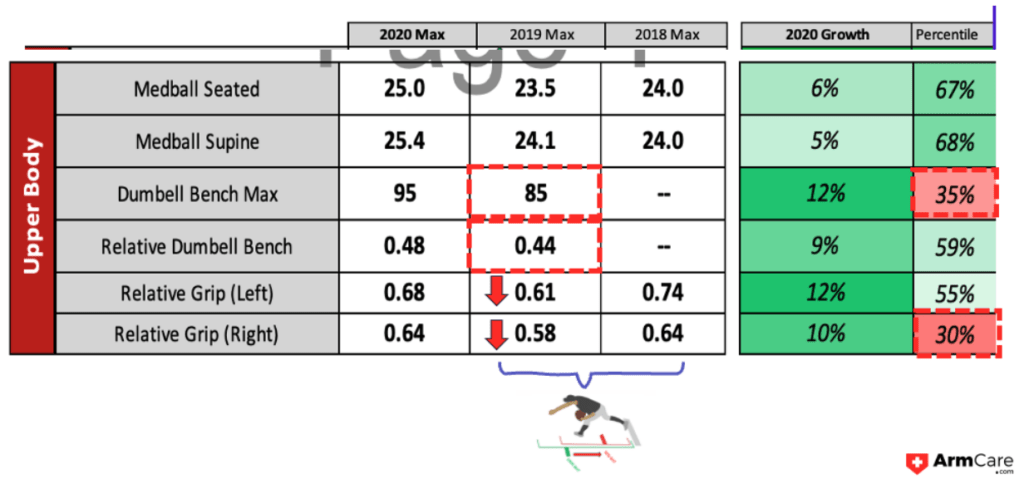
A cutout from an actual Angels Body Bank Report indicated that the bench press strength was in the 35th percentile, meaning that 65% of all pitchers were stronger than him and could not press his body weight. The pitcher was also right-handed, and the year he came back to our team with a pain-free delivery, both throwing arm grip strength and non-throwing arm grip strength reduced, indicating both central and peripheral nervous system fatigue (both arms weakening).
A SAD DAY FOR ALL
We are in the meeting room at the start of Spring Training in 2019. I was just promoted to Director of Performance Integration, connecting departments on performance and health.
After testing this player, I understood that he was susceptible to more throwing arm fatigue, his grip was lower, and all the signs showed that he needed time to build strength if he was going to perform.
Additionally, somewhere in the communication between the athlete and our organization, something very frightening emerged.
Despite throwing pain-free, the team wanted to change his delivery yet again.
I pounded the tables but lost.
I asked our front office and coordinators to give him two weeks to work on his strength without facing batters. I also begged them not to change his delivery as he had been working on it all offseason and was pain-free.
However, it was vetoed by the committee.
When the athlete was reinstated, he still had forearm weakness, but getting him on the field was the critical piece, not getting him stronger.
From case studies like this, it’s impossible to know if the outcome was due to his new delivery coming into the team, our attempt to change it, his strength profile, or some other factor. But, within one day, he had arm pain again, and he eventually had Tommy John Surgery only a short time after being reinstated.
Yet, based on my research and evaluating all the available evidence on the topic of throwing injuries, my conclusion is that this player was not strong enough to match their level of performance.
An injury was bound to happen regardless of his mechanics.
THE DECISION
The debate between Eugene and me, at times, was heated.
To the outsider, you may think we don’t like each other, but it’s actually the opposite. I have much respect and find 108 Performance and ArmCare worthy opponents.
Both are successful in their own right in advancing athletes’ careers and cumulatively will advance many more players and maximize their futures.
However, the conclusion of the event solidified a few things in my mind.
1. DON’T BREAK A DOOR THAT DOESN’T NEED FIXING
You have a greater chance of causing problems than fixing them if you attempt to change a player performing well without pain.
2. FIX STRENGTH AND LENGTH (MUSCLE TISSUE AND TENDONS) FIRST BEFORE TINKERING
If a player is in pain or not performing to their potential, work on strength before anything else.
You have a good chance of fixing the problems without making new ones. But also, if you don’t start by fixing strength issues, a weak arm is weak; even if it doesn’t feel pain, it won’t be able to perform.
I will leave you with this final point.
As a coach, you have a lot of influence over your players’ growth, but ultimately, you will only partially control a player’s development or mechanics.
Things will constantly change for that player, and many egos will get in the way as they advance in their careers. But if you start with strength, you will provide your player with a flexible foundation that can better absorb whatever teaching that player receives.
Ultimately, this is how you reduce the risk of your athletes’ careers ending.
If you want to dive deep, I encourage you to take the Certified Pitching Biomechanist Course.
You will see how to blend mechanics and strength through a pathway to ensure your athletes are unbeatable and unbreakable.
Thanks for hanging with us in this highly controversial yet critical debate.
I hope you now understand me when I say, “Strength Matters Most!”