

Strength in Numbers #137
Back in 2012, deep in the underground of Camden Yards, I had an epiphany.
I was part of a full transformation for the Baltimore Orioles, a facelift in training that will never be repeated, replicated, or duplicated. It was the most disruptive overhaul in training that MLB had ever seen, and it made MLB news.
We blended gymnastics, Olympic lifting, traditional track and field, and conditioning challenges that dialed up muscle recruitment in improving oxygen saturation and ATP production for sustained muscle contraction. As a staff, we competed.
I remember breaking our single-arm kettlebell snatch record during one game.
I was able to snatch for six consecutive minutes with a 32 kg bell. I also tore my hands apart as the prize. It was as much about experimentation, pushing ourselves to the limits as a staff, testing on the animals (us) before the humans (the players).
At the end of 2012, our team developed a remote training method involving Excel sheets and text messaging strategies to make dynamic adjustments for our MLB players.
The biggest problem was that we filmed a good number of exercises using cable machines – a piece of equipment that only 10% of our MLB players had in their homes.
This problem drove us to get creative and replicate cable-based training methods using elastic bands.
Here is a throwback video of me getting after it at Birdland.
At the time, I was a 365-pound bench presser then, and the thought of band training without finite resistance scared me as a sports scientist.
Despite bands being a great remote solution, I was used to the iron and bumper plates. I wasn’t comfortable with pure elastic training without involving a barbell, dumbbell, or trapbar as the main course.
EUREKA
As I was filming more variations with bands, my creativity and curiosity increased.
Bands are very different than inertial-based resistance like dumbbells and plates. They allow an athlete to be more dynamic, meaning you can create very high accelerations in the concentric contractions, but what I enjoyed most was the negative resistance.
I could load up the tension by moving away from the tether point, and without gravity taking over at the sticking points, there is a constant fight to slow the band down to the return position.
My nickname became the “Bandy-Man” as I created more than 200 exercises involving elastic resistance for our club.
ENTER THE NOW
The resistance bands we sell at ArmCare.com came into play for me in my previous career as the former Director of Performance Integration for the Angels.
Most importantly, the sleeves on our bands prevent injuries from the elastics snapping or the clasp coming undone and hitting athletes in the eyes, face, and throat.
That said, the fact that you have to grip the bands fires me even more.
GRIP THE $HIT OUT OF IT, OR YOU WON’T GET $HIT OUT OF IT
In the opening years with the Angels, we used bands without handles and a single tension.
Interestingly, when I arrived, the Pitching Coordinators purchased the bands used by pitchers and not strength coaches, which was a point of contention.
When we started testing arm strength, we found that these “one-tension no-handle bands” did not improve shoulder or elbow strength in players over 17.
Here’s why this elastic band strategy failed:
More developed throwing arms require increased activation of the rotator cuff, lower trap, and forearm flexors that is heightened when you grip handles at 50% of maximum intensity or greater.
First Failed Attempt at Solving the Strength Problem:
Using bands without handles, we had our players grip baseballs as hard as possible to spike activation. It worked for a time but then had diminished returns as the athletes were too acclimated to the band tension and needed more resistance.
Also, when the band got exposed to the sun without a nylon sheath, it dried up, cracked, and didn’t have the same firepower.
More developed throwing arms do not increase strength with more reps.
Second Failed Attempt at Solving the Strength Problem:
With our inability to part ways with the bands with no handles, we asked our athletes to increase their rep ranges, thinking it would help them gain strength.
As someone with significant education in muscle physiology, all that increased reps do at the same weight is dropout fast-twitch muscle fiber contraction—this is the opposite of what we wanted to accomplish.
We were developing slower arms that could, in essence, jog for miles but couldn’t sprint.
Athletes were not experiencing mechanical overload. They were experiencing metabolic overload, which took us down the throwing arm fatigue path, a place you don’t want to be in the training game.
If what I am saying above is hard to conceptualize, let’s turn to the story of the Milo of Croton.
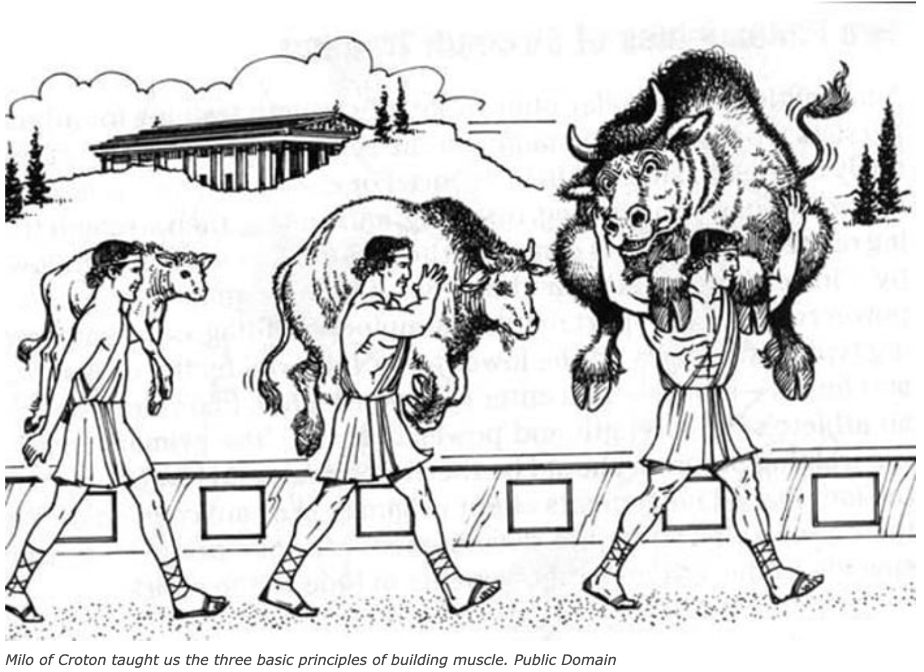
Milo of Croton, a legendary ancient Greek athlete, stands as the poster boy of strength. Born around the 6th century BCE in the city of Croton in southern Italy, Milo was a six-time Olympic champion in wrestling, dominating the prestigious competition for nearly 24 years.
His most famous feat involved carrying a growing calf daily until it became a fully grown bull, showcasing his incredible strength and the principle of progressive overload in training.
In other words, we gave our athletes the calf and told them to walk farther.
With no overload, the kind of strength required to sustain high octane velocities, resist wear and tear, bounce back faster, and maintain shoulder balance is unattainable with light resistance repeated over and over and over again.
Returning to the main point, we finally put the Crossover Symmetry bands that we use at ArmCare.com into the weight room, because of the heavier resistances and our athletes had to grip handles.
The bands didn’t match the team colors, which ironically is a big deal in baseball—still very weird to me when fashion is considered more critical than function—but it was necessary to get our players strong.
In later years, when I was hired by ArmCare.com, my “Bandy Man” senses are revved up again, where you can get bands up to 40-lb band, which double that when stretched.
Not a place you should start, but if you see what I have seen, you will begin to develop athletes with strength profiles such as below by gripping and challenging the throwing arm:

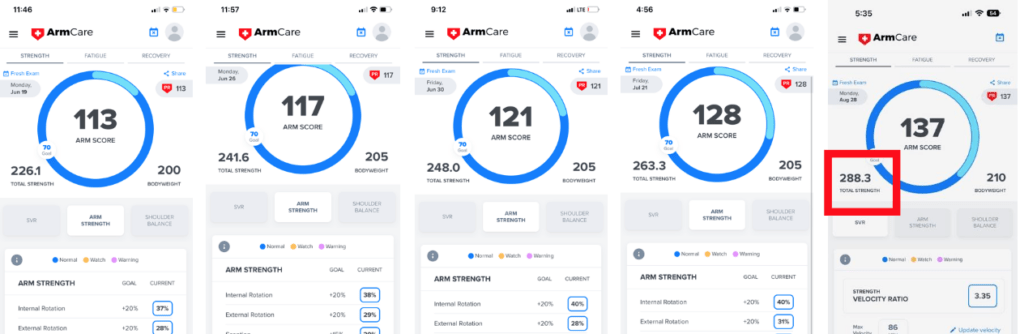
If improving sheer strength excites you, learn more about how elastic tension and gripping exercises can be used to accelerate desired changes in your athletes’ mechanics from our Certified Pitching Biomechanist Course.
Exercises like this one below with progressive overload will help train your players to generate, store, and transfer energy more efficiently, resulting in safe velocity enhancement for athletes on the mound and the field.
If the handles aren’t bending, you’re pretending – IT’S TIME TO GET AFTER IT.