Strength in Numbers #156
I am not going to lie; I am all about companies pushing the boundaries of throwing high octane, especially with a concentrated effort on command and control.
However, what is giving velocity enhancement a bad name is the lack of evaluation.
For example, this athlete below has met the minimum cut for the Strength-Velocity Ratio, meaning his pounds of arm strength is 60% stronger versus the velocity he can achieve.
However, he has a big body, a relatively weak arm, and an unbalanced shoulder—does it make sense to put him into a velocity enhancement program throwing at max capacity?
Absolutely not! But it’s happening all the time and around the world for athletes and coaches who are flying blind.
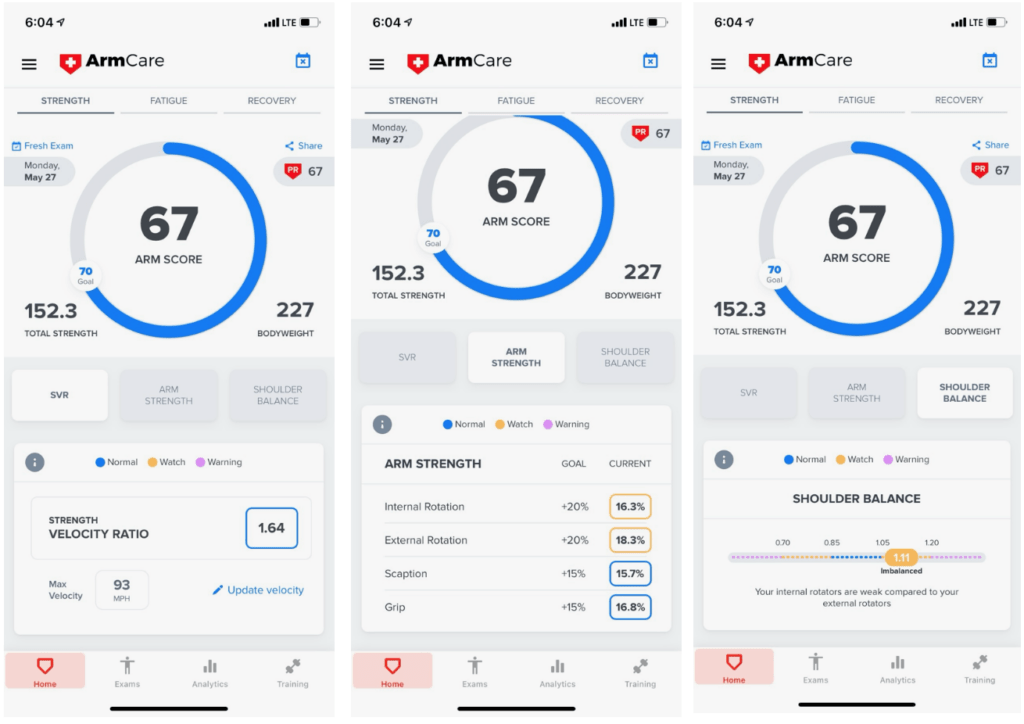
This athlete has a Strength-Velocity Ratio of 1.64, but at 227 lbs and 152.3 lbs of total arm force, he has outgrown his arm strength as he needs to hit a score of 70 at least.
The momentum exchange (mass x velocity) between a heavy body and a relatively weak arm is not uncommon, as most of professional baseball displays this trend (ref). You don’t have to be a detective to see the effects of altered momentum and what happens to grip by reading these abstracts (ref1, ref2).
In the middle image, you can see where the athlete is weak, and that has caused a layback imbalance, meaning his brakes slowing the arm behind him need a tune-up.
ENTER VELO U
Dr. Nick Serio, a versatile high-performance specialist with a doctoral education in sport psychology, has teamed up with Cassie Reilly Boccia to establish Velocity University (Velo U) as one of the leading velocity enhancement companies in the nation. But they are more than just that. You can get a quick glimpse of them and their staff here.
In the modern era of baseball, velocity has become a crucial metric for evaluating a pitcher’s potential and performance. The ability to throw fast not only increases the chances of striking out batters but also enhances a pitcher’s overall effectiveness on the mound.
However, velocity enhancement training is a multifaceted endeavor that requires serious attention to various physical, mental, and internal elements, which VeloU covers to a high degree.
PHYSICAL ELEMENTS
The physical aspect of velocity enhancement involves a combination of strength training, biomechanics, and conditioning. Effective training programs focus on building explosive strength in key muscle groups, particularly those involved in the pitching motion.
This includes the legs, core, and upper body. Programs like VeloU’s high-performance training are designed to maximize these physical attributes, enabling pitchers to achieve higher velocities while maintaining their athletic durability.
By employing state-of-the-art training techniques and individualized plans, VeloU helps pitchers optimize their physical capabilities, ensuring they can generate maximum force with each pitch and have their throwing arms have the tolerance to withstand the demands.
MENTAL COMPONENTS
Mental toughness and focus are equally important in velocity enhancement. Pitchers must learn to maintain composure under pressure, concentrate on their mechanics, and stay committed to their training regimens.
The mental preparation involved in pitching at high velocities requires a strong mindset and the ability to overcome obstacles. VeloU infuses elements of mindset performance into its programs, helping athletes develop the psychological resilience needed to perform at their best.
Techniques such as visualization, goal setting, and stress management are integral parts of their comprehensive approach to velocity enhancement for the company, handling the past, and not looking too far into the future.
I think moment-to-moment player development is a real strength, as is the dynamic ability to adjust to the environment and anything that could disrupt a regular routine.
INTERNAL FEATURES
Internal elements, such as nutrition, recovery, and injury prevention, play a significant role in a pitcher’s ability to sustain high performance. Proper nutrition fuels the body, aiding in muscle recovery and overall health.
Adequate sleep and rest periods are critical for allowing the body to repair and strengthen itself after intense training sessions. VeloU emphasizes the importance of these internal elements and has crucial discussions around recovery protocols.
Their approach ensures that pitchers are training hard and taking the necessary steps to prevent injuries and extend their careers.
HOLISTIC EVALUATION
Evaluating baseball pitchers holistically involves assessing all these elements to create a well-rounded and effective training program. By considering an athlete’s physical, mental, and internal aspects of development, trainers can provide a more comprehensive approach to velocity enhancement.
This holistic perspective is crucial for maximizing performance and protecting athletes from common pitching injuries, such as ulnar collateral ligament (UCL) tears, which can be career-threatening.
EFFECTIVENESS OF VELO U’S HIGH PERFORMANCE PROGRAMS
VeloU’s high-performance programs have proven effective in delivering exceptional results. Their commitment to a holistic training approach ensures that pitchers are not only throwing harder but also doing so with a reduced risk of injury.
Athletes who have undergone VeloU’s training have reported significant increases in their pitching velocity, improved overall athletic performance, and enhanced durability on the mound.
By addressing all aspects of a pitcher’s development, VeloU sets a high standard for velocity enhancement training in baseball that comes with many key ingredients, but one they trust in their individualized throwing arm assessments and training.
THEIR KEY INGREDIENTS FOR SUCCESS
- Create a relationship with the human first than the athlete
- Individualization affords a higher magnitude of change through the consistent adaptation of an athlete’s program, which relies on the ability to gather and synthesize data daily.
- Movement is the body’s expression of its ability to adapt to its contextual environment. Generalized movement patterns performed in exhaustive repetition reduce the body’s ability to adapt and, therefore, move freely.
My heuristics are:
- “Learn Your Learner“
- Individualization = Optimization”
- “Motor Preference > Motor Pattern“
It’s obvious how aligned VeloU is with the ArmCare.com education and process. They’re on the attack to have a program focused on maximizing velocity while doing the same for health.
I’ll end with a text quote that Nick sent to me: “We know we need velocity, but we do not want to accept that this comes with responsibilities.” Isn’t that the truth?
In this week’s podcast, we dive in with Nick and discuss this conundrum: Can you have your cake and eat it, too?
After watching the podcast, I think you can, but you must be dynamic, data-led, and understanding…
STRENGTH MATTERS MOST.
Welcome aboard VeloU,
Ryan
P.S. – If you have a company that focuses on high-velocity pitching, please contact us to discuss partnerships in taking the necessary steps to maximize performance and minimize risks. Or, if you are unsure about how to put pieces together, enroll in one of our most popular courses on data-led velocity enhancement, which is one of a kind.