Strength in Numbers #162
Injury prevention is paramount in baseball, particularly for pitchers.
Handgrip dynamometry—measuring the force generated when squeezing a device with the whole hand—has gained popularity among the various methods used to assess potential injury risks.
However, its effectiveness in predicting throwing arm injuries, particularly those related to the ulnar collateral ligament (UCL), remains questionable.
LIMITATIONS OF FULL HANDGRIP DYNAMOMETRY
Despite its widespread use, full handgrip dynamometry has shown limited effectiveness in predicting throwing arm injuries in pitchers.
One significant limitation is the lack of research demonstrating clear differences in grip strength between injured and healthy pitching populations.
While handgrip strength might offer a general indication of forearm muscle function, it does not provide a nuanced understanding of the specific muscular demands placed on a pitcher’s arm during throwing motions.
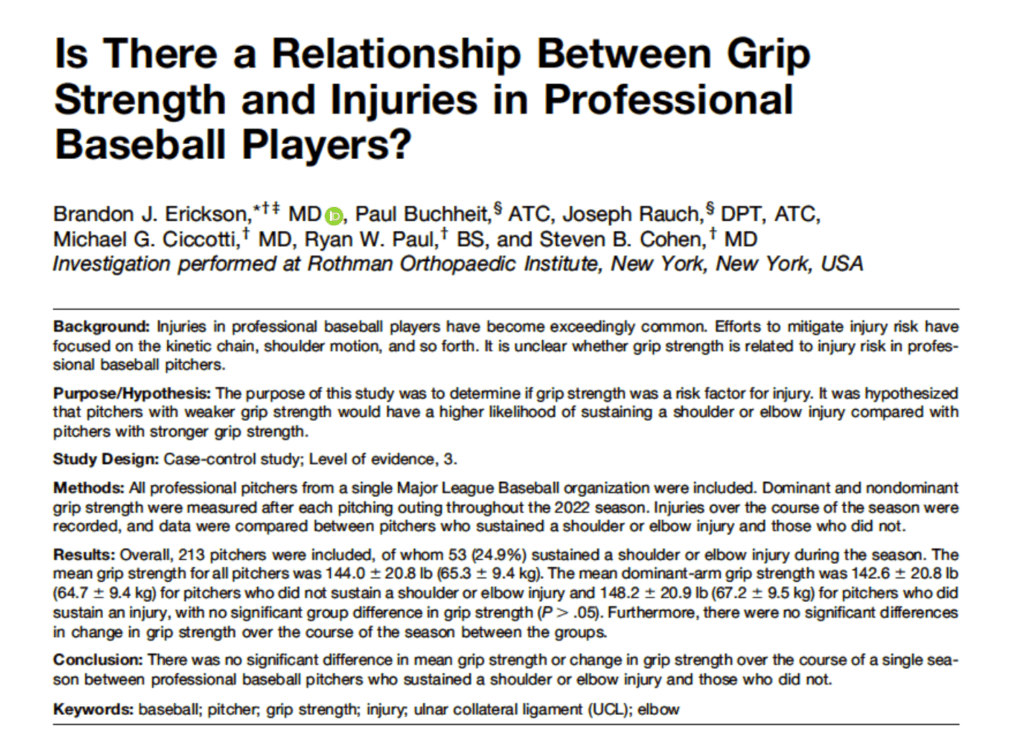
Like many of you, I deeply believed in full-hand grip strength. Over four years with the Angels, we evaluated grip strength without statistically significant findings.
We did a fatigue analysis, looking at forearm strength the day before pitching, forearm strength right after pitching, and forearm strength 24 hours after pitching to get a full neurological understanding. We tested different sensitivities and recognized that seated in 90-90 was the most telling for fatigue and that any other handgrip position was ineffective in showing fatigue trends.
However, we first introduced pinch grip to better understand spin associations in pitchers and through the finger, which led to much more impactful results.
If you think of a checkmark, the start (day before) was really high, and after pitching, it was really low (big valley), indicating a significant loss of strength.
The rebound, the day after, or the end point of the checkmark, was more flat, indicating greater recovery needs.
GRIP UNDER ULTRASOUND
Researchers have evaluated grip strength under ultrasound to evaluate the role of flexor-pronator mass muscle contraction pre- and post-pitching. In a study performed by researchers in Japan, pitchers were tested in a loaded position, the ulnar collateral ligament (UCL) scanned, and muscles contracted by holding a handgrip dynamometer.
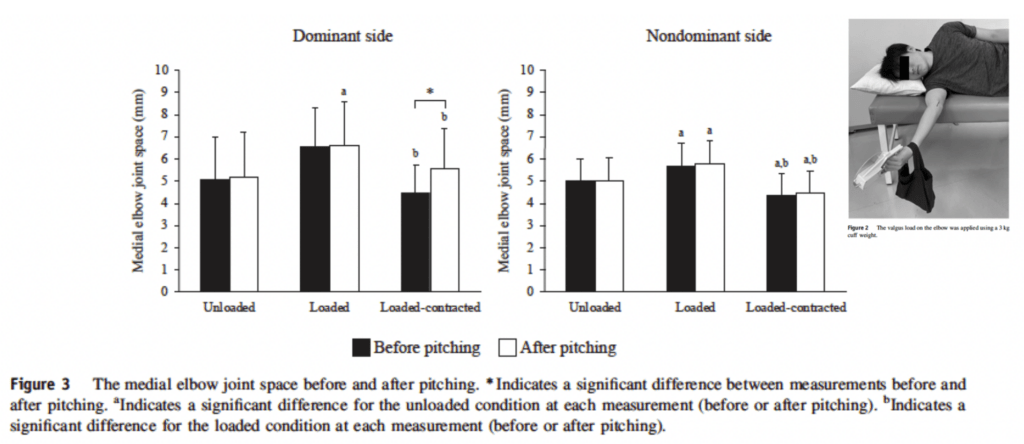
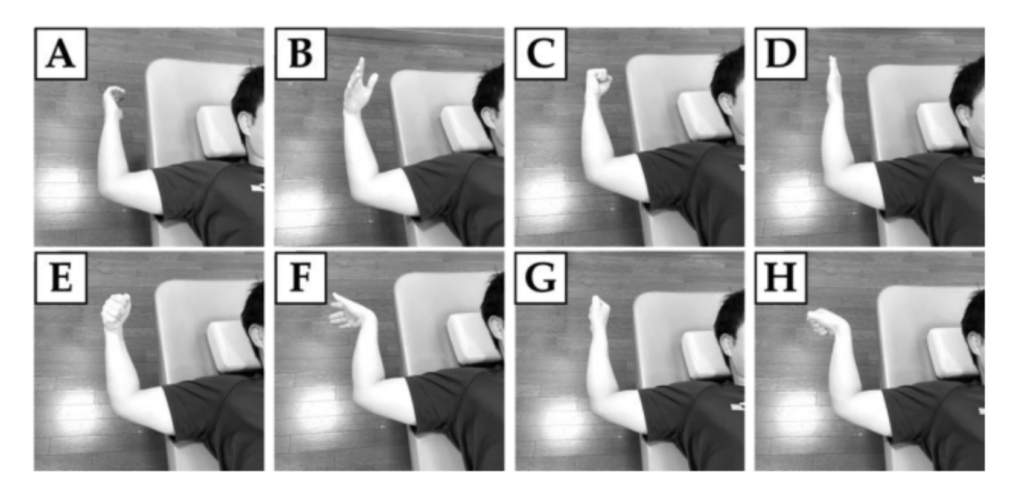
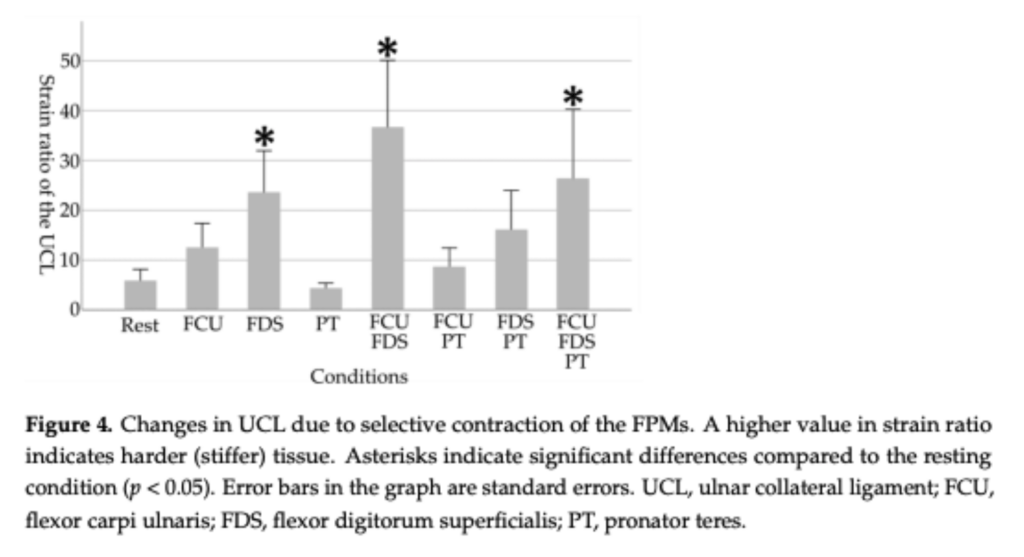
In other work evaluating the stiffness of the UCL and inner elbow joint gap, a series of forearm positions and activations were studied to determine which muscles, or combinations of muscles led to the smallest joint gap and the stiffest ligament for stability.
Here, looking at UCL stiffness, the flexor digitorum superficialis (FDS) was the clear winner indicating it’s ability to be much more critical as it relates to fatigue induced injury and loss of UCL stiffness with increased joint gapping.
UNDERSTANDING THE FDS
The FDS and FDP muscles are integral to a pitcher’s ability to maintain elbow stability during the high-stress phases of the pitching motion. These muscles are responsible for flexing the fingers, particularly when gripping a baseball, which in turn helps stabilize the elbow joint and protect the UCL from excessive strain.
When a pitcher grips a baseball, the pressure is applied differently across the fingers compared to when squeezing a handgrip dynamometer. The act of gripping a baseball engages the FDS and FDP muscles in a more specific manner, as the fingers must conform to the shape of the ball, and the grip strength must be modulated to control the ball’s spin and trajectory.
This activation pattern is distinct from the uniform squeeze required by a handgrip dynamometer, where the entire hand and forearm muscles are activated more globally. We need to think logically here. Pitchers or any player do not hold a ball with the whole hand, and therefore, we need to pivot to a 3-finger grip evaluation (index, middle finger, and thumb) to understand the potential for loss of stability, or reduced stiffness for the ligament.
The specificity of finger pressure during a baseball grip is critical for the fine motor control required in pitching, which is not replicated in the gross motor task of squeezing a dynamometer. As a result, the dynamometer fails to provide a relevant assessment of the muscle function that directly impacts UCL protection and injury prevention.
MOVING TOWARD A TARGETED ASSESSMENT
Given the limitations of full handgrip dynamometry, there is a clear need for more targeted assessment tools that focus on the specific muscle groups and movements relevant to pitching. Evaluating the strength qualities of the FDS and FDP muscles through more precise measurements, such as finger-specific dynamometry or digital grip strength tests that simulate baseball grip, could provide more relevant data for predicting injury risks.
This is something that is easily accomplished by our FDS test. We knock out the legs, reduce the muscle irradiation effects for the upper body as well, and put the athlete in a provocative position (90-90) that has the potential denote reduced blood flow to the forearm stabilizers and the UCL itself.
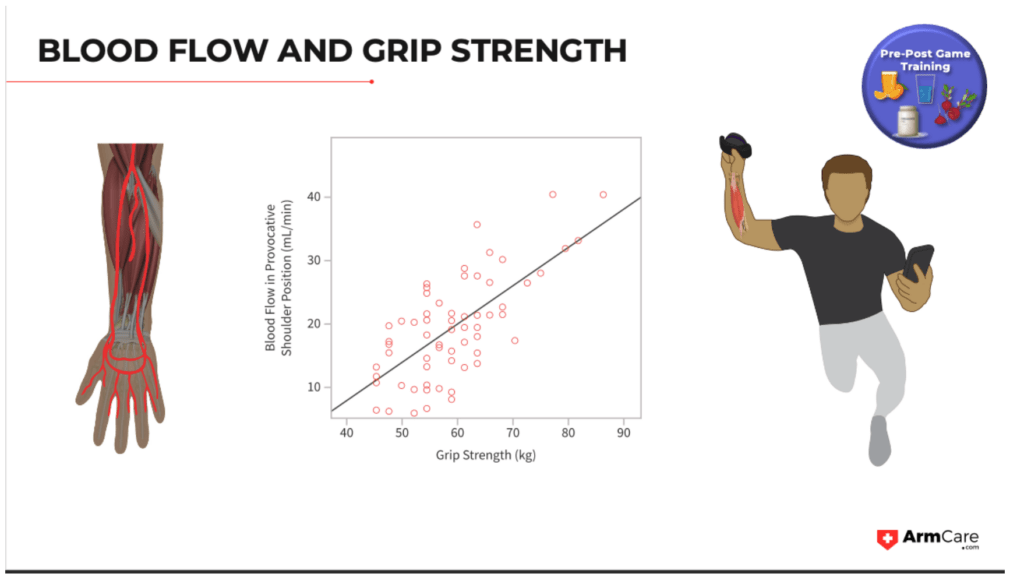
In our Certified Pitching Biomechanics Course, we go into deep detail on how to train the FDS to improve baseball grip strength and that all starts by understanding the dynamic role of the forearm stabilizers during the pitching motion. By focusing on exercises that mimic the functional demands of pitching, athletes can better prepare their muscles to withstand the stresses of high-velocity throws, thereby reducing the risk of injury.
CLOSING THE GAP
While full handgrip dynamometry has its uses, it is not a reliable predictor of throwing arm injuries in baseball pitchers, particularly in the context of UCL injuries. The assessment fails to capture the specific muscle activation patterns and strength qualities required during pitching. As the understanding of pitching biomechanics advances, so should the methods used to assess and protect the throwing arm.
The baseball community can better safeguard its athletes from the debilitating effects of UCL injuries and other throwing-related issues by moving toward more targeted evaluations and training interventions.
3-Finger Grip It and Don’t Rip It.
STRENGTH MATTERS MOST.
Ryan
Ryan@armcare.com