‘
Strength in Numbers #177
When you hear the word “INVERTED,” your mind instantly wanders to the dark side. Two elbows over the shoulders, arms turned down, a la Kerry Wood and Mark Prior, the famously perceived mechanical flaw considered insidious by the entire industry.
However, the word “inverted” can be positive and is integrated routinely in training.
Inverted rowing is a powerful exercise that benefits throwing athletes, particularly in baseball, where shoulder and elbow stability, grip strength, and muscular endurance are critical.
This horizontal pulling exercise strengthens the upper body and emphasizes joint stabilization, grip endurance, and eccentric control. It is a highly functional movement for throwing athletes, not to mention balancing the shoulder from back to front.
In this article, we will show variations of inverted rowing and use some strange terms, such as “brachiation,” a specific locomotor feature of primates swinging from trees that is heavily used to create joint stability and stress-shielding for the throwing arm.
Brachiation and Joint Stability – Stabilizing Against Distraction
Brachiation, the ability to swing or hang from one’s arms, is an underutilized but highly beneficial element of training for throwing athletes. In inverted rows, the shoulder and elbow muscles are engaged in stabilizing the joints from distraction forces (forces pulling the joint apart).
These distraction forces replicate the stresses a pitcher’s or thrower’s arm experiences during the deceleration phase of a throw, making the exercise directly applicable to athletic performance and offering body weight forces that can get up there.
Key stabilizers such as the rotator cuff, trapezius, and rhomboids must activate to prevent the shoulder joint from “dislocating” during the pulling motion. Similarly, the elbow muscles, such as the brachialis and brachioradialis, provide stability under tension. Training these stabilizing systems can improve shoulder and elbow integrity, reducing the likelihood of injuries such as rotator cuff strains or medial elbow ligament damage (e.g., ulnar collateral ligament injuries).
Muscular Endurance Through Isometric Co-Contraction
One of the unique benefits of inverted rowing is its capacity to enhance muscular endurance through isometric co-contraction. When hanging in the starting position, the athlete’s shoulder girdle and core musculature must work isometrically to stabilize the body. This static hold builds endurance in key muscle groups like the serratus anterior, rotator cuff, and scapular stabilizers, which are crucial for throwing athletes.
Throwers need this endurance to maintain optimal mechanics throughout games or training sessions. Inverted rows mimic the sustained muscle activation required to hold the scapula in a stable position during high-intensity throwing motions, reducing compensatory movements that lead to injury.
Variations in Lower Body Position
Inverted rows can be made more challenging and functional by incorporating lower-body movements, such as walking or marching, during the exercise. These progressions emphasize the cross-flexion-extension reflex, the natural alternation of upper and lower limb movements seen in walking, sprinting, and throwing.
Single-leg marching or sprinter rows involve a single-leg position during the row. This position challenges hip and core stability by placing the athlete in a “hip-locked” position, like the stance phase of pitching. This develops strong co-contraction strength in the hip flexors, glutes, and core, essential for maintaining pelvic stability through rotation.
Strength Gains Through Eccentric Control
Eccentric strength, or the ability to control muscle lengthening under load, is critical to athletic performance. In the inverted row, the lowering phase against gravity forces the muscles of the back, shoulders, and arms to decelerate the body with control.
This eccentric emphasis strengthens the lats, traps, and biceps while reinforcing the posterior chain’s ability to absorb and dissipate force effectively.
For throwing athletes, this translates to better control during the deceleration phase of a throw, where the muscles must absorb significant kinetic energy to protect the arm from injury. Developing eccentric strength through exercises like inverted rows can improve force management and resilience during high-velocity movements.

Inverted rowing and following the SPEAR Training algorithm from the Certified ArmCare Specialist Course will put the athlete on a course of correction and overcome programming that is highly activating for the pecs, lats and teres major.
Grip Strength Variations: Full Hand, Thumbs-Off, and Three-Finger Grips
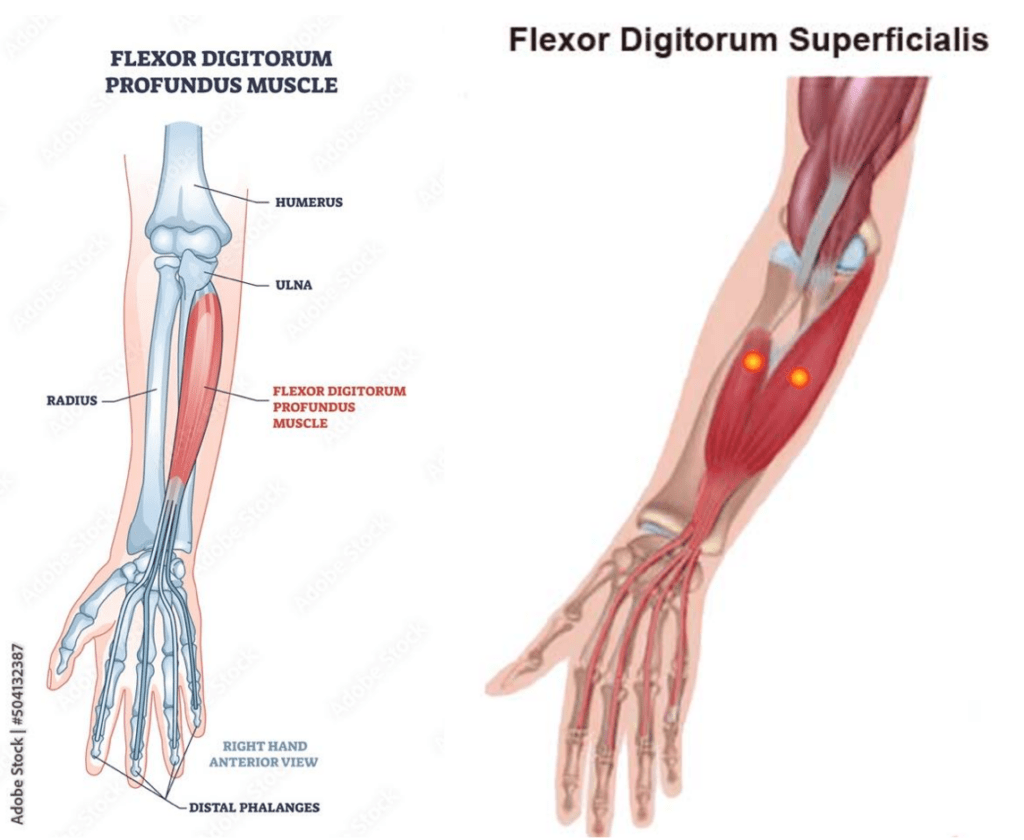
Grip strength is an often overlooked but essential quality for throwing athletes. The ability to grip a baseball effectively engages forearm stabilizers like the pronator teres and flexor digitorum superficialis, which are critical for controlling the throwing motion and reducing stress on the elbow joint.
Getting into the weeds – Inverted rows allow for various grip modifications to target these muscles:
- Full-Hand Grip: The standard grip emphasizes overall forearm and finger strength, providing general benefits for gripping tasks like throwing or batting.
- Thumbs-Off Grip: This grip shifts more activation to the flexor digitorum profundus and pronator teres, muscles that stabilize the elbow during throwing.
- Three-Finger Grip: Using only three fingers (typically the middle, ring, and pinky fingers) increases grip specificity and strength endurance, as it mimics the finger pressure used in holding and throwing a baseball, targeting the flexor digitorum superficialis.
Final Thoughts
Inverted rowing offers significant benefits for throwing athletes, from building joint stability and grip strength to enhancing eccentric control and functional movement patterns.
Incorporating variations and progressions that emphasize hanging, brachiation, and single-limb stability can improve shoulder and elbow durability, as well as overall athletic performance.
As throwing athletes continue to seek ways to improve their durability and on-field effectiveness, exercises like inverted rows should be integrated into their training programs.
It’s never too late to brachiate – or take advantage of our Black Friday Deals!
Ryan
Ryan@armcare.com