

Strength in Numbers #214
When it comes to returning from injury, most athletes think about one goal—getting back on the field. To me, that’s not good enough.
Just being back on the field playing does not justify a successful return – you must be a better athlete after rehabilitation than you were beforehand.
At Velocity University, a premier baseball training facility in Pleasantville, New York, Dr. Nick Serio and his team believe in going further. The mission isn’t simply to return players to baseline performance, but to push them beyond their previous performance levels.
This philosophy is the essential piece missing in the game—what we call Return Beyond Performance Education. It focuses beyond physical rehab, requiring an infusion of coaching athletes into stronger, smarter, and more adaptable players than they’ve ever been.
It requires an objective process – using strength and range of motion testing to manipulate key training variables – type of exercise, exercise tempo, density of exercise (how much to be done in a session or week), volume of exercise (how many reps), intensity of exercise and how you integrate movement features and corrective approaches so athletes are challenged and come back better than ever.
In this edition of Strength in Numbers, you are going to get an inside look at our new in-person course offering, one that blends technology, sports science, data, applied concepts, practical applications, and getting your hands dirty by going through foundations of training and seeing how all the key ingredients in a player development, injury protection and rehabilitation model can fit together.
Attack Your Confirmation Biases!
Attacking your confirmation biases is the first step on the path to enlightenment and a non-negotiable if you are going to grow as a coach, player, therapist, or anyone involved in driving high performance and creating opportunity for athletes.
Dr. Serio embodies a key principle that many overlook – great coaches are also lifelong students. In hosting our event and in speaking with him, his mind is constantly on what more can be learned, what ideals can be challenged, even his own.
In the competitive world of baseball development, it’s easy for coaches to rely on what they’ve always done or lean heavily on methods that worked for one standout player. This is where confirmation bias can limit growth—mistaking isolated success as proof that a method works universally.
At Velocity University, there’s no “one-size-fits-all” approach. Every athlete is evaluated individually, ensuring programming is built around their unique biomechanics, movement patterns, and developmental needs. This flexibility allows athletes to explore different pathways to progress.
At the same time, coaches continue refining their confirmation bias, which is the tendency to seek, interpret, and recall information in a way that confirms our pre-existing beliefs.
In player development, it might look like assuming a certain drill works because it helped one athlete succeed or sticking with a rehab method. After all, it “has always worked” in the past. In sports medicine, it can mean interpreting a player’s progress based only on subjective signs, rather than using objective data to verify that their performance markers and physical readiness have truly improved. While this bias is human nature, in baseball, it can be dangerous—it can lead to misdiagnoses, stalled development, and preventable injuries.
VIDEO OF TWO DIFFERENT PITCHERS (BRADY AND BRAYDEN)
It should be easy to see that these two pitchers have different body types and delivery styles. Given the unique differences, does it make sense to apply one approach to both?
If the answer is yes for you, you need to rationalize which aspects of the movement, athletic qualities ingrained in the athlete, or commonality should tie them together in the same approach to training. If the answer is no, you are leaning more toward challenging your position, your closely held beliefs.
You Can Be a Scientist
You do not need a PhD to be a scientist. You do not need any formal education to collect data before and after you institute a new dimension of your player development and your injury prevention approaches. If you are a clinician, you already have heard of evidence-based practice, but it’s time for practice-based evidence.
The biggest pitfalls occur when coaches and medical professionals fail to challenge their assumptions and lack the use of data – quite simply, building throwing programs and training plans, rehabilitating throwing arms without strength and range of motion information. Without questioning our methods, we risk ignoring early warning signs, missing better options, or overlooking unique needs that don’t fit a cookie-cutter program.
Objective data—whether it’s range of motion, force output, velocity tracking, or workload metrics—is the antidote. It allows us to qualify our perceptions and make evidence-based adjustments. Each player is a unique system, with different mechanics, physical capacities, and recovery timelines. Adapting our approaches to meet these individual needs isn’t just a best practice—it’s essential for optimizing performance and protecting long-term health.
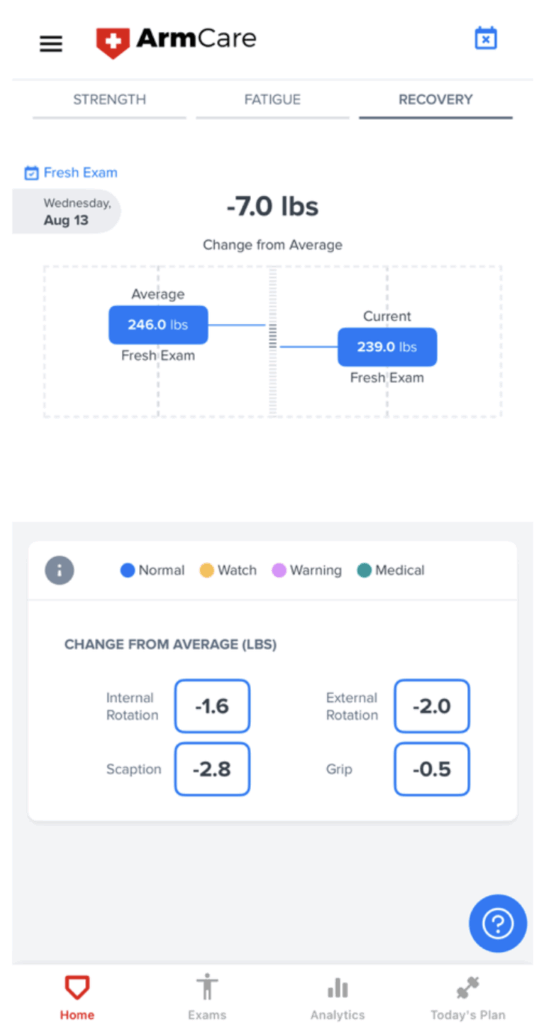
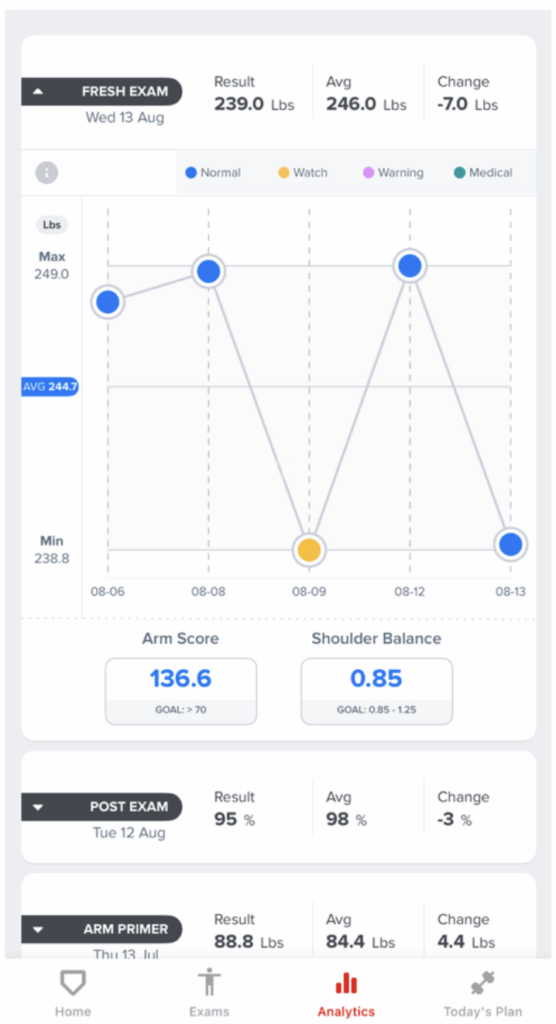
Charting recovery and adjusting is essential for long-term success. By looking at the throwing arm 24 hours after a high-intensity throwing or pitching session, you can dial in recovery processes and scale your workouts to support better return of neurological function – how well your nerves can activate your muscles.
By actively challenging our perspectives, embracing variation, and using objective measurement to guide decisions, we move away from the dangers of “what worked before” thinking. In doing so, we create a development and medical environment where athletes don’t just return to play—they return better than before. In the end, progress in baseball is not about defending what we believe—it’s about discovering what works best for this player, right now.
The result is a variation-rich environment where players are coached, not just trained. We need options, and Return-to-throw programming is taught in detail. Velocity University also provided some interesting information to showcase how players are carefully monitored to ensure that each phase not only restores capacity but also elevates performance metrics—arm health, velocity, movement efficiency—beyond pre-injury levels.
Dr. Serio’s approach breaks the cycle of simply getting “back to normal.” Instead, players return stronger, smarter, and more prepared to handle the demands of the game. It’s proof that when athletes are guided by coaches who are also willing to learn, the road back from injury can lead to an entirely new level of success.
In these videos, Dr. Serio presented how using a wall and reducing visual distractions and preconceptions helps the athlete stay loose. In these drills, separation between the trunk and pelvis is emphasized with the kneeling position removing the linear component to focus on blocked rotation and sequencing with the throwing arm.
A Sheet of Paper Doesn’t Work
The return-to-throwing (RTT) phase is one of the most critical—and dangerous—stages in a baseball player’s recovery. A therapist gives an athlete a sheet of paper containing their RTT program, which was either given to them by a surgeon or downloaded from a surgeon who never attended to the athlete in question.
Unfortunately, many athletes navigate this stage with minimal oversight, relying on generalized, cookie-cutter programs that fail to account for individual differences in healing, mechanics, workload tolerance, and recovery capacity.
Most RTT programs are structured with progressive increases in both throwing intensity and volume at the same time—a combination that exponentially raises injury risk. This is the phase where the arm is still adapting to the stresses of throwing after a layoff, yet players often receive minimal real-time evaluation, feedback, or recovery windows. Without personalized scaling, the athlete’s arm is asked to handle more than it’s ready for, leaving the door open for setbacks, compensations, or reinjury.
Compounding the problem is the lack of function and feel evaluation in real-time – not enough players, physical therapists, and coaches are using the ArmCare platform to test strength and range of motion responses.
Similarly, a player’s mechanics may have changed subtly since before the injury—sometimes due to fatigue, sometimes due to misguided coaching cues during rehab. These changes in form can place added stress on vulnerable joints, creating the same environment that caused the original injury. Without careful observation and objective monitoring, these warning signs are easy to miss until it’s too late. Every return-to-throw plan should be individualized and flexible enough to adjust based on how the arm is responding day-to-day, with an emphasis on restoring efficient mechanics, building arm capacity, and ensuring sustainable recovery.
Key Highlights:
- Generalized RTT programs are ineffective—they ignore individual healing timelines, workload tolerance, and mechanics.
- Intensity and volume are often increased simultaneously, placing the arm at maximum risk during its weakest stage.
- Players are often on their own during this phase, with minimal hands-on monitoring or recovery guidance.
- Mechanics can change post-injury due to fatigue or poor coaching cues, leading to harmful joint stress.
- Lack of form assessment means subtle warning signs often go unnoticed until reinjury occurs.
- All RTT programs must be scaled, with both function and feel evaluated regularly.
- Objective monitoring is key to ensuring sustainable progress and a true return beyond performance.
Fatigue and misaligned coaching processes can increase load on the catapult, your throwing arm. Similarly, when the training provided to athletes is ineffective, especially during the return beyond the performance period, athletes can be exposed to more risk. In this video, we go through ineffective scap loading and bracing strategies – strength and coordination aspects are not in alignment with the delivery.
Here, the class is learning about muscle irradiation to intensify contraction and train the forearm in the later stages of Tommy John Surgery, with the addition of a squeeze constraint, such as our plyoballs. Testing forearm strength responses is essential to the process to ensure the athlete is not overworked and fatigued, as both can lead to secondary injuries throughout the rehabilitation process. Be a scientist!
Key Takeaways
We need as much education as we can in preventing throwing arm injuries and ensuring athletes are provided an elite rehabilitation experience with the use of data and creativity. Doing what has always been done gives you what you already did. If the process does not streamline, customize, or individualize, we are in trouble.
Generalization = Hospitalization……….Individualization = Optimization
You have a mathematical choice in how you steer player development and Return Beyond Performance. I am hoping to see you at one of our events – it is a unique experience that is constantly evolving, and you need to stay ahead of the curve.
Growing our community with places like VeloU is key. If you own a facility, give yourself a competitive advantage by being with us to facilitate the best process in customizing all aspects of your athletes’ return beyond performance.
A sheet of paper with a throwing program on it can be customized and expedited– check out our in-person courses near you.
Strength Matters Most and Your Education Matters.
Ryan
Ryan@armcare.com