Strength in Numbers #216
Better bracing equals better baseball. You cannot deny it or even argue with me. If you have no brakes, you will break. Too much gas and you will blow up in flames.
When hitters and pitchers learn to create and control intra-abdominal pressure (IAP), they transfer more force to the bat/ball, stabilize the spine under speed, and spare the shoulder–elbow complex from doing jobs the trunk should handle.
How does this happen? It’s called the proximal kinetic chain – the area of the body that essentially goes from the knees to the shoulders, segments closest to your center mass. For all intents and purposes, our center of mass is roughly around our belly button.
We negotiate the center of mass by accelerating and decelerating it, rotating well around it, and stopping its forward progression – we turn the hand and bat into a whip that sends energy to the barrel and fingertips.
In other words, we hit a boost button from your belly button.
Why IAP matters in baseball
Exit velocity (hitters). A stiffer, well-braced trunk lets the pelvis “block,” the torso whip, and the bat accelerate with fewer leaks. More proximal stiffness at the instant of contact improves energy transfer and barrel consistency. When we have impact stiffness, the bat will be relatively stiffer, causing the baseball to behave like a tennis ball with recoil.
Note that the ball compresses off the bat in the impact zone, and when barreled, it will jump off the bat. Need to be strong at that point in the swing – lead arm, proximal kinetic chain (core muscles, groin, glutes, hamstrings, quads, low back, diaphragm, pecs) to amplify impact stiffness.

Energy moves linearly in the swing, then at foot contact, the energy is transferred to rotation. At the Smash stage, the ball compresses off the bat, and any potential weakness in the core region has players rely on arm strength to create compression of the baseball – good thing we know how to identify arm weakness. Lock in strength for the upper body while you strengthen the lower body and trunk.
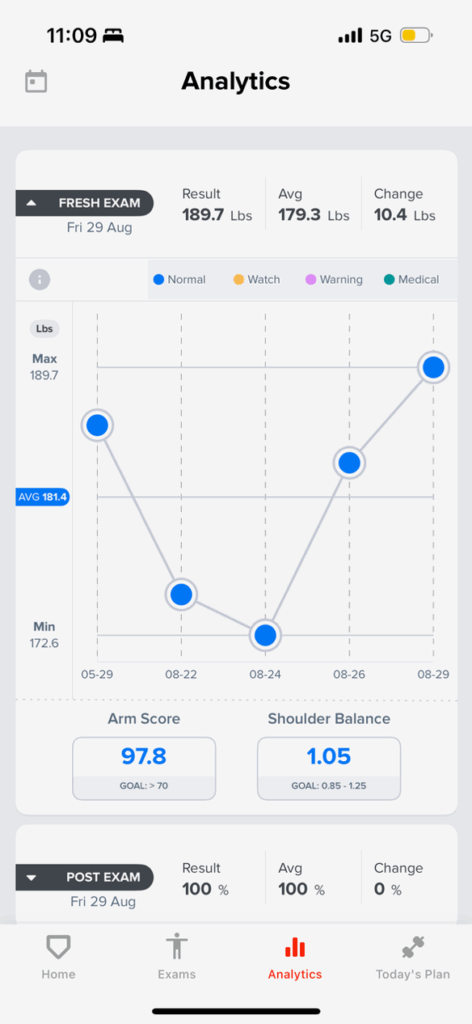
Tracking strength in a 2-Way pitcher is very important not only for durability on the mound, but for adding more acceleration of the barrel into the Smash. Hitting the gas with the lower body and applying the brakes with the core sends the barrel into warp speed, compressing the baseball at the point of impact.
Release speed (pitchers). Efficient bracing times the torso’s peak speed and deceleration, sharpening hip–shoulder separation and delivering a cleaner kinetic cascade to the arm—often with less perceived effort. At the point of ball release, the arm must be stable in the release point position, and what whips the arm into position is how the center of mass decelerates.
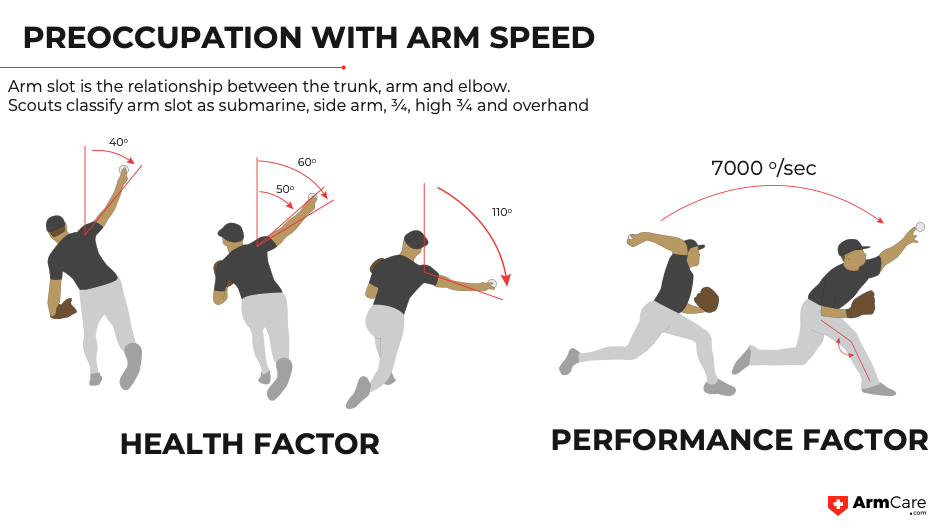
This slide is from our Certified Pitching Biomechanist Course. We are at a crossroads in the game. Most often, people are focused on the performance factor – having the arm move at alarmingly high speeds – while the health and stability of the throwing arm are usually ignored. There are important gains to be made by how the arm holds its position, but if the core fires on all cylinders, the added effect of a strong arm that has mobility raises throwing arm speed with less risk.
Lower arm fatigue. This one is a no-brainer for me. When the trunk decelerates rotation effectively, the rotator cuff doesn’t have to “catch” the arm as hard. That typically lowers the burden on internal rotation torque at the shoulder and varus torque at the elbow over the course of an outing.
We are talking about accelerating and decelerating the pelvis and trunk. Players who have a better ability to brace, stronger and more reactive intra-abdominal pressure, can boost their ability to ramp up rotational speed and put the brakes on – that sends the hand moving faster. We want athletes to have sharp movement curves when tracking in 3D space.
Spinal stability. IAP increases trunk stiffness (“super-stiffness”), distributing load across the abdominal wall and fascia to protect the lumbar spine during high-speed rotation and during heavy lifts in training. Generally, we think of spinal stiffness in terms of how we brace during squatting or deadlifting. Still, we need to have strength when loading in front of the center of mass. Think of your arm or bat – they need to be whipped in front of the body, which means we need strength with outstretched arms, or loading away from the center of mass.
VIDEO: 3:55 – 4:20
This is a complex exercise featured in our Certified Pitching Biomechanist Course called a pullback with an abrupt stop. This is different and safer than water bag training, as the spine does not have to adapt to the same chaotic motion. If you complete the course, we will demonstrate how you progress up to an exercise like this. However, you can see the power of intra-abdominal pressure training for enhancing proximal strength and deceleration in the swing or during throwing.
The Mechanism: How IAP is coordinated
Think of the trunk as a soda can. When pressurized, it resists deformation.
- The diaphragm descends on inhalation, pressurizing the abdominal cavity.
- Transversus abdominis (TrA) and internal/external obliques cinch circumferentially (“360° expansion”).
- The pelvic floor co-contracts with the diaphragm to “cap the bottom.”
- Multifidus/erector spinae co-contract posteriorly to lock the cylinder.
- A brief, well-timed Valsalva-like brace (not maximal, not prolonged) spikes stiffness right when force must be transferred or absorbed (ball contact/release, plant/block).
Note all the muscles in the core region that need to compress and contract to build up intra-abdominal pressure in the body. Include the diaphragm and paraspinal muscles at the back. I found this video a little gross, but also relaxing at the same time. Watch it and consider how large your core muscles are, from the pelvic floor to your shoulders.
Translating IAP to On-Field results
Hitters—more EV, better consistency
- Earlier, sharper pelvis block and timed trunk whip.
- Reduced torso “bleed” at contact → cleaner barrel attack angle
- Better repeatability late in games as trunk handles decel, not the shoulder.
Pitchers—high intent with less cost
- Crisper hip–shoulder separation and a more predictable kinematic sequence.
- Proximal deceleration absorbs angular momentum, resulting in less cuff overwork.
- Arm speed with lower perceived exertion and slower fatigue buildup.
Both—back health you can bank on
- Stiffer, safer trunk under load in the weight room and during rotational speed.
- Fewer compensations (excessive lumbar extension/rib flare) that rob force.
Key Takeaway
Intra-abdominal pressure is not just a weight-room trick—it’s intra- and intermuscular core technology in our bodies that connects force production, transfer, and absorption in baseball.
You can learn a lot about core training in our certified courses. Combine our key exercises to train the mechanism (breathing + bracing), build the necessary muscle groups (obliques/transverse abdominis diaphragm/pelvic floor), and apply it where it counts (plant, contact, release).
Do it well and you’ll see the trifecta – higher exit velocity, sustainable release speed, and a back and arm that lasts all season.
Enjoy the Labor Day Weekend, All!
Ryan
Ryan@armcare.com