Strength in Numbers – 250
There is a sad reality in baseball, but in this case, we have avoided a major problem.
I recently advised a pitcher whose arm was worn down. We examined everything thoroughly and constructed a tight plan, but there was still a wildcard…
The pitcher was uncertain when he was counted on to pitch.
By uncertainty, he didn’t know when he would pitch. Sometimes he was told the day before, or even the day of the start. And he could be used as a reliever on the spur of the moment.
With this lack of structure, there was zero clarity on when to train or how hard to train. Circumventing the strength dip in his arm was not a development problem…it was a planning problem.
Let me show you what the arm data looked like.
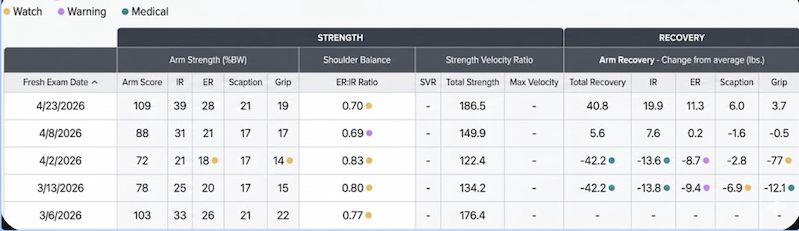
Note the dip in arm strength occurring from 3/13/2026 to 4/8/2026.
This can result from a variety of factors, but recovery planning was off, which impacted how hard he could train, especially for a hardworking athlete.
As we hit 4/23/26, a little over two weeks in, he hopped up to almost 41 pounds and hit PRs. The season is still going on, but the trajectory is in the right direction.
How the Narrative Changed
In most cases, injuries aren’t random.
They’re the result of:
- Missed observation — not seeing fatigue or recovery trends
- Poor communication — unclear roles, late decisions
- Incorrect implementation — generic programs, no adjustment, pitching with pain
- No evaluation of response — training without feedback
Without these pieces, even talented arms break down. So we put guardrails in place to fix the gaps.
We implemented a structured, responsive plan:
- Clear throwing schedule with built-in flexibility in all facets of training
- Defined intensity days and pivots based on potential game use and spur-of-the-moment game entries
- Consistent strength and arm care integration, with the player following up directly
- Ongoing monitoring to adjust in real time, with extreme focus on not overworking the arm — doing what’s best, not necessarily less
The player does not control the coaching cadence, but he does control the chaos around his role.
He identified how to create control within the system.
The Takeaway
When pitchers have structure, they can:
- Time their neurological output — when to push vs. recover
- Build strength without interfering with competition
- Enter games prepared, not guessing
- Recover more efficiently between outings
Strength Matters Most.
(Structure is what lets you build it—and keep it).
To learn more about building structure into your pitching development program, check out our Podcast with Coach Kyle Dupic at Wartburg College.
Ryan
Ryan@armcare.com