Strength in Numbers #94
This week, I joined Team Canada as a sports science advisor evaluating player health and performance. It should not be shocking that my focus with the team is throwing arm durability.
I learned a lot about strength metrics and player habits. The experience also taught me about the concentrated schedule that arises from bringing in the country’s best and the need to formulate time for practice, assessments, and playing against local minor league spring training teams in Florida who are onsite for extended development.
The information shared between great coaches who were once players was incredible.
Almost the entire staff had either MLB playing or coaching experience. I heard many great stories, although some were sad retellings about throwing arm injuries that cut careers short.
Canada has a small competitive playing population compared to the United States, but it is growing, and the travel ball industry is improving yearly. As a result, every year, an increasing number of great players go on to collegiate and professional baseball, who then give back as coaches to develop the next crop of talent.
Greg Hamilton, Director of National Team Programs, invited me to work with the players. Greg recruited me to play at the University of Maine and coached me briefly at UMaine before heading up Team Canada in player selection and development.
Still, to this day, he has a fantastic arm, as I saw him throw batting practice to almost every hitter in batting practice with only a few baseballs on the ground. I believe all but four of Greg’s throws were hit out to the field.
Joining Greg in high performance and who I assisted is Jeff Krushell. He pioneered strength and conditioning for the league with the Blue Jays as the third-ever Minor League Strength and Conditioning Coordinator and broke new ground with the team.
Together, they are serious about player health and performance and have such deep knowledge of the terrain and atmosphere of playing in world tournaments and how to maintain team cohesion from coast to coast in the country.
A Career Cut Short
One of my former teammates, a Team Canada player, and former professional outfielder, Tim Smith, was there as the outfield and hitting coach.
I vividly remember playing with Tim in a special independent league in Canada called the Intercounty League. This league had former MLB players, minor league players, collegiate players, and even elite high school players who competed with the big dawgs.
The league is a scout’s dream, as you can see how a high school prospect matches up against players who are way above his tactical understanding, physical development, and experience in the game.
Tim was built like a man at the age of a boy, maybe 17 at the time, and could hammer the baseball. This eventually led him to Arizona State University. Tim was drafted three times and was on the path to the MLB level with the Texas Rangers, as he could hit for power and average, but then injuries started creeping up.
One impacted his shoulder and affected his ability to throw guys out at the dish. He had a big arm, another tool in the belt that created tremendous value in him.
Now, he takes all his experience in working with national team outfielders and hitters. In the summer, Tim is a coach with the Ontario Blue Jays, who use ArmCare religiously on the pitching side.
One of the things we talked about on the bus was how players at a young age do not form habits until they are injured. We feel invincible in our teens and then come to grips with our bodies and the maintenance required as we age.
However, when a player gets to the point where money is on the table, things start to click, and the show-and-go mentality shifts to getting to the ballpark early, getting work in before going out on the field, and then taking care of the body after the game in training and recovery.
My mottos for young professionals are “Your Body I$ Your Business” and “Quality Reps Cash Checks.”
It resonates with the older guys because they know the economic ties with being in great shape and having durability throughout their careers, but what about high schoolers?
The best place to start is getting the player their first fresh test, which is what I did with Team Canada.
Of course, as a coach, you should begin by communicating the process’s WHY, HOW, and WHAT. But beyond knowing the advantages of testing, you will see their natural competitiveness kick in— players want to know where they stand and who is the best.
That kind of competitive mentality is what we need as coaches, as players are thinking big, and they are on their path to cashing quality reps and making sure business is solid by looking after their bodies.
The second element is acting on the data with the players. They could very easily train by using the app on their own, but you still want to communicate what the data means, why it’s essential to improve upon the metrics and how you will go about it, and the benefits of making improvements.
The ArmCare Specialist Course serves to transform coaches into ArmCare experts, empowering them to share knowledge on the app with players and parents. This not only improves compliance but also helps to optimize care for arms.
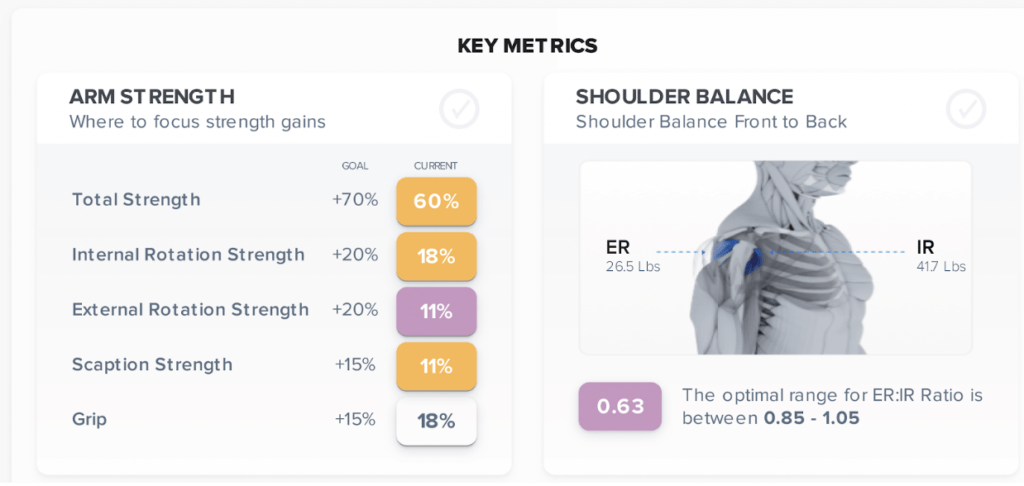
For example, you may see data like this early on.
Start by asking a new player what their approach to training and preparation is and then observe them doing it.
Of course, you know there are holes per the data, but with further investigation, you’ll likely find there’s not much of a training process. They just play and lift weights.
Now you’ve identified an opportunity to bring up their performance.
As Tim and I discussed on the bus, athletes will now have information like the above example to guide them and their coaches to build throwing arm strength and ensure proper balance.
Both aspects contribute to a more resilient arm that’s less fatigable and able to maintain throwing velocity.
But of course, most importantly, it reduces their chance of arm injuries, which is the unfortunate early exit for many players in the game, not just exclusively pitchers.
If this device was around when Tim played, there’s no telling what kind of player he could have become.