Strength in Numbers #96
I feel lucky to have been mentored by industry leaders who helped shape our understanding of how training programs improve performance and enhance durability for throwing athletes through a structure known as Strength and Coordination Training (SCT).
I am thrilled to serve as a research associate for a few different baseball science think tanks, including Louisiana Tech Human Performance Laboratories and Auckland University of Technology – Sports Performance Institute New Zealand. I also collaborate with leaders in the field, such as the American Sports Medicine Institute, working with the most accomplished baseball biomechanist, Glenn Fleisig.
These roles have provided some incredible insights that have helped me learn and give the application necessary for change to deliver to you.
In this newsletter, I will give you some insights into Strength and Coordination Training so you can experience INDIVIDUALIZED PLAYER DEVELOPMENT and see how it will solve many baseball problems.
SPEED – ACCURACY TRADE-OFF
Just like throwing strikes, sports science has a speed-accuracy trade-off.
Research-grade tools take longer to acquire data, but there’s more precision, and I am not okay with good enough.
The apex tools I use to collect data to validate high accuracy include:
- ArmCare Strength Sensor– A research-grade dynamometer that samples at 100 measurements per second
- Noraxon Ultium Motion System– a cameraless IMU system that measures movement along with muscle activation via electromyography
These tools provide insights into how strength, coordination, and muscular recruitment intersect to help refine training, profile throwing drills, and examine athletic performance.
The ArmCare Strength Sensor is readily available to everyone, and there are motion capture options available at many different price points and levels of sophistication.
The beauty of the specific research-grade tools I work with is that I can evaluate athletes anywhere (lab, field, or in a simulated game).

NOW FOR A DEEP DIVE INTO A STRENGTH AND COORDINATION EVALUATION
STRENGTH FIRST
I’ll take you through the process of a complete biomechanical pitcher evaluation for a player struggling with an increased miss-up and an elevated strike zone using the abovementioned technology.
Starting with strength first, we found this athlete lacked Accel and Decel strength from our Primer test and was very weak in scaption—all of the above screamed long-lever (extended arm) strength deficiency.
The athlete was not training based on the ArmCare app, so I was first interested in reviewing his strength training program.
Then as seen on the motion capture, the trunk position from max external rotation to ball release lacked positional stability,
Due to velocity enhancement characteristics, much of the baseball community focuses on trunk rotation in the transverse/overhead plane. However, in this case, there was a need to recognize the importance of increasing strength in truck flexion and extension.
With strength needs identified, coordination comes next in the Strength and Coordination Decision-Tree. But before even looking at the delivery, I start my process with drill selection.
I first look at the motor learning element before the sporting activities due to the tendency to “overcook” a movement. I describe this in the Certified Pitching Biomechanics Course, where drills can cause movement confusion when the athlete blends the drill pattern and the motor preference for their sport.
Essentially, if an athlete wants to move one way, but if the drill is hugely different, they go beyond correction into error.
NOW FOR COORDINATION
I can’t go into all the drills we evaluated, but I will give you a good breakdown of the first drill in his repertoire that will resonate with almost everyone reading this newsletter, the Reverse Pick, sometimes called Marshall 1’s.
Take a look at the animation below to see the interaction of joint angles operating from the motion capture.
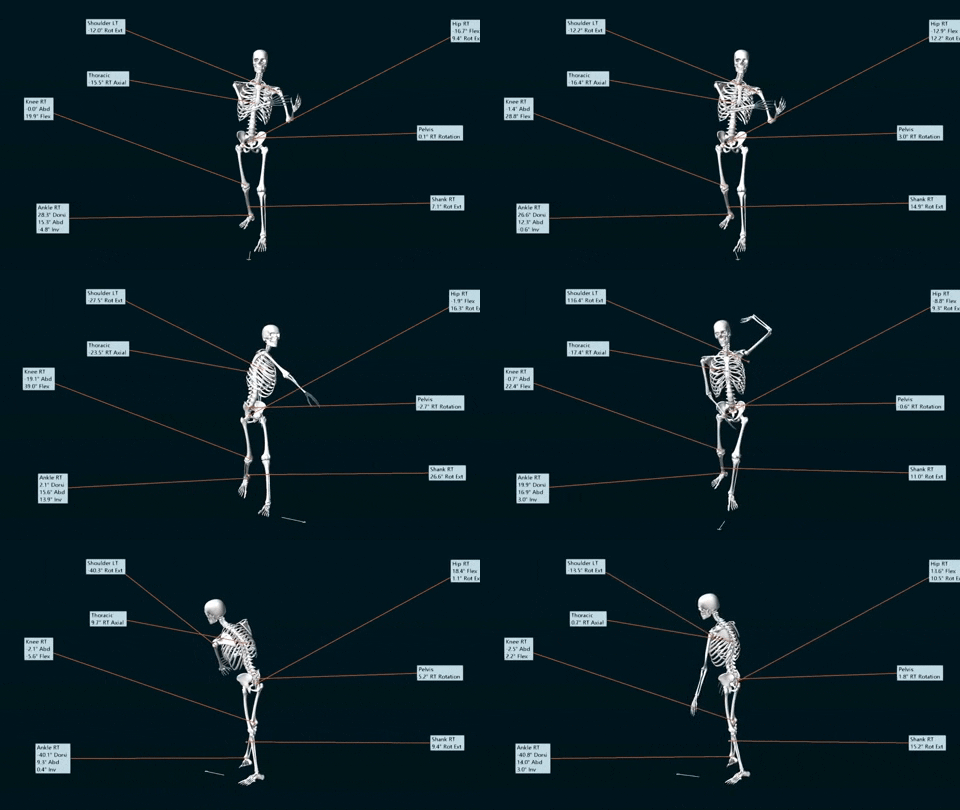
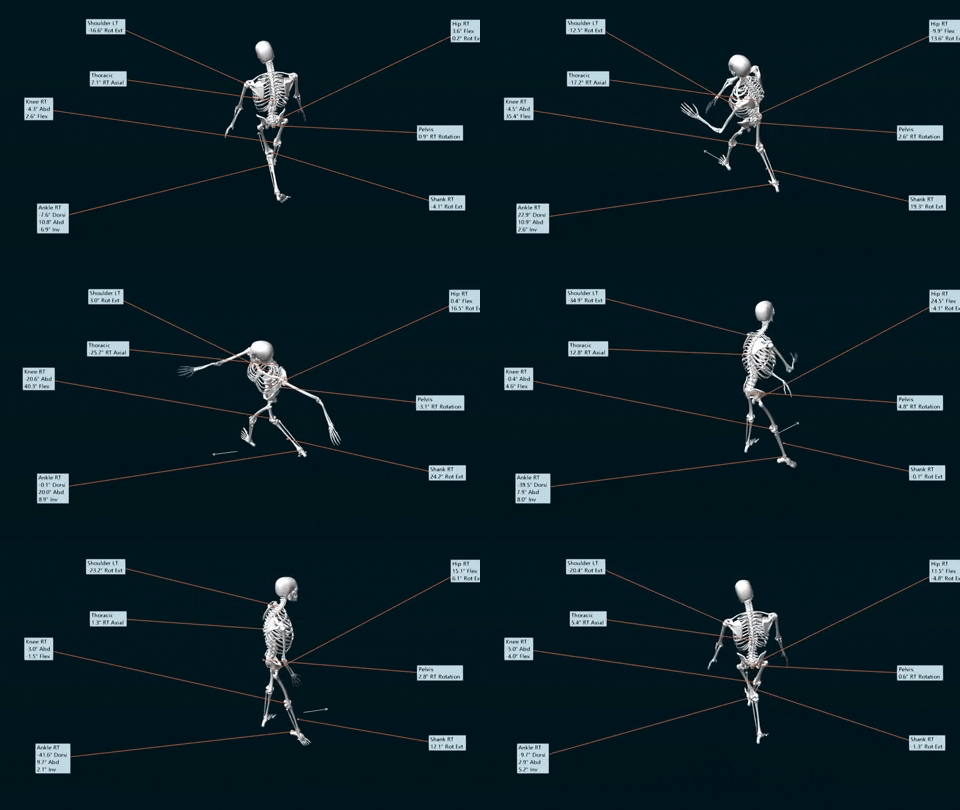
After I reviewed the key joint interactions in the Reverse Pick drill, I found that the trunk was more upright with the 2lbs ball. This compensation reinforces an upright delivery, which leads to more shoulder effort in acceleration and deceleration.
Ultimately, using a 2lb ball for this drill was less effective than using lighter balls.
The lighter balls allowed for better trunk flexion during delivery, resulting in a more positive angle at ball release by keeping the trunk closer to the midline as it rotated.
Another tip was to put the heavy ball inside the glove while doing the Reverse Pick. This helped prevent a weak glove arm and provided more stability for coordinating better trunk flexion.
ONE OF THE RECOMMENDED SCT DRILLS
Okay, we have identified the strength and coordination elements and dialed in the drills for this player. Now, we can focus on the fun part, which is developing the strength program to develop this player further and hopefully solve his high miss percentage.
One of the things we identified is the coordination of knee extension and trunk flexion in the delivery. For this the muscles must be strong enough to work against an external load initially, but the lead knee must brace long enough to accelerate the trunk forward into flexion. Then the trunk has to control the rate of trunk flexion for the throwing arm to accelerate toward home plate.
In the case of this athlete, lead leg bracing wasn’t timed well with trunk flexion, and arm acceleration effort was increased. A good exercise for this athlete’s delivery was the Zercher RDL which you can see here.
BUILD YOUR REPERTOIRE
I plan to open this treasure chest for the ArmCare Elite members soon, where we will continue to unpack things related to helping players build strength and coordination.
All you need is to become dual-certified as both a Certified Pitching Biomechanist and ArmCare Specialist.
With these courses, you’ll better understand the optimization factors for designing programs that fix strength imbalances and inconsistencies in the delivery.