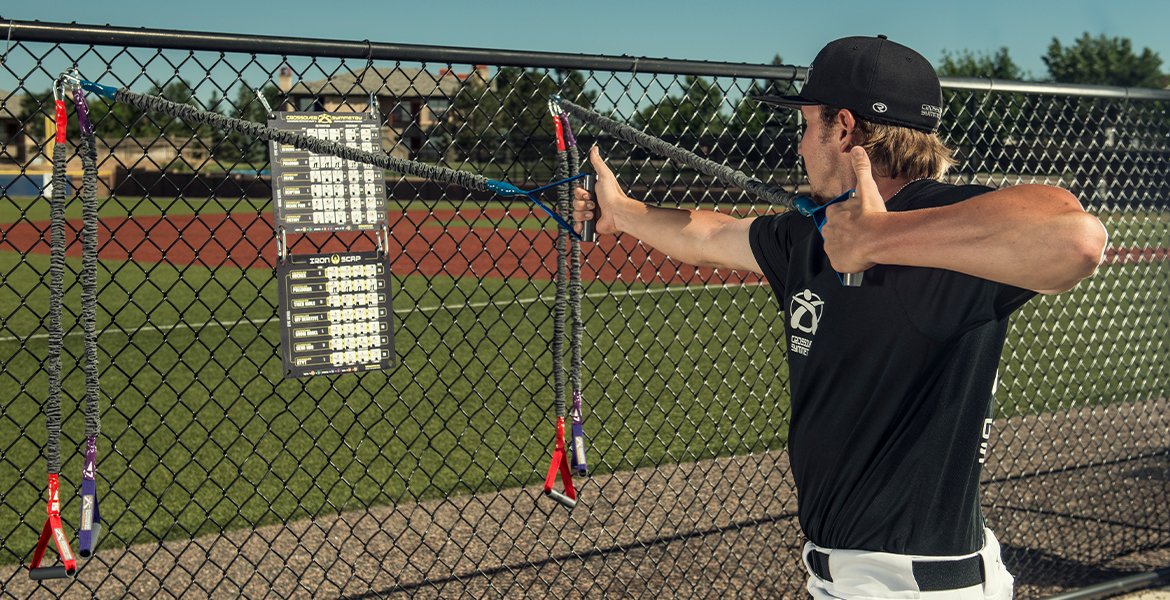
Baseball players represent an interesting population in how they treat their throwing arms. It’s often ritualistic in how they handle their throwing arm as their prized possession. Players are constantly conscious of their arms, ensuring they don’t sleep on them wrong, avoid overuse, and sometimes avoid lifting heavy weights altogether. Or in other cases, some baseball players continuously train their throwing arm to prevent injury and prepare themselves for performance.
But what about the non-throwing side?
Many athletes will train bilaterally with their strength training but feel that working the non-throwing arm is a waste of time during arm care. Although, we believe that training the non-dominant arm provides an opportunity for development through a “cross-education” effect that players should take advantage of.
What’s Cross-Education?
Research shows a “cross-education” effect within the body. This refers to improving strength on one side of the body by exercising the opposite side.
Although the mechanisms are unclear, the largest research study on the effect of unilateral training showed that training the biceps on only one arm increased biceps strength on the opposite side (1). A second study undertaken in Australia at Edith Cowan University showed that muscle wasting and strength loss were reduced in an immobilized arm by exercising the opposite side (2).
Although, the volume and tempo of the workouts were key to cross-body improvements.
The first study saw no effect with only a single set but a 7% increase when the sets were increased to three.
The Edith Cowan Study found eccentrics, being a slow tempo in lowering weight during a lift, were even more effective in gaining strength and muscle growth on the contralateral side . But opposite to the data on eccentrics, further research shows that exerting muscles at a high rate of force development increased contralateral limb strength by 11% (3).
Train Your Brain
Many consider the brain to be the main driver of the cross-education training effect. And even if an exercise trains the muscles on the working side, it can excite both sides of the sensorimotor cortex in the brain.
This suggests that by only working the throwing side, you’re lessening the nervous system input and actually reducing the strength gains of your throwing arm.
Additionally, it’s common for an injury or soreness may limit your ability to train your throwing arm. Still, you can continue to exercise the non-dominant arm to reduce muscle and strength loss on the throwing side.
Although as with all training, it needs to be strenuous to get the maximum training effect. Eccentrics and rapid exercise promote cross-education effects between both sides of the body.
KEY CONCEPTS
- You are actually reducing the strength of your throwing arm by not training your non-dominant arm.
- Eccentrics and rapid exercise promote cross-education effects between both sides of the body.
- If you have an arm injury or experience soreness in your throwing arm that causes you to be unable to perform training activities, continue to exercise your non-dominant arm to reduce muscle wasting and strength loss in your throwing arm.