Strength in Numbers #121
In the world of throwing sports, our throwing arms are our prized possessions.
What is a tennis player without a serve?
A volleyball player who cannot spike?
A cricket bowler who cannot throw?
The point is that arm injuries plague many other sports, and what is common to all of them are missed observations.
An observation is a data point, and the frequency of gathering data points is essential and can quickly become a liability if we neglect their importance in monitoring athletes.
THE DANGERS ASSOCIATED WITH MISSED OBSERVATIONS
Undetected issues can fester, leading to pain and discomfort that can disrupt your game and enjoyment of the sport. What starts as a minor annoyance can escalate into a debilitating injury.
The best medicine is prevention. It’s easier to stay well than to get well.
I often tell athletes that it’s important to act when you have the snivels rather than waiting for full-blown pneumonia.
In our app,
- WATCH alerts would indicate that you are at the sniffing stage,
- WARNING alert is when the throwing arm is in full preservation mode and needs recovery,
- MEDICAL alerts are precisely that—a medical observation that something is wrong. Here, we are now fighting pneumonia.
REAL CASE STUDY
I just started advising a new athlete who had an internal UCL repair shortly after him having a forearm flexor strain.
Out of all the athletes I advise, he is the hardest-throwing athlete per pound. He’s a college kid, throws 89mph, and weighs 153 pounds. That translates to 0.58 mph/lb.
For reference, one of my MLB athletes throws 100mph and weighs 230lbs, which translates to 0.43 mph/lb.
The larger athlete has a lot of momentum behind his delivery, which helps him create velocity based on a greater mass effect. However, this lighter athlete must move incredibly fast, which he can, and that kind of body speed cannot have gaps in assessment.
You will notice on the graph on the left below that the hardest-throwing pitcher per pound had quite a long stretch in testing. His exam before the medical alert was in August, and he attempted to pitch in a college Fall game and tested after he had a forearm flexor strain the next day.
In other words, six weeks went by, and he had no idea where his arm strength was.
I came in about a day after the injury, and I asked why he was not testing frequently. He mentioned feeling good and didn’t consider going through an exam.
The six minutes he should have taken have now cost him six weeks.
You will notice on the right that his arm strength is at an all-time high, and the ball is back in his hand.
However, he is performing a Fresh exam every day of the week until I determine his next throwing progression. We are revamping his arm care approach, and we are being dynamic in his throwing programming. We advance when his arm strength advances and regress when his arm strength regresses.
Getting him game-ready will take about six weeks, especially after an internal brace repair. We’ll need to be patient but also urgent in his return as the season starts in late January.
The other thing is that he’s still a teenager. When athletes are younger, I take even more precautions as re-injury to the UCL before an arbitration year can impact athletes financially, not to mention impact their earning potential in the draft.
I think MLB with every player I advise. I see their arms as being worth millions, and sometimes I have to remind them of that, as in the case of this young man.
With a data-led approach in his Return-to-Performance (RTP) program, he’s going to come back better than ever, and I have also incorporated an MLB Registered Dietitian to oversee his lean mass development so that the mass effect on velocity will counterbalance the high rate of speed he needs to generate in the momentum equation for high powered throwing.
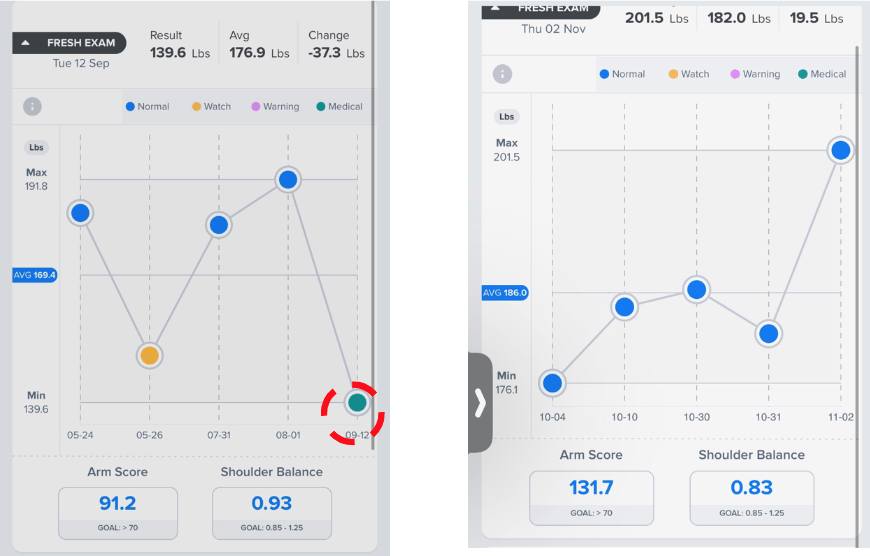
The analytics tab on the app shows trends in the hardest-throwing pitcher per pound. Notice on the left the severe strength loss of over 52 pounds after injury. Think about picking up a 52 lb dumbbell; that’s how much strength loss he experienced. On the right, his strength has skyrocketed in under two months. The focus now is on shoulder balance.
I foresee great things in the future of this athlete. He’s learned a valuable lesson that prioritizing his arm strength and range of motion is key. If you are a pitcher, nothing else matters outside of having a healthy throwing arm. Would you agree?
If you want to gain more expertise in understanding the ArmCare platform, learn how to attack problems such as what I have described in this case study, or better yet, join an army of the most advanced population of baseball performance specialists and become dually certified.
Dominating pitching and throwing performance and being dedicated to eradicating throwing arm injuries is what we do. Save arms and save careers.
I now have one question left…
Do you have 6 minutes?
Because if you do, it could convert to 6 million, as that is signing bonus money if your athlete catapults to the big leagues, as 70% of first-rounders make it to the top (ref).
It’s time to consider all your athletes as potential first-rounders.