Strength in Numbers #168
I am going to set the record straight. When a player throws a ball maximally, especially over 90 mph, the force on the shoulder to keep it in its socket is above their body weight.
In other words, when the ball is let go, the force trying to pull your arm off your body is equal to an athlete’s body weight and sometimes even higher.
With that kind of compression force requirement, keeping the joint together as the ball is delivered, co-contraction and all muscles firing together to brace the shoulder joint is essential, and in the case of Stan, that interaction was not happening well, which caused arm pain.
There’s only so much you can load an athlete overhead before it can cause injury. If you want to have the athlete manage body weight forces, you need inverted co-contraction training, and there’s a progression you will learn here.
VOLUME LOAD CALCULATIONS
In baseball, most things are quantified, but when it comes to pitch count, rep counting alone has not been proven effective in actualizing injury risk. One of the reasons is that a fastball is not a fastball. Now, what do I mean by that?
Well, in previous posts, I talked about the Velocity-Torque relationship in pitchers. This means that torque does not rise at the same rate as velocity increases for some. For others, an increase in ball velocity can significantly increase joint torque.
More simply, you have two pitchers who throw 95mph. One could have joint loading as if he was throwing 85mph but much lower than their peers.
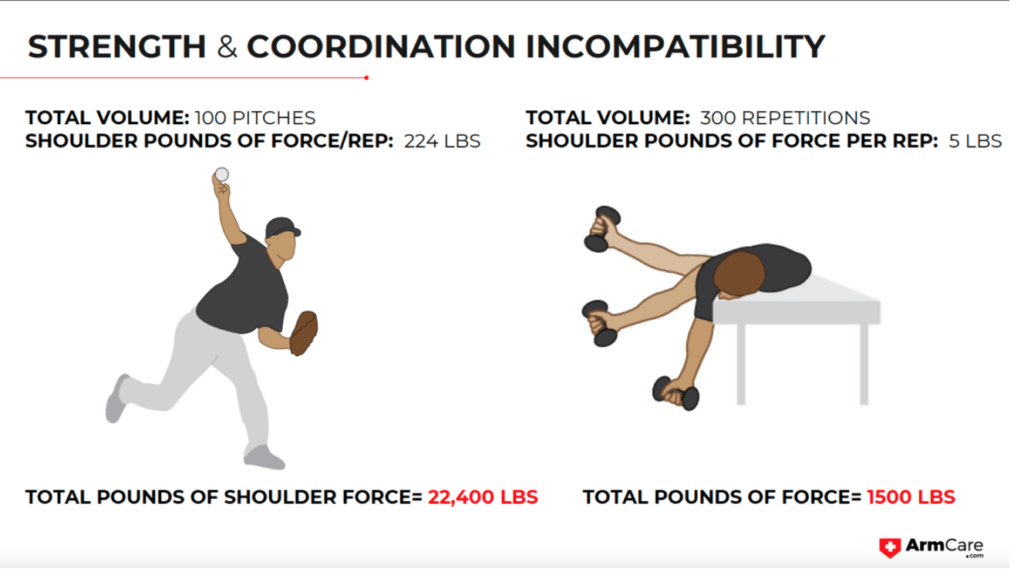
As a result, when you think of all the pitches thrown in a game and try to equate training, the force multiplier of pitches thrown shows the true amount of loading that accumulates. When you design exercise training, you need to be strategic about how you will train capacity, especially through the shoulder joint.
BACK TO STAN
So we established that there’s inconsistency in training. We throw with thunder but the training is generally spitting rain.
With Stan, he could not lift 3lbs over his head, and we could not do the scaption test as even with prepping the arm with 50%, he had discomfort. When an athlete has pain in certain joint ranges, I start them with low-level isometrics.
In Stan’s case, the pain was still experienced, and just like throwing, we are not going to train through pain. When strength increases, pain decreases, and we cannot inhibit strength gains by pushing the athlete to overcome pain, especially one who has had 3 years of it.
So scaption is out, a long-lever test….where do we begin?
We went to the floor.
With the floor, the arms are fixed on the ground. The brain has already created a painful pathway when the arm is lifted in the air. We must change his brain-pain pathway; some of it comes from the brain’s sensor motor area and guarding, a psychophysiological phenomenon called kinesiophobia (mind-body-pain connection).
A fear of movement, or consciously hunting for pain, can restrict motion, speed, and power in an injured area of the body. We want the athlete to first sense pain but then find pain-free positions to build confidence and get to work.
We found ranges where he can have both ground reaction force coming through the floor to the shoulder and manage less body weight than completely inverted. We found our entry point to gaining strength and getting closer to handling the force per pitch.
As I mentioned in the previous article, the big thing here is that you must understand if the athlete has wrist problems.
That requires placing handles on the ground and adjusting them to accommodate the athlete.
PROGRESS INVERSION
This is not as easy as it looks. We tackled pain-free closed-chain training. We began by seeing if he could manage a high plank with his trunk horizontal to the floor.
We mastered the downward dog with Cobra; now it’s time to get him inverted. I am amazed by what retraining the scapular stabilizers can do to build confidence and get him out of the mold that he is weak.
Elevating the athlete’s legs and repeating a downward dog starts to invert the body, bidirectionally putting more loading into the shoulder. The trunk mass pushes down into the shoulder joint, and the ground reaction force from the floor travels through the hands, wrists, elbows, and shoulders. The joint contact forces go up, and the muscle’s co-contraction strength demands have, too.
When elevating the feet and going into inversion, you need to again work in non-painful shoulder arcs.
Some athletes cannot get overhead because of pec and lat restrictions, so do not force it. Strength will come, and greater inversion will occur. The push-up can be eliminated. We included it to get more serratus activation.
After accomplishing feet elevated on a box, we went to wall walk-ups. This generally is not achieved all in one day, but with Stan, we listened to his body and went at his pace. Increasing inversion of the body and increased force require a safe way to get there, as well as transient moments where there’s a brief period of high co-contraction on one arm with wall walk-ups.
After seeing this progress, I knew he was ready for expansion training in open chain. I loaded the arm under the shoulder height with weight to challenge proprioception and proximal and shoulder co-contraction. This is a mouthful for you that I will explain next week.
If you are going to try what is shown in the videos, I highly suggest you take our Certified Biomechanist Course to learn the technical cues and how to start an athlete who may have never done anything like this in their career. You will also learn how these exercises improve pitch efficiency ratios (higher strikes per inning and fewer total throws per inning). This key delivery optimization factor increases competitive success and injury protection.
What can I say? Watching Stan’s incredible display of strength lit a fire of confidence and changed his brain and the narrative around his arm. No longer can he believe the constant messages he hears from people who say his arm is weak, tight, and vulnerable to surgery.
Stan witnessed it in one 7-hour day with me – strength certainly does matter most. Seeing was believing, and the progress made in such a short time was unbelievable.
Enjoy the weekend, guys!
Ryan
Ryan@armcare.com