Strength in Numbers #27
I spent the week in Chicago for the American Baseball Coaches Association (ABCA) Conference. This is the largest baseball conference in the world, with many tech and equipment companies represented.
As a sports scientist in baseball, it’s quite an awesome display.
I had the opportunity to connect with companies making ball flight tracking technology, virtual reality applications, 3D motion capture, and much more. And when I look at the products available, I’m excited to see how ArmCare.com falls in line with all of them and can enhance their effectiveness.
For instance, take ball flight tracking. Player development efforts can be even more specific in identifying changes in spin rate, spin axis, induced vertical break, horizontal break, and release point related to a change in throwing arm strength. We can predict how performance will change if strength decreases or increases and how to attack deficiencies in training. I expect a strong relationship between throwing arm weakness, change in release point, and the potential for changes in spin factors.
This type of multilayer analysis will have groundbreaking impacts upon scouting as well.
Certain strength profiles may be better with certain pitches than others, especially with our new three-finger grip test that can indicate how much pressure can be applied to the ball between the index, middle finger, and thumb.
One thing is for sure, every technology here understands its “WHY.”
Essentially, we are all looking to capture the right data and improve the transfer of training effects. Yet, I find the major differentiator in technology is focusing on player availability.
Because, while I have always been a performance guy— seeking better ways to coach an athlete in throwing at higher velocities—it doesn’t matter if the athlete cannot stay on the field.
Specifically, I have always had an internal battle with biomechanics technology, as I cannot rationalize it as performance-driven or health-driven technology.
There are many studies to indicate differences in biomechanics based on fastball velocity performance, however, minimal research has been done to accurately connect biomechanics metrics to injury, as technologies differ in frame rate, modeling, and calculations.
To strengthen a biomechanical approach, the involvement of ArmCare.com allows coaches to understand how strength changes affect motion and potentially increase throwing arm loading through release point compensations.
Before analyzing motion, we should first evaluate the athlete’s function by assessing their range of motion and strength since these are the barriers to coordination. I am excited for the coaching world to integrate our product into multiple forms of 3D monitoring, and in return, it will yield the best results for both performance and health for players.
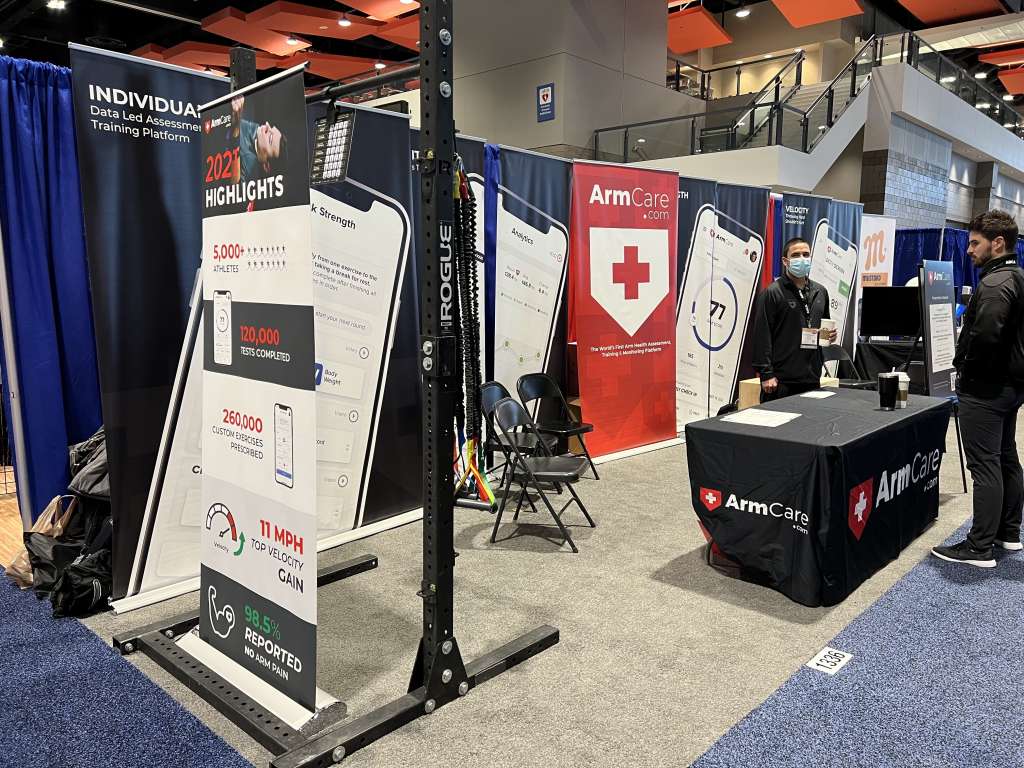
Being at the conference has had me think— what is my WHY?
After seeing all these great technology offerings, my purpose has become a little clearer in providing education to help fully integrate our product with other forms of monitoring and evaluation so that no observations are missed, and no athlete slips through the cracks.
If you are purchasing technology that does not involve the evaluation of strength and range of motion, introduce the ArmCare.com platform, as you will be amazed how integral throwing arm strength and range of motion is to skill and injury prevention success.
Combining more performance-centric technologies with our platform provides a complete player development approach that tackles both readiness and availability.
Whether you attended or did not attend the event, we want to meet you and know your WHY. We want to know why you use the technologies you do and figure out a way to optimize those practices by integrating ArmCare.com.
Send me an email at Ryan@armcare.com, and we will get to work.
The game is at the apex of sports science now, and we want to help you achieve your mission and vision for data-led player development programming to enhance individual performance.