Strength in Numbers #135
If you think a row is a row—that cannot be further from the truth.
The first thing I do when I start teaching upper body training exercises is examine how an athlete rows from a standing position.
We compete standing up, so we must be strong in an upright trunk position.
Your rhomboids, the muscles between your shoulder blades, pull your scaps back. They are important for scap-loading, but more importantly, counter-rotation in keeping your trunk closed through fascial slings (diagonally arranged soft-tissue layers that overlay muscles).
We talk about this in great detail in the Certified Biomechanist Course on how the diagonal and opposite sides of our body work to accelerate and decelerate the meat of our bodies that are regulated by optimizing stretch-shortening of muscle and fascia.

In pursuing excellence on the baseball field, the focus on acceleration training has long been a cornerstone of player development.
The ability to generate explosive speed and power is undoubtedly vital, but equally crucial, if not more so, is the often-overlooked facet of deceleration training. Here’s why deceleration training deserves a prime spot in every baseball player’s regimen.
Critical Bits of Information on Deceleration
1. Arm Speed Acceleration is Governed by Deceleration
For pitchers, hurling a baseball at blinding speed displays acceleration prowess. However, what separates elite pitchers from the rest is their ability to accelerate the ball and their mastery of deceleration.
The incredible forces generated during a pitch must be effectively dissipated post-release.
Failure to decelerate the arm appropriately can lead to undue stress on the shoulder and elbow, paving the way for injuries, not to mention lowered velocity, as you can only speed up what you can slow down.
2. Slowing Down Layback to Set-Up the Catapult for Success
High-intensity weighted ball training with run and guns increases the playback speed of the arm. It must increase layback speed to keep up with a high-speed center of mass. Put a light ball in your hand, and you are laying back faster than with a baseball.
We often think of deceleration training as the back of the body. Still, your internal rotators of the shoulder are critical in stretching and slowing down layback that prepares the arm for high-speed acceleration.
Think about the hinge in the catapult equation being your elbow. Your arm will fly off at the hinge if you cannot decelerate layback.
3. Counter-rotation vs. Clockwise Rotation
Most of the training programs I review have a greater focus on clockwise rotation. Throwing medicine balls into a wall, grooving pathways that use the opposite foot and hand in pressing and pulling.
I am concerned about it. We are teaching athletes to speed up more than we are in slowing down, creating a place for weakness and injury risk.
4. Eccentrics vs. Concentrics
In addition to the clockwise or acceleration bias we have in baseball training, people are not focused on negative tempos, lengthening contractions with time under tension, which prepares the athlete for tension load resistance, and greater ability to withstand high-speed stretching sudden stops, and changes in force direction to safeguard joints and muscles in absorbing excessive stress.
If you ignore your tempos in training, you are generally not concerned with improving deceleration.
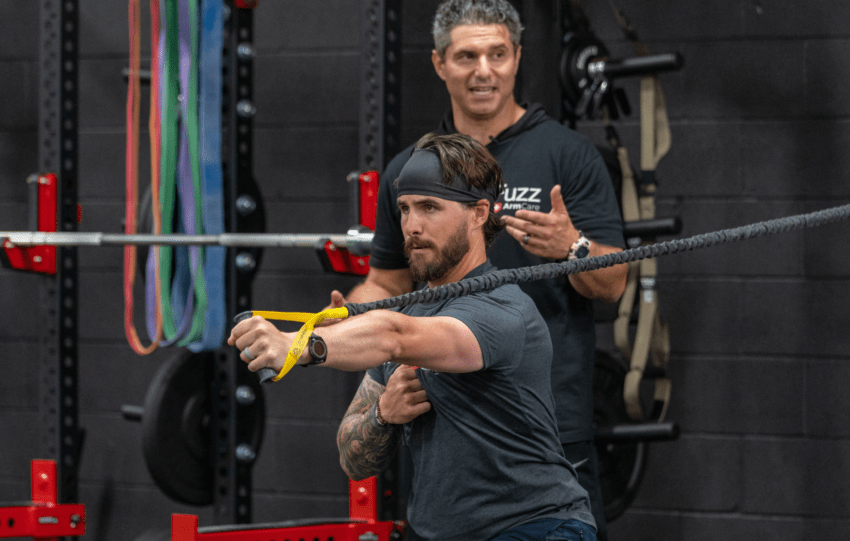
Next time you perform a training exercise with our Crossover Symmetry bands, humor me and count 3 seconds in returning to your starting position under tension with each rep and let me know if you feel a big difference versus going through the motions that are concentric only, but just the shortening movements after the starting position for each rep in the exercise.
The Importance of Deceleration
In conclusion, while acceleration training is undeniably crucial in baseball, the significance of deceleration training cannot be overstated. It’s the unsung hero, the graceful stop after the powerful sprint, the controlled release of the arm after the explosive pitch.
Incorporating deceleration training into a player’s regimen prevents injuries and enhances overall performance, making it a game-changer in the quest for baseball excellence.
Critically pick apart your training and make sure 70% of your training is focused on deceleration versus acceleration and not the other way around.
Watch this segment where I communicate a simple fix in an exercise that takes the focus from acceleration to deceleration by changing your feet’ position.
How simple and awesome is that?
The MLB Season 2024 is upon us—be strong, resilient, balanced, educated, and more than you have ever been in your career.