Strength in Numbers #5
We have put out a lot of material on the dangers of fatigue and how it relates to reduced performance and health in baseball pitchers. But one we haven’t touched on is how we communicate using the word “pitching efficiency,” which is often related to pitching mechanics.
You likely hear statements like, “so and so has an efficient delivery,” when people in the industry talk about mechanics.
But really, what does that mean?
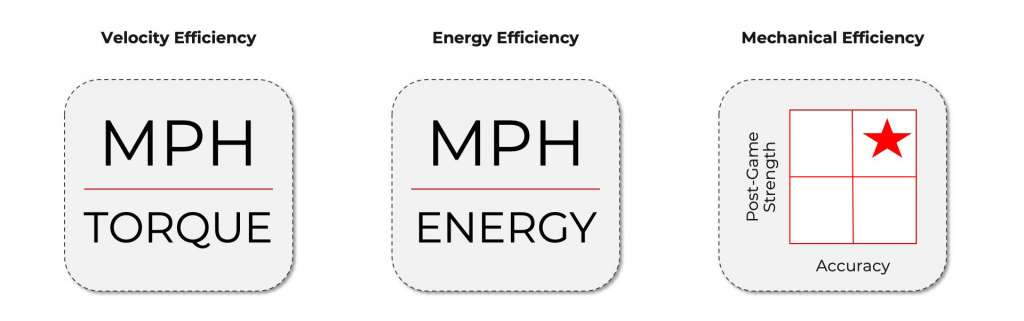
We define efficiency through three different data-driven methods:
3 Ways to Measure Pitching Efficiency
VELOCITY EFFICIENCY
This can also be considered pitch efficiency which looks at maximizing the highest unit of velocity per unit of throwing arm torque. Assessing velocity efficiency requires 3D motion capture to identify arm-loads accurately. Additionally, fatigue can lower velocity relative to torque to make the pitcher less efficient from a force standpoint.
ENERGY EFFICIENCY
This calculation looks at velocity achieved versus energy generated by the throwing arm. A more efficient pitcher transfers energy efficiently to the throwing arm, meaning the shoulder and elbow generate less energy relative to the velocity achieved. This assessment also requires 3D motion capture techniques to measure energy flow. If a pitcher has a reduction in energy transfer to the throwing arm, the ratio between velocity and energy generation reduces, and therefore, the pitcher is less efficient.
MECHANICAL EFFICIENCY
This measure is the most available to the everyday player and coach via the ArmCare App. Aligning with previous insights related to injury and fatigue, a post-game strength test is the best and potentially most intuitive way to assess this type of efficiency. Combined with pitching accuracy, coaches and athletes will understand the impact of fatigue on mechanics.
The goal of using this intersection of data is to see how mechanics change in relation to strength. For example, the top right box (see the red star) shows the player maintained post-game strength from baseline along with a high degree of pitching accuracy (strike-throwing percentage). These results would indicate that the pitcher has efficient mechanics that don’t change with fatigue, and the delivery is repeatable.
Strength & Accuracy
A few weeks ago, I presented research on this topic at the International Society of Biomechanics in Stockholm Sweden and we are recapping the data in this week’s ArmCareIQ. After viewing the ArmCare IQ segment, you will better understand the importance of post-game strength testing of the forearm to compare against changing mechanics that will allow pitchers to better protect their ulnar collateral ligament (UCL.)
The take-home is that the next time you hear the word “efficiency,” consider strength testing and accuracy tracking as essential benchmarks for this metric. And by using the ArmCare App, coaches and athletes can determine fatigue levels coming out of games and when to adjust mechanics and workload. The bottom line, we put the lab in your hands to unlock optimum throwing health and performance.