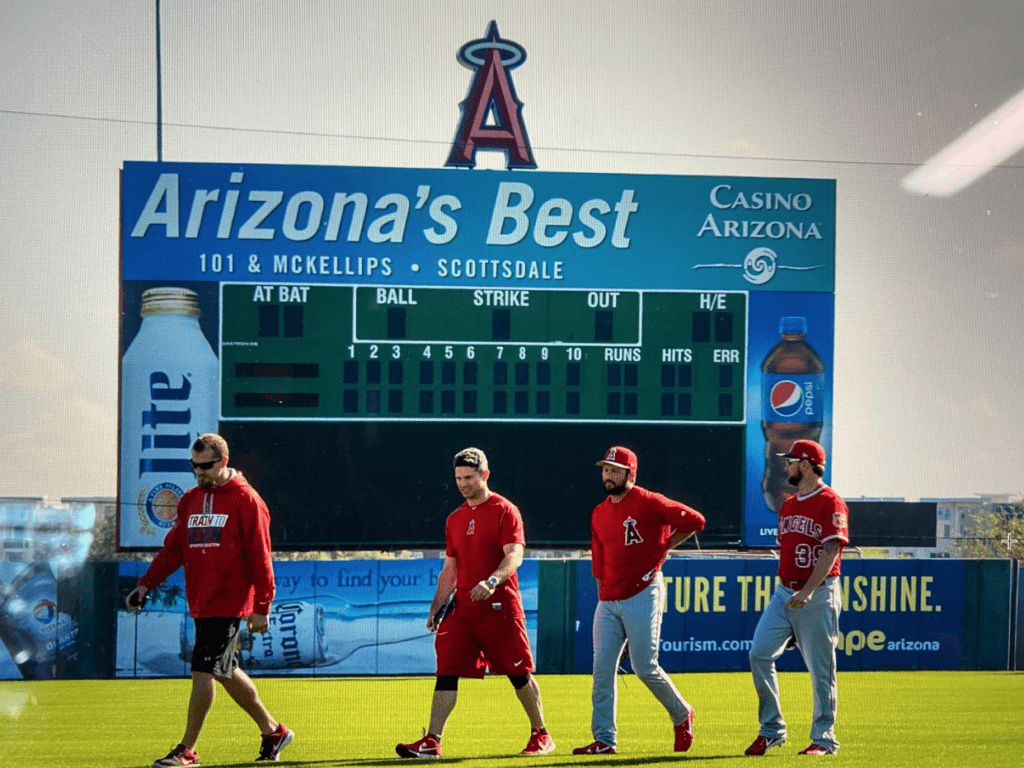
The arrival of Spring Training reminds me of my time in Major League Baseball. I am incredibly grateful that I got to serve some of the game’s best and work with amazing people who had intellectual curiosity and a drive for a winning culture.
In this week’s newsletter, I will let you in on some of the inside details behind the scenes, so you get a feel for what goes on and the dynamics inside a Major League Spring Training clubhouse.
REPORT DAY
The most boring day by far in Spring Training is the most important day of all—Report Day.
When players report to camp, they must undergo a comprehensive evaluation. With the Angels, ours was much longer, as we included more orthopedic, functional, and range of motion screening and the typical blood and urine analyses.
And although it was time-consuming, we also integrated strength testing to truly understand the imbalances, deficits, and potential injury risks as we approached the most injurious time of the year for all players.
Injuries—at least for the throwing arm and hamstrings—skyrocket on all MLB teams in March and April, taper down in May, and then jump up in new players after the draft.
The issue is multifactorial, from lack of observation in the offseason to having an acute rise in workload from Day 1 in Spring Training. As a result, we did things differently by implementing three important approaches – the 25-minute rule, training acclimation, and training fatigue assessment.
THE 25-MINUTE RULE
In the offseason, the high-performance staff met every two weeks to discuss new approaches, technologies, and training strategies.
In the programs set for Spring Training, our goal was to minimize workload, as we understood that it was baseball time. These athletes are not lifters that play baseball. They are baseball players, first and foremost, that lift.
As such, we created a 25-minute training program and timed our lowest-conditioned players to ensure they could complete it in that time frame.
Most simply, a training session this short reduces the explosion of cortisol, improves testosterone and growth hormone release, and lessens inflammation and cognitive loading that takes athletes from optimal to hospital.
Again, it was baseball time, and we needed to practice essentialism.
TRAINING ACCLIMATION
A common mistake at the beginning of Spring Training is to test strength, speed, and power. It is 100% not the time to do it.
Players are not in the swing of things, and there are many imbalances to address before pushing athletes to beat their acceleration times, jump performance, and estimated maximum strength numbers.
Remember, just as you are getting into a routine in Spring Training and handling early mornings and late evenings with plenty of meetings, the players are managing even greater anxiety. For some, they’re unsure if they will even make the team.
Performance testing should never take place in the first ten days of Spring Training, and although it’s natural for players to compete in Spring Training, try to set up stations with small numbers integrated into the training sessions so that athletes are busy moving through testing without paying attention to other players performances.
The goal is to help athletes be better than they were the year prior instead of trying to beat someone they are not. Especially when it comes to speed testing, racing athletes is a no-go for me.
TRAINING FATIGUE ASSESSMENT
This is where you have to be detailed and communicate with your athletes.
First, you pick three guys—one highly trained, one in the middle, and one who is low training age or at a lower conditioning level. Then ask them how the training session was and give it a score out of 10.
Before the next training session, you get together with your training staff and report the RPEs and make adjustments for the players.
It starts with where you want the middle guy to be because he represents a blend of both worlds of high-performing and low-performing athletes. So if you want the majority to experience a 6 in the training session and you nail it with your middle athlete, then you are doing well for the majority.
If your high-training guy says it was a 4, you must increase the demand for that athlete and those like him. But suppose your low-conditioned guy says it was an 8. In that case, you must regress the training for these athletes to ensure that you do not push them too far into overreaching, which is a brief state of overtraining where the athletes may reveal poor recovery and greater exposure to injury risk.
This is where the ArmCare.com platform fits in. The throwing arm’s max strength is a window into the soul. We saw a positive correlation between a reduction in ER strength and hip strength, which means when ER went down, so did hip abduction strength.
Reduced hip abduction goes down a lot of other things are impacted in the delivery (we go into this detail in the Certified Pitching Biomechanist Course).
The ArmCare platform tests are simple and fast, and an assessment can be done daily, either a FRESH test, POST test, or PRIMER depending on the athlete’s practice schedule.
Therefore, you always have an opportunity to evaluate fatigue, which is the number one cause of sports injuries, especially for the throwing arm.