

Strength in Numbers #59
When I started with ArmCare.com, I was attracted by the fact that I could work remotely and stay in Arizona. It’s been a year and a half, and I have realized that talking to people on zoom about the importance of throwing arm health and performance is much different than being with someone in person.
I like to educate and demonstrate, and really cannot accomplish the same coaching dynamics with video.
I presented the opportunity to educate high-level thinkers at baseball destinations who use our product through a private learning experience called the ArmCare Performance Clinic (APC).
We kicked the idea around from time to time but recently noted that our customers wanted us to come to them to educate their staff to advance their monitoring approach.
Outside of networking and sharing ideas, the biggest benefit is that we get to share the many ideas behind our mantra, “health drives velocity.”
We take a deep dive into velocity gains that come from strength-dependent variables, like internal, external, scaption, and grip strength. And discuss managing increased range of motion so that the length-tension curve is balanced for the throwing arm.
This is important because poor performance and injuries result from changes in the strength and length of tissues. Oftentimes this occurs from expanding the range of motion about a joint without any change in strength.
This education helps coaches fine-tune or even create their own arm care training beyond what’s just provided in the ArmCare App. And we believe this is paramount to high-level coaching.
Trip Through LA
We delivered APCs at a couple of cool places in Louisiana.
The first was Louisiana Tech, where I am a faculty member, and the second was Top Velocity, owned by Brent Porciau, a pioneer in velocity enhancement methods that do not involve weighted balls.
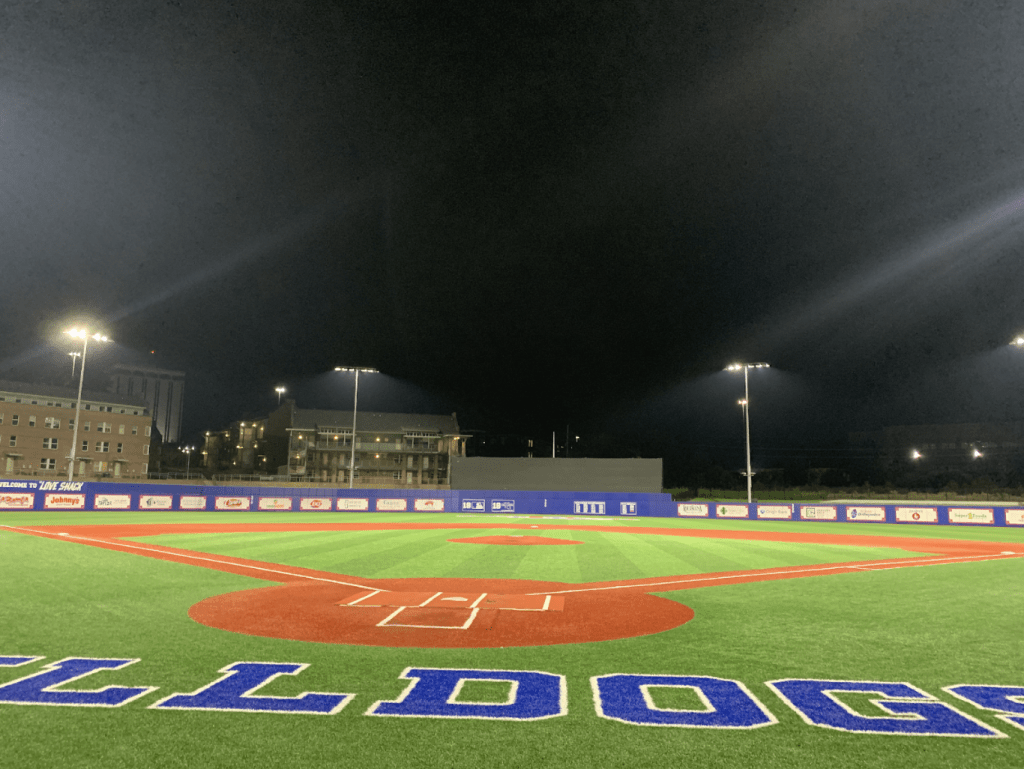
Louisiana Tech was exciting as Dr. David Szymanski and his wife Jessica, Pitching Coach Matt Miller and Head Pitching Coach and Recruiting Coordinator Cooper Fouts, as well as two new graduate students, were in attendance to learn about how to integrate ArmCare technology, go over individualized training methodologies, and identify connections with other data that the team values.
I really enjoyed collaborative conversations with all attendees, and I learned so many interesting sports psychology aspects, especially how we think negative thoughts 74% of the time.
We were on the topic of creating buy-in around a new sports science initiative and what it takes to have the players onboard.
It’s always been important to me to have uniformed coaches be the strongest voice to the players versus support staff regarding monitoring technology (ie. pitching coaches versus medical and strength).
With everyone aligned, the next approach is to communicate the WHAT, WHY, and HOWs of a new approach that adds to an existing data-informed player development model, such as the one available at Louisiana Tech.
HOW YOU CREATE STRONG MESSAGES FOR PLAYERS
For years, I have integrated technology with professional athletes.
Each year, you are met with new skepticism from baseball’s elite talent, and rightfully so, as anything that may distract them or make them overly critical, could be a barrier to success.
There are different types of athletes to acknowledge in communications. Some want to be told what to do and not look at the data, some want certain aspects of the data communicated and others you may find highly analytical. For me, the athletes that are highly analytical are the ones that tend to think something always needs to be fixed in their delivery or training process.
Be aware of those athletes and choose the best information to present to them that focuses on their strengths. If you can avoid discussing their weaknesses and explain that you are going to customize the training based on the data, they may not be so hyperaware or question you. One of the reasons we do not use red on our app is that for the analytical athlete, it lessens psychological sensitivity to less than optimal functioning for strength and range of motion.
If you identify athletes’ deficiencies in red, there is a chance that the alert signal may be burned in your athletes’ minds which could impact their mindset on the field.
All athletes need to learn the overall purpose of adding something new to their competitive approach and saying to them that performance will improve is not tangible enough. We need to learn our learners. I think the first thing that we should do is find out how our athletes are motivated?
What do they want to accomplish in their careers? What is the everlasting message you want them to walk away with after listening to you?
I had noted consistent motivators among pro baseball players that were very clear. Players want to earn more money, have greater competitive opportunities, and want to win a World Series. Greater income, higher playing level, and being a champion will definitely resonate with players and any innovative undertaking introduced into their programming should be initiated by addressing their specific motivations.
If you are working with a high school athlete, it may be to connect ArmCare technology with earning a college scholarship, becoming the best player in the city, or state, or simply preventing injuries and maintaining fun in the sport as a result of optimizing arm strength and range of motion.
I HOPE TO SEE YOU SOON
For those attending one of our APCs, bring a notepad and a camera because we do not scratch the surface.
We want you to walk away understanding how your program can fully execute upon implementing a monitoring and training process that involves throwing arm analytics to customize workloads and training to give you, or your athletes a leg up on the competition.
Please reach out if you have an interest in knowing more about our ArmCare Performance Clinics. It’s a great way to learn as we customize our education to meet your competitive needs for your team, school, or private business.