Strength in Numbers #234
Grip strength has long been used in baseball as a quick screening tool for fatigue and injury risk. It’s easy to measure, inexpensive, and has proven to decline during games and across a season.
But multiple studies have exposed a critical limitation:
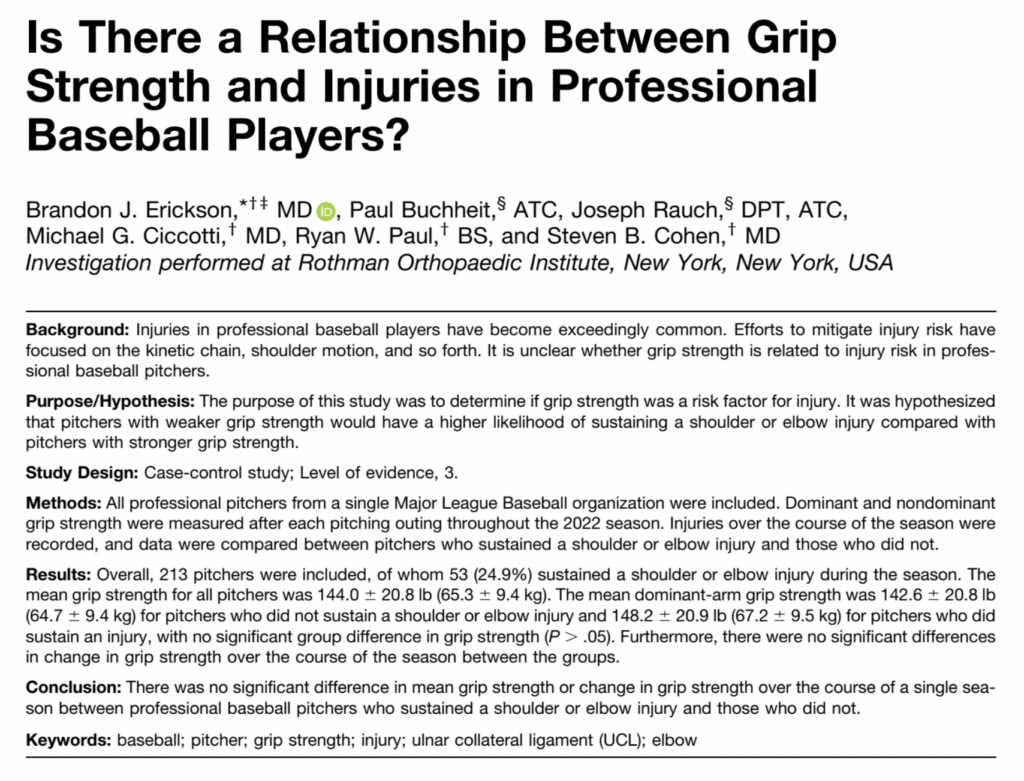
Why grip strength falls short
- It measures the wrong output
Handgrip reflects global forearm force production, not the highly specific stabilizing demands placed on the elbow and shoulder during pitching. - Pitchers compensate well
Injured or fatigued pitchers often preserve grip strength by recruiting surrounding musculature, even as the rotator cuff and scapular stabilizers degrade. The system adapts—until it can’t. - Timing matters
Changes in grip strength often lag behind more meaningful losses in rotational strength and control—the variables that directly influence mechanics, joint loading, and injury risk.
What grip strength IS good for
In my own research, grip strength proved more useful as an indicator of mechanical inefficiency rather than injury status. For example, declining grip values tracked well with fatigue-related changes in stride length and force transfer.
That signal would have been even more meaningful if grip testing had been paired with rotational strength profiling using platforms like ArmCare, where shoulder and elbow demands can be isolated rather than averaged.
Key Takeaway
If you only test handgrip, you’re assessing the wrong system.
You miss:
- The specific contribution of the flexor digitorum superficialis as a key medial elbow stabilizer
- Early losses in rotational strength and control
- The neuromuscular breakdowns that precede changes in raw force output
Grip strength isn’t useless—but on its own, it’s an incomplete and often misleading metric for injury risk in pitchers.