Strength in Numbers #25
If your preparation routine for the throwing arm starts with throwing a baseball, you are leaving a lot on the table as far as maximal and sustainable throwing velocity.
In the ’80s and early ’90s, pitchers would perform calisthenics, bodyweight exercise that is mostly aerobic and continuous, and would generally not involve loading the throwing arm before competitive games.
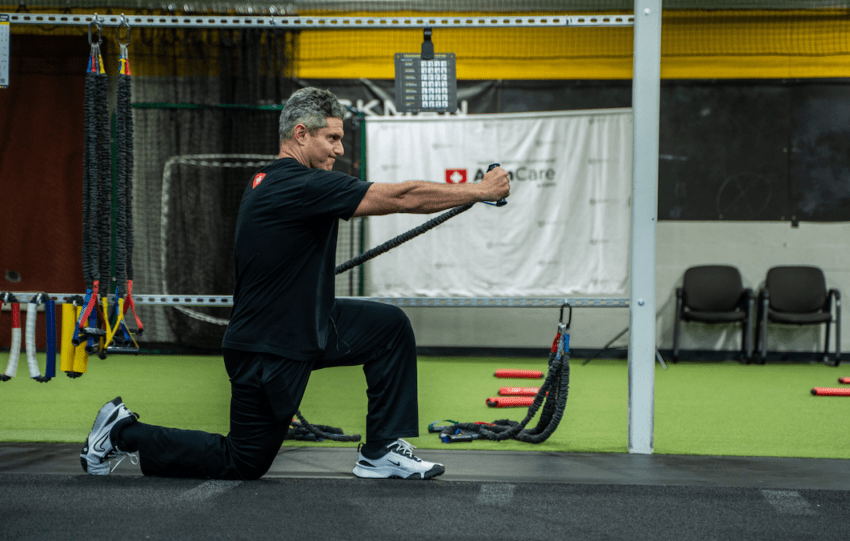
The industry has moved on from this preparation concept in the early 2000s. Yet, some elements are still included, which are typically placed at the end of dynamic warm-up routines (i.e., arm circles, seal claps, overhead pressing in the air, etc.). In this week’s ArmCareIQ, I discuss the concept of potentiation, which simply means applying force in your preparation routine prior to explosive competitive actions.
Hopefully, after watching this segment, you will have the confidence to kiss those unloaded, rhythmic, bodyweight methods goodbye, or at least minimize their use.
At present, there are many more tools available to potentiate the throwing arm, from bands to plyocare balls, medicine balls, and more. The throwing arm needs considerable activation to ensure muscles are recruited maximally under the time pressure of each throw, which is 150 ms from the time the foot hits the ground.
The mechanism for how potentiation works is a microscopic phenomenon. On a cellular level, potentiation increases calcium concentration in the muscle cell, which in turn, increases the binding sites between two important proteins, actin and myosin, which are the functional units in muscle contraction.
If there is no calcium, they cannot bind and contract. So, more calcium means more binding sites between these two proteins, which means more contractile tension when the actin slides over the myosin and the muscles shorten. The goal is to increase binding sites between these two proteins to allow for greater force to be transmitted from the throwing arm muscles to the baseball in the shortest unit of time.

The selection of options and potentiation timing needs to be customized to each athlete, as doing too much for a lesser trained athlete could encourage throwing arm fatigue, and doing too little for an experienced lifter may not rev up the system enough for explosive movement. If you are a reliever, potentiation in the bullpen would be effective in ramping the body up for competition under a time crunch. Most relievers sit for long periods of time and have little activity, and then the call comes in and the reliever must rapidly get the body ready, throw 10 pitches and then come into the game. This is quite shocking for the body and the shock is amplified by competitive pressure, as relievers come into game situations usually with the game on the line.
Most potentiation benefits happen in short-term, within an hour after a potentiation routine, while some studies indicate that potentiation benefits can satisfy power improvement over 24-hours. Therefore, starters are encouraged to participate in a potentiation routine prior to going out to throw and may benefit from a light lifting session (no more than 7 minutes) the day before their outing, which we had prescribed to some pitchers when working in pro ball.
In a nutshell, athletes need to find their own potentiation routine, but we start everyone off with our Arm Primer, a long-lever isometric in the preparation routine that prepares the arm for battle in less than 2 minutes. Without priming, muscle recruitment is far less. This translates to lower velocities earlier in competition and increases the potential of getting the hook early or running the risk of throwing more than expected in the beginning innings of the game. Both of these scenarios increase the odds of losing and increases the potential for overuse, as a 9-minute inning could turn into 15 minutes from being hit around the yard.
Our podcast this week speaks to the effect of throwing arm injuries, as athletes go through both physical and emotional pain. Keep your athletes on the field and throwing fuel by applying the information presented in our links below. If you have any questions about the information presented, feel free to reach out to me at ryan@armcare.com
Related Content
-
How to Deal with Injuries (More Than Velocity #20)
In this episode of More Than Velocity, we walk through the mental and physical approach for helping athletes who are injured.