Strength in Numbers #219
Right about now is when we see a surge of injuries in college baseball. It’s been a long summer for some, as players have been competing in multiple collegiate summer leagues, taking little time off. And then there’s a population of players who didn’t compete at all since the college season ended in the Spring.
Strangely, in most cases, the throwing programming and build-up appear very similar for players when they step foot on their college campuses – but they are walking in the door with varying levels of ability, capacity, and understanding about the state of their throwing arms.
We must empower our players to test their throwing arms and communicate – but that takes guts sometimes for players to communicate with their coaches and ask for a more individualized path. With greater openness between players and coaches, and focused communication on objective data, we can enter a new frontier in player development: Player-Informed Coaching.
What is Player-Informed Coaching?
Player-informed coaching means empowering athletes to provide you with objective data and feedback that shape individualized changes in strength and throwing programs.
Instead of prescribing generalized, “one-size-fits-all” programming, player-informed coaching leverages information directly from the athlete’s body—strength testing, recovery status, and subjective feel—to optimize health and performance. This approach ensures that training reflects the unique physical and psychological demands each player faces.
It requires the player to speak, the coach to listen, and to create a process that is in perfect harmony and adapts to an ever-changing landscape of the collegiate season.
If you are a player or coach who is seeking to be more informed to improve your coaching process, this Strength in Numbers is for you.
The Pitfalls of Generalized Programming
One of the most common flaws in baseball player development and training models is reliance on generalized training plans. Too often, players are grouped under the assumption that the same sets, reps, and progressions will yield equal benefits across the roster. This overlooks the reality of individual stress responses.
We say ONE SIZE FITS NONE because science has shown this to us from the earliest model to illustrate training adaptation – Hans Selye’s General Adaptation Syndrome.
Hans Selye’s General Adaptation Syndrome (GAS) model explains this clearly:
- Alarm Phase: The body perceives stress (training stimulus or throwing workload), triggering fatigue, inflammation, and decreased performance.
- Resistance Phase: With proper recovery, the body adapts, increasing capacity and resilience.
- Exhaustion Phase: If the stress is too great or recovery is insufficient, performance declines, injuries arise, and breakdowns outweigh repairs.
Without data, coaches often fail to recognize when athletes are lingering in the phase of exhaustion. Relying only on pitch counts or training calendars ignores the individualized recovery curve and increases the risk of overtraining injuries.
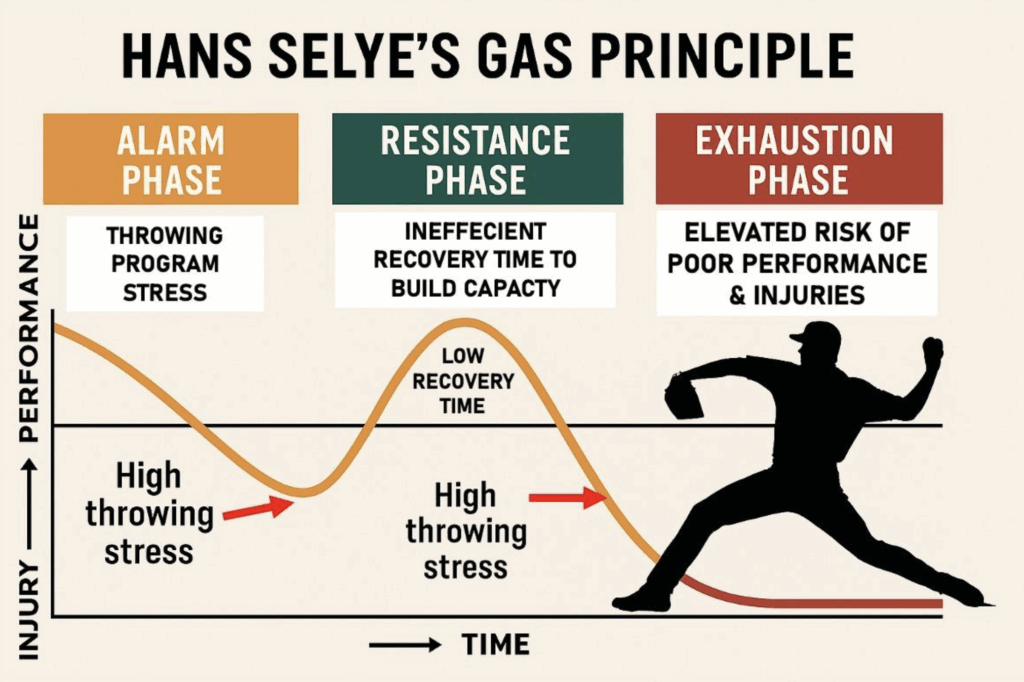
When stress is applied in a generalized manner, the throwing arm may become alarmed, as indicated by fatigue, inflammation, and weakness. Without testing the throwing arm, there’s no way to know if the athlete has entered the resistance phase. If the stress is continually applied, the resistance lowers, and the athlete enters the exhaustion phase, which isn’t beneficial for anyone.
The Role of Testing and Data
Every athlete responds differently to stress. Some recover quickly and thrive on higher workloads; others need longer to rebound between bouts of high-intensity throwing. Without measurable data on throwing arm strength, range of motion, or fatigue, coaches are forced to make blind guesses.
Allowing players to routinely test their arms—measuring force output, imbalances, and fatigue markers—provides clarity and insight. With this information, coaches can adjust training variables such as:
- Volume (number of throws, sets, or reps)
- Intensity (effort level or load)
- Frequency (days per week of stress exposure)
- Type (training methods to use, such as unbalancing strength programs for better balance)
Player-informed adjustments transform programming from reactive to proactive, reducing risk and enhancing readiness.
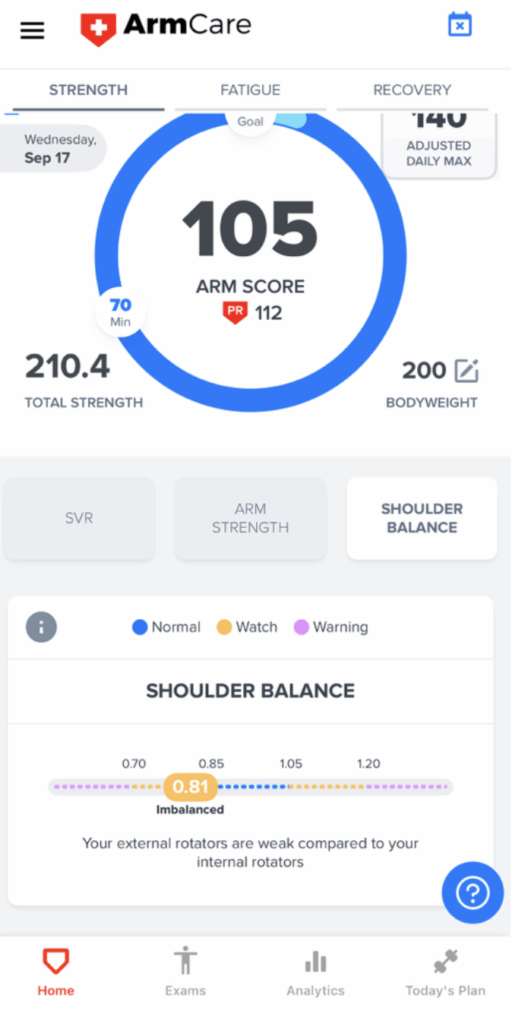
On the left is a screenshot of a player’s data. You can see that the shoulder is on the cusp of further imbalance and needs to regain its balance, ideally between 0.85 and 1.05, so that the forces are more evenly distributed across the shoulder and elbow.
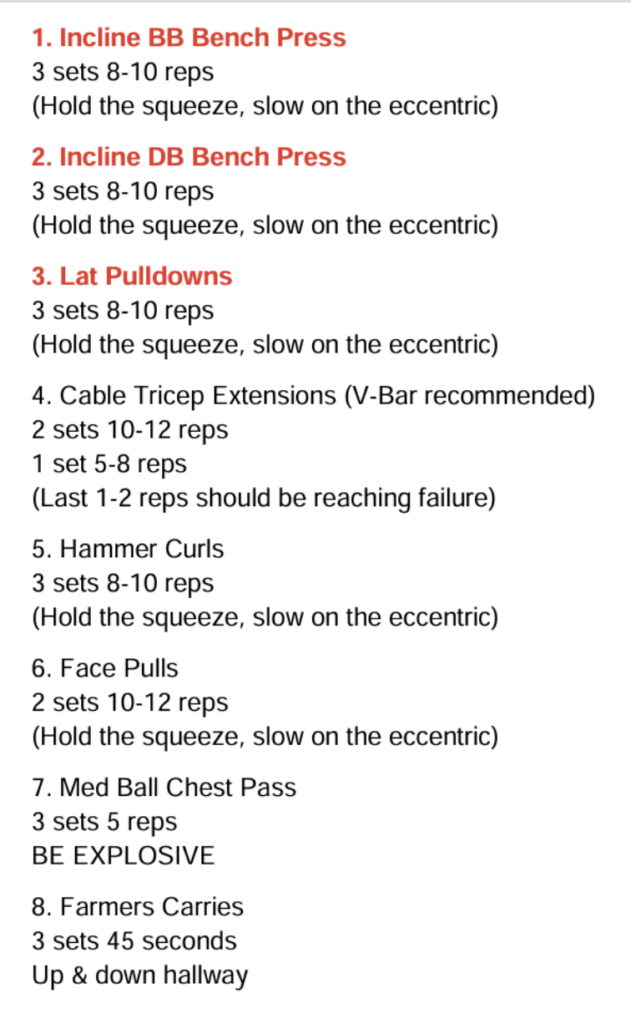
On the right is an upper-body training program that may be written for this athlete, which could cause further imbalance. The first three exercises activate the internal rotator cuff heavily and would also further activate the pectoralis major, latissimus dorsi, and subscapularis. If the process is player-informed, the exercise approach can shift to accommodate the individual player’s needs.
If the program remains generalized, declines in throwing health and on-field performance can occur.
The Inflammatory Cascade and Recovery Windows
Understanding muscle physiology is key to programming. Every high-intensity throwing or training session causes microtrauma—tiny tears in muscle fibers that initiate an inflammatory cascade. This process includes:
- Inflammation Phase (0–72 hours): Muscle fibers swell and soreness peaks as immune cells clear damaged tissue.
- Repair Phase (3–5 days): Satellite cells activate to rebuild damaged fibers.
- Remodeling Phase (5–14+ days): Fibers strengthen and adapt, resulting in increased capacity.
If training resumes before the body has cleared inflammation and adequately repaired itself, the breakdown accelerates beyond the ability to recover. This is how repeated microtrauma develops into chronic injuries, particularly in the shoulder and elbow. Player-informed coaching ensures recovery windows are respected.
This clip from our MLB Performance and Recovery Habits Course communicates what the best in the game do and delves into the beginnings of building a top-level hydration process – essential for lowering inflammation, expediting repair, and maximizing contraction strength. A dry muscle is more susceptible to tearing, so a hydration plan is essential to the performance process.
Why a Player-Informed Approach Matters
Durability is the ultimate performance enhancer. A player who can stay healthy, train consistently, and adapt intelligently will outperform a teammate sidelined by preventable injuries. Player-informed coaching is the key to aligning training with an athlete’s biology, giving them the best chance to thrive.
Bottom line:
- General programs fail to reflect individual stress responses.
- When workloads are not individually met, overtraining or undertraining results.
- Consistent player testing ensures that throwing and training programs are safe, scalable, and performance-driven.
Data belongs in the hands of each athlete, and our athletes possess the knowledge to engage in critical conversations with their coaches. With strength, imbalance, range, fatigue, and recovery metrics guiding programming, players, coaches, and teams can make smarter decisions to sustain performance and minimize injury risks.
If you are a player, parent, or coach looking to stay informed this season, check out our new offering from ArmCareU below!
Ryan
Ryan@armcare.com