Strength in Numbers #32
I’ve been curious about dynamometry to evaluate force potential for specific muscles even before I came onboard with ArmCare.com.
Although our company focuses on the throwing arm, one of the most common forms of dynamometry in sports today is the force plate.
Coaches most often use force plate technology to evaluate jump metrics to assess neuromuscular fatigue through changes in lower body power, both of which influence training and recovery cycles.
FORCE PLATE TECHNOLOGY FOR JUMPING
One of the most common measures captured in jump testing with a force plate is the force involved in stretching the quadriceps as the athlete moves downward to the bottom position, called the eccentric rate of force development (see eccentric phase below.) This number is significant because the highest jumping athletes usually have the steepest rise in braking forces for their lower bodies.
The next phase of the jump movement is called the concentric impulse. This measures the time and application of force (force x time) applied into the ground at the bottom position until take off as the muscles shorten to explode off the ground (see concentric phase below.) For this measurement, athletes want to have a high peak ground reaction force so that when multiplied by the time from the bottom position to take off, there is a huge area under the curve of a force-time graph.
Finally, peak power is the metric commonly tied to performance and found to be greater in harder throwing pitchers. Peak power multiplies jump force by the velocity of the center of mass (ref).

UPPER BODY TESTING WITH A FORCE PLATE
As I had been considering alternative uses for the force plate, the Houston Astros put out a social media post that they were using the ASH test (Athletic Shoulder Test) to measure the strength of the arm in multiple joint angles with an outstretched arm.
I started researching this testing method and had made a mental note of the author named Ben Ashworth. Shortly after reading the article, a friend randomly introduced me to Ben and we met at the 2018 MLB Winter Meetings.
I knew then that Ben was someone I had to know. We had dinner together and talked about some of the shortcomings of current shoulder evaluations in pro sport.
Although short lever testing with a bent elbow in baseball makes sense for internal and external rotation strength, in other sports, such as rugby, shoulder vulnerability occurs with an outstretched arm. That struck a chord with me because the highest forces experienced at the shoulder during throwing occur at the release point and are usually higher than body weight.

INTRODUCING THE ACCEL AND DECEL TEST
Fast forward and within the first month of working with ArmCare.com, I proposed a release point-specific test using our dynamometer.
I knew that force plate testing for the upper body was not cost-effective since most force plates are between $10,000 – $25,000, not to mention they’re only used on the ground.
In our version of the long lever test, the athlete can measure release point strength anywhere by pushing into a fixed surface with an upright trunk. Not only does the test evaluate maximum force generated by the shoulder, but also how force is developed through the trunk and core and transferred through the shoulder to the wrist.
When we press forward, we call that ACCEL testing as it mirrors the acceleration muscle activation of the throwing arm. When we press backward, we call that DECEL testing to evaluate the strength in decelerating after ball release. Both tests are involved in our Arm Primer, a preparation activity before throwing that also gives us a checkpoint on arm function in under 40 seconds. We tested this internally and found that overall, our measure of variability was 7% which is well under the threshold accepted by the research of 10% that is typically used to identify reliability in a measure.

MEET BEN
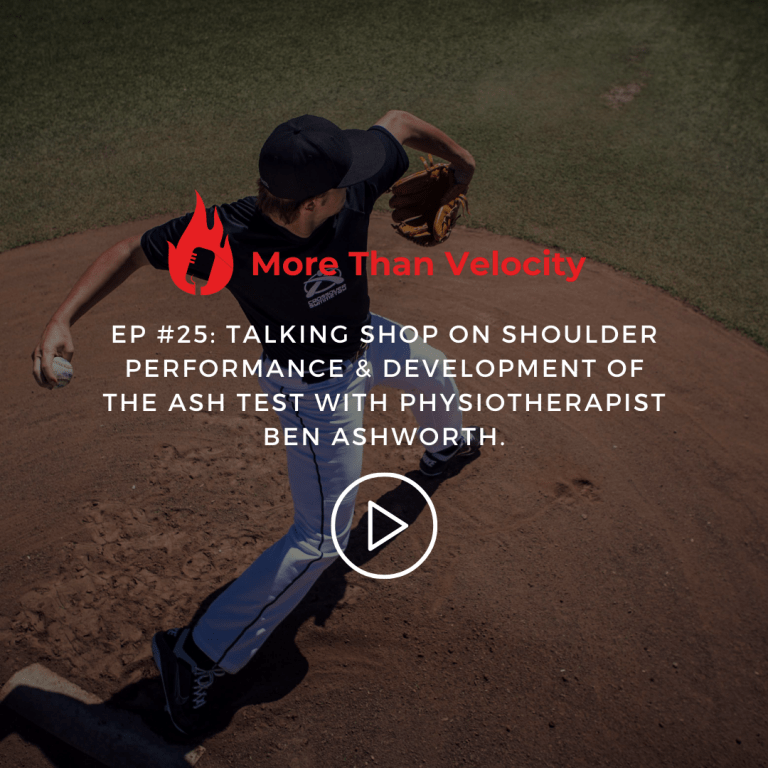
This week’s podcast features Ben Ashworth and covers his experience as a performance director and physical therapist. He goes through some of the key metrics and experiences he has had in professional sport, how he applies data to his practice, and what he believes the future entails for monitoring the throwing arm.
This is an episode you don’t want to miss!
FINAL THOUGHTS
We pride ourselves on being research-based. With more athletes using our system, we will have more scientific answers regarding measures that reduce velocity, increase soreness, and potentially cause injury.
The key is to keep increasing arm strength, get to at least an Arm Score of 70, but don’t stop there, keep pushing forward. The throwing arm can only handle forces up to a level that it can absorb. Athletes can test with our Arm Primer every day and ensure their arms are strong in a very vulnerable joint position. Coaches can use this data to program long-lever training and dial-up or dial down the throwing intensity for the day.
Stay tuned for more about monitoring, training, and biomechanics concerning the long lever position!
Related Content
-
Talking Shop on Shoulder Performance & Development of the ASH Test With Physiotherapist Ben Ashworth (More Than Velocity #25)
In this episode, we dive into assessing and training the shoulder for performance with the notable physiotherapist Ben Ashworth.