Strength in Numbers #70
I love connecting with our dedicated customers, who come from all walks of life.
I’ve met parents, high school athletes, professional athletes and skill coaches, sports scientists, researchers, facility owners, physical therapists, athletic therapists, doctors, agents, front office members, and strength coaches. You name it, and we have someone to fit any profile in life.
Yet, despite the diversity in our customer population, they all share one thing in common.
They want to push the limits of the throwing arm, make it as robust as possible and prevent any stop in play for themselves, their team or organization, or for their son or daughter.
However, there are different viewpoints between each member. For some reason, it’s not until an athlete makes it to the college that perceived value changes the perspective from velocity enhancement by using ArmCare and leans toward injury protection.
After college, there is more loss aversion (worry about sunk costs for organizations) in having a potential multimillion-dollar throwing arm on the shelf. That is with good reason, but it also confuses me.
For anyone who purchases our product, platform, or education, the perceived value of the athlete as an amateur versus a Cy Young winner should be the same. We don’t see a difference, and we must treat everyone’s arm like it is a multimillion-dollar investment.
I have a close friend who recently became an agent and transitioned from the scouting world. He is enlightened, and the first questions he asks any player are habit-driven. He wants to know about athletes’ development approaches, and most importantly, he is listening to how the athlete takes care of himself in his quest to become the next superstar. And, of course, ArmCare fits into this conversation.
If the player is…
- Monitoring their throwing arm,
- Giving it specific attention and recovery when they need it,
- Pushing the pedal down at the right time and,
- In the right state of strength and range of motion,
- and following an individualized throwing and training program,
…then that is a multimillion-dollar arm with a multimillion-dollar approach.
Some players have talent or work ethic, but when both aspects match (multimillion-dollar talent with a high-level approach), then that’s when you know it’s time to sign the check and lock down that player!
And you can be a multimillion-dollar parent or coach too.
Here’s an excerpt from an email I received from a father who has been his son’s coach for his entire life and has finally given the reigns to another coach who is generalizing training and taking on risky throwing drills:
-Concerned Parent
Good morning Ryan,Thanks for the quick response…for the first time I will not coach in [name] in baseball (outside of playing on US teams in tournaments)…last night his new club had their 1st pitchers practice, and he met his pitching coach for the 1st time…having said that, I do look to educate him on all baseball matters, in particular pitching and the whys and why nots…anyways, last night the coach got them following a long static stretching routine to get right into a workout with reverse throws, pivot picks…he has a lower arm slot and the coach has never seen him pitch (or I don’t think he is even aware of how he uses his kinetic chain) so I am not a fan of getting into pivot picks and arm path drills without them understanding of how he can effectively use his (or any other pitcher for that matter) body from the ground up and understanding his arm slot (which is the by product of his kinetic chain…they were using either plyo of weighted balls (not sure) but the coach told him that you have to “strain your arm now to make it deal with strain later”…I am a big believer in “strength matters most” but think that there is a better way than this and not sure of the necessity of a different kind of undo arm strain at this point…
I had to read this email twice.
The first time through, I saw that the parent who wrote to me has a multimillion-dollar arm mentality, which has been bestowed upon his son.
He equipped his son to make major decisions in his player development from an early age. Unfortunately, not all young players receive this education or opportunity.
Then, the second time I read the email, I was concerned.
My concern is that the coach has a “make or break” approach. They don’t understand that not all drills are appropriate for every player, and the result could reduce future value for the player and potentially compromise their athletes’ health in the long run.
I don’t believe this is the fault of the coach. It’s more the fault of society’s message that one size fits all is good enough and the answer is always “shut up and work harder.” We believe strongly in hard work, but these are generalized thoughts that lead to poor results and increased risk.
We do have to be cognizant of advancing velocity in young players. It is the way of the game, but we cannot lose sight of the costs if we do not individualize, be objective with supporting data, and put player health and innings pitched at the forefront of our minds.
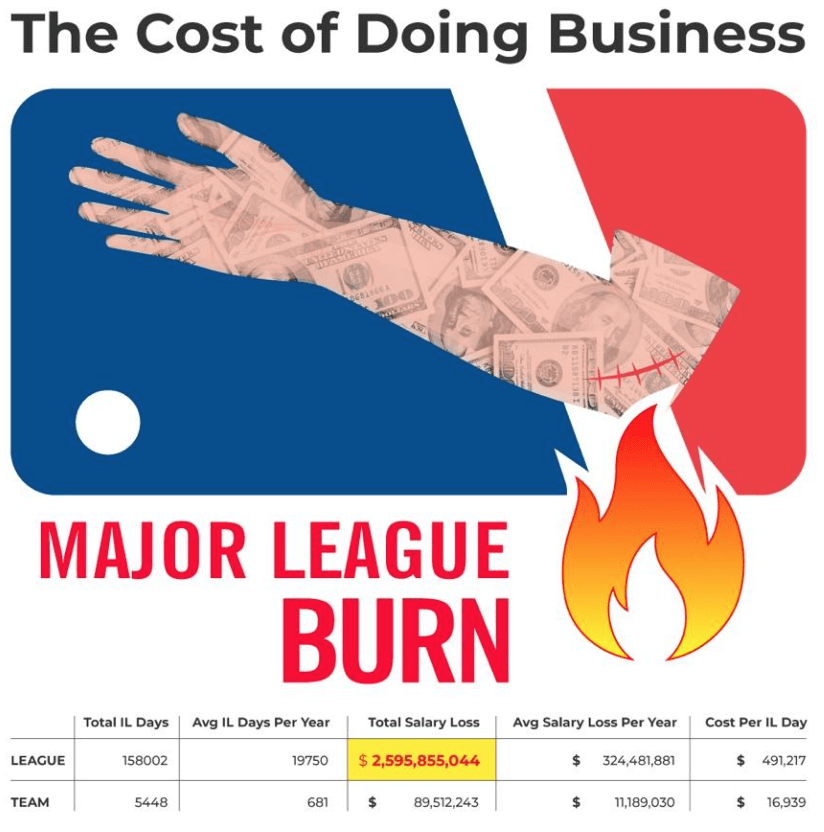
I am going to leave you with this infographic below. It is the cost of pitching injuries at the MLB level from 2015-2022.
Teams appear to be happy to spend money on injuries. As a result, they pay more for players now than ever before. The athletes who lose playing time and are accounted for in the data tables are getting paid.
But, for most of the baseball world, sidelining injuries have no guarantees.
However, I can guarantee that STRENGTH MATTERS MOST, and it should matter to you to maximize your potential and play as long as you want to and not be cut short or cut open.
Bottom line – treat your arm like it’s worth 100 million because, in the future, there is a possibility that it can be. The only way it can’t be is if you can no longer pick up the ball.
STRENGTH MATTERS MOST!