Passive range of motion tests pin down the scapula and does not allow any intermuscular interactions to happen. Therefore the test isolates pure shoulder rotation. It does not account for ribcage movement, pliability or dimensions, thoracic extension, clavicular elevation, triplanar scapular movement, or intra-abdominal pressure, all of which contribute to the layback.
One thing that needs to be understood from earlier in this newsletter is the UCL becomes thicker and more elastic. Measuring the rotation of the forearm by cranking it back can produce a valgus load that opens the inner elbow (the spring of the catapult) and can contribute to artificial readings.
In other words, external rotation could be increased by medial elbow laxity rather than purely shoulder joint motion.
Similarly, throwing athletes have varying degrees of bone rotation for the humerus, and ultrasound assessment of the bicipital groove could indicate that the humerus is retroverted, or twisted, meaning the true external rotation of the humerus is less.
The other major gripe I have is that we compete in a vertically-oriented torso position, which will change joint centration for the shoulder and is much different than lying down.
I also think you cannot accurately examine something called reciprocal inhibition, meaning that as your muscles move you in one direction, the opposing muscles need to turn down when lying on the table.
All these criticisms point to an active test where intermuscular interactions are occurring and that the trunk orientation is more representative of throwing, not to mention the throwing arm is moving actively in the delivery, where muscles are involved in managing length-tension aspects.
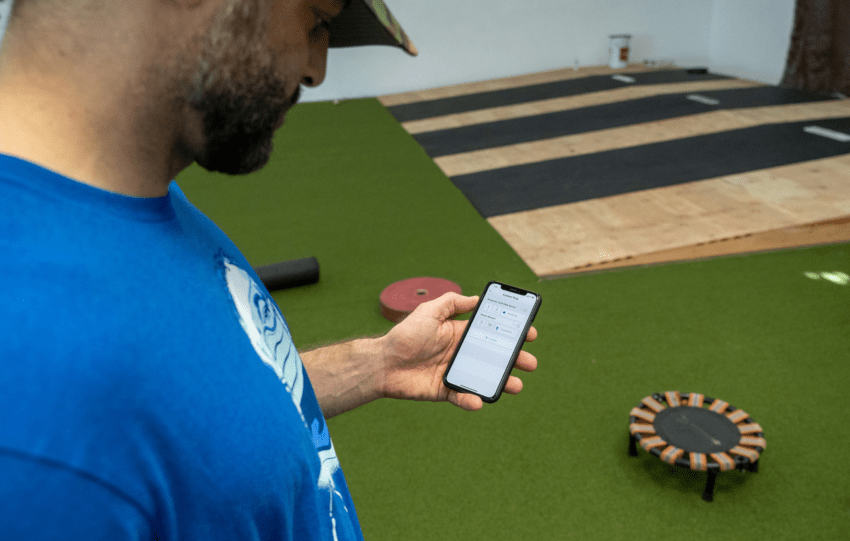
Additionally, an active test can be performed independently of clinicians and daily. Some guidance early on can be helpful for athletes in using the ArmCare platform, and once they are technically sound and frequent with testing, a stronger approach may come to light with large datasets (approaching 15000 athletes testing).
GET MOCAPPING
After understanding the active range of motion, the next layer is to examine what range of motion is achieved in the delivery in 3D space. To do this, you must evaluate your athletes’ shoulder rotation angles.
What is considered adequate for boosting biomechanical efficiency (greater mph relative to medial elbow torque) is to examine if athletes are achieving more than 160 degrees.
In some cases, athletes with desired external rotation range of motion dynamically at 160 or greater and a little more active range of motion than passive.
The 3D assessment, especially with hard-throwing pitchers, is a safety point to ensure you are not giving your athletes the kiss of death by hyper-mobilizing the shoulder in external rotation that could expose the UCL to greater tension in layback.
Couple this with an athlete who prefers light balls relative to the baseball, and you have a faster and farther-moving catapult coupled with a weaker hinge at the elbow. Yikes!
PUTTING IT ALL TOGETHER
Coaching athletes into greater lengths without improved strength is a major contributor to throwing arm injuries.
If you truly want to make sound decisions blending arm strength testing, range of motion assessment, and 3D motion capture, I truly believe you will have the necessary expertise to avoid potholes in the road by becoming dual certified.
Not to mention, if you are evaluating a passive range of motion only once per month, you are missing important observation windows that are void of detecting restrictions caused by a change in muscle tone or loss of reciprocal inhibition (turning down the activity of an opposing muscle group).
A strong muscle is a long muscle; you need to champion both range of motion and strength assessment processes that can be consistent and frequent.
I am going to leave you with this last fact. In my first year with the Angels in 2017, we led the MLB in pitching-related injured list days. We took a stringent and aggressive stance on range of motion testing and hammered restrictions wherever we saw them. As a result, in 2018, we again led the league in MLB pitching-related injured list days and had even more during Spring Training.
Things changed in 2019 and 2020 with the addition of arm strength testing. The combination of balancing strength and length was achieved by integrating a consistent arm strength assessment process. We became one of the few teams without any surgical injuries within their active roster pitchers.
To mobilize or not to mobilize? That is the ultimate Spring Training question.