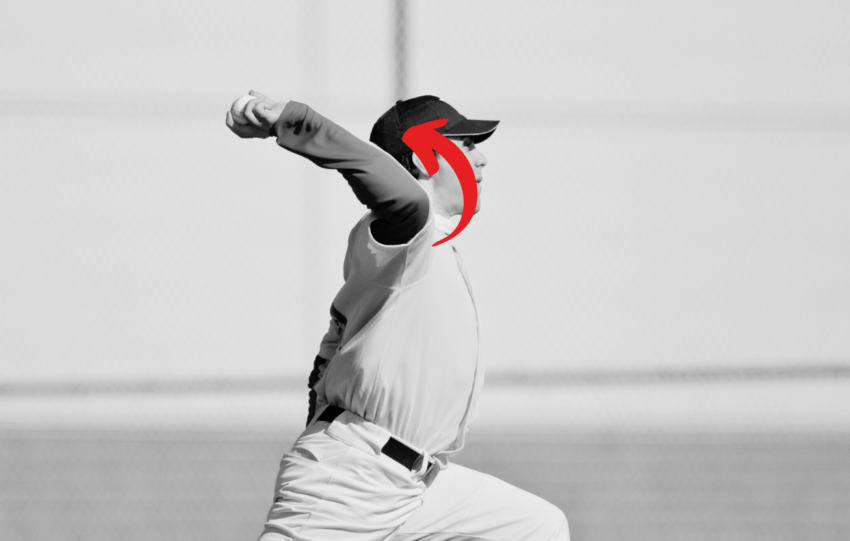
End-range testing and training can apply heavy loads on a player while in full layback. It occurs in many teams and organizations and makes some sense, considering the “sport-specific nature of this movement.
Although, given the critical observation necessary to make end-range testing safe, overall, I do not support it and feel that it should be avoided during both testing and training.
Here’s why you should think twice about maximally loading a player in layback.
PROVOKING THE PROVOCATIVE POSITION IN TESTING
Training and testing are very different. You can train in end ranges submaximally, but maximum isometric testing requires pulling on an athlete in extreme layback.
A few things happen when loading at this extreme range.
- The first is that in the extreme layback with maximum internal rotation torque applied, greater torsion and traction occur to the biceps tendon. A very high number of athletes in baseball are walking around with asymptomatic SLAP tears, and the combination of isometric contraction and biceps tendon torsion can cause stiffening of the biceps tendon to apply more tensile stress to the labrum.
- A certain number of athletes experience discomfort in this position due to provocative positioning of the humeral head, with the most common complaint being pinching at the back of the shoulder. The technical name for a clinical test examining the end range is the RELOCATION TEST because the test requires the examiner to relocate the humeral head to experience relief.
- Extreme layback testing is 100% contraindicated for hypermobile athletes. For many of my athletes who have had SLAP tears, I do not train them anywhere near their end range and never, ever, perform a maximal isometric contraction at the end range with them. The humeral head will glide, but not only that, young high schoolers have a larger subscapularis muscle compared to the posterior muscles, and muscle hypertrophy sucks the humeral head in its direction. This complicates things if someone tests an athlete in extreme layback with an isometric pull, as the humeral head will naturally glide toward the front of the shoulder.
- Additionally, if they have a tight posterior capsule (noted by an active range of motion restriction on the ArmCare app), the athlete’s humeral head is likely to be translated superiorly and posteriorly (up and back) in the shoulder socket due to a tighter posterior shoulder capsule.
In short, it puts a lot of stress and potential pain on a shoulder predisposed to several underlying issues. YIKES!
UNPROVOKING THE PROVOCATIVE POSITION IN TRAINING
Strength is indeed length-specific, meaning strength decreases if you extend the range of motion beyond the optimal muscle length. Although, training can lessen strength disparities between endpoints if the training heightens muscle activation of synergistic muscles.
For example, take the serratus. The Certified ArmCare Specialist Course discusses how external rotation strength is maintained as the arm is elevated due to greater serratus activation, despite lower activation of the infraspinatus and teres minor, the two posterior rotator cuff muscles responsible for external rotation.
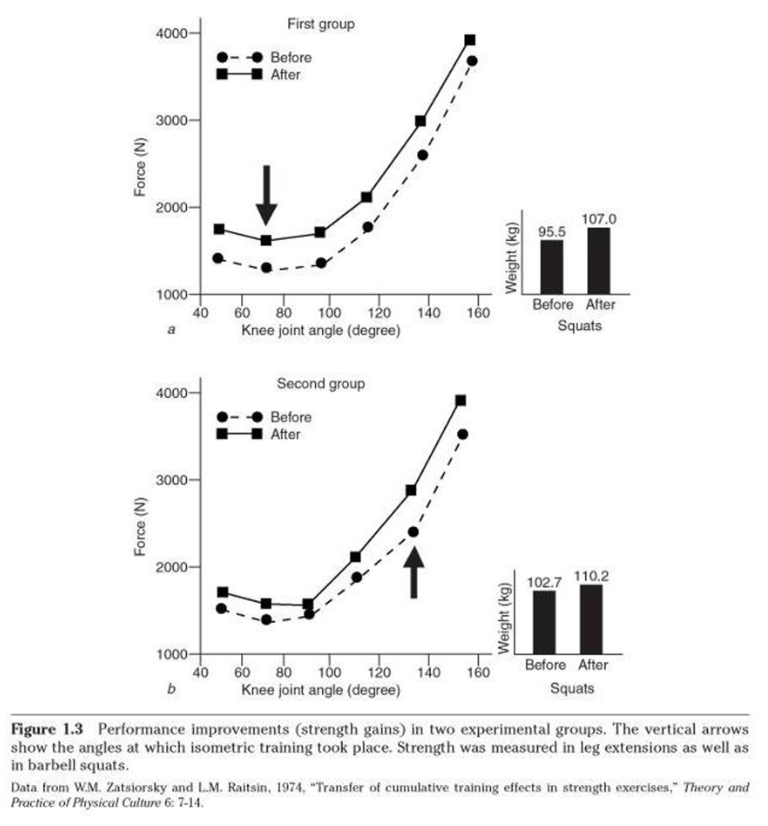
The book Science and Practice of Strength Training by two profound sports science researchers convinced me that you do not have to train at end-range strength.
You can download the book here and see these graphs in the first chapter, with dialogue starting on page 7 and the chart on page 8.
In a nutshell, two groups trained knee extension exercises, one near 90 degrees and another at an extreme range of knee extension. The dark arrow on each graph below shows the joint angle where the athletes trained.
The take-home message is that at extreme extension, strength increases more toward the extreme position. However, a position closer to 90 degrees produced strength gains across all joint angles from short extremes to the very longest extremes similarly.
The conclusion is that you can increase end-range strength without training the athlete in a provocative position. As a parallel, you can stay around 90 degrees of external rotation and increase your force potential with the arm loaded back.
BETTER OPTIONS FOR IMPROVING END-RANGE STRENGTH
Now, I will show you how I train athletes to improve end range both with perturbation and eccentrics.
The first is perturbation or rhythmic contraction. I do perturbations to ensure the resistance is not overloading or provoking pain, as the athlete can move out of the end range.
In the Certified ArmCare Specialist Course, we discuss the benefits of this type of rhythmic co-contraction done slowly to yield greater tension versus other rhythmic tools that increase perturbation speed.
Heavier-loaded perturbation also unloads the biceps tendon while developing end-range strength. In this type of training, the traction is short, which reduces the chance for stress relaxation that allows the tissue to creep under tension, lose force, and potentially make the shoulder unstable.
The second element of end-range training is the importance of having stronger co-contraction leading into end-range controlled by eccentric strength.
Injuries occur due to weakness, and deceleration-based injuries are most prevalent as the muscles may lose strength as they lengthen. Therefore, you cannot improve resistance to injury by focusing primarily on isometric training.
Isometric testing is safe when not in a provocative position, but eccentric training allows the arm to resist injury.
You can see in the video above that I am assisting myself in an eccentric internal rotation exercise going into layback.
Like the study results I shared, I don’t need to train in deep eccentric end ranges to get the strength benefits that will allow me to decelerate while in maximal external rotation.
Remember, the external rotator cuff is shortened and cannot produce as much force in extreme layback. Therefore, the eccentric layback control of the antagonist muscle (the internal rotators) sets up the catapult. Note that it’s not an isometric contraction of the rotator cuff at the end range in a maximally lengthed position.
Just look at throwing a baseball and how the arm decelerates into co-contraction. This is why safely training eccentrics performed in layback is essential, and maximally testing in a provocative position doesn’t yield the perceived benefits and potentially leads to a greater risk of injury.
Conclusion
In conclusion, while end-range strength training and testing might seem necessary for a baseball player, it’s more likely to lead to injuries and pain. The evidence provides betters options for developing a player to meet the demands of their sport.