Strength in Numbers #93
Most of you probably remember the “Head, Shoulders, Knees and Toes” song …
It was a childhood favorite, and I remember singing it with my boys, who are now 5 and 3 and would rather listen to my country music in the car than sing with me.
And up until a few days ago, I never at all thought about it introspectively.
But as the repetition of “Knees and Toes” reverberates in my mind, I can only think how between your knees and toes is one of the most critical joints in the body, but it didn’t even make the song.
We are talking about the ankle, folks, which is the focus of a recent research paper hot off the press that I published with my friend and former Ph.D. Chair, Dr. Dan Ramsey, graduate faculty at D’Youville College.
It is the first to discuss the ankle in 3D for baseball pitchers. We dive deep into full ankle dynamics, including biomechanical data on position, velocity, joint torque, and joint power.
Simply put, Dr. Ramsey and I expanded on the basic biomechanics of the ankle by using 3D segment tracking and embedded force plates to help describe the concentric and eccentric contractions of the ankle in multiple planes of movement.
THE DORSIFLEXION PARADOX
I have a strength coach pedigree. And as a strength coach, I can say we’re keenly focused on an athlete’s results for one principal lift.
That is the squat.
Or, if you are a functional movement specialist, you’re likely also focused on the same pattern. Although you may have the individual perform it in an overhead position to note the lines of symmetry between the shin, thigh, and spine and ensure the arms are all oriented in the same direction and making a common angle with the ground.
But no matter if you’re squatting for strength or to demonstrate proficiency in movement, it’s a product of good ole’ dorsiflexion—which occurs at the ankle as the angle of the toes gets closer to the shin.
So if you want to be a strong squatter and Olympic Lifter, you must buckle down and improve your dorsiflexion, right?
Which seems to have bled into baseball as well. If you are aware of and train your throwing athletes to move better, you are likely focusing on ensuring adequate dorsiflexion mobility.
Although we’re overlooking many other aspects of the ankle, for example, have you considered plantarflexion strength for movements where the toe points away?
I am not saying that having “adequate dorsiflexion” (whatever that means) is not important. But, I am saying that you may be living in a 2D world, which is precisely the thing I am trying to get people away from in our Certified Pitching Biomechanist Course because it’s the infamous pattern-based training that is killing motor preferences.
Motor preferences comprise the anatomical, functional, psychological, physiological, and tactical motor strategies we each have for completing a movement task, such as throwing a ball.
Motor preferences make us unique, whereas motor patterns make us generic, generalized, and non-optimized.
Imagine you have an athlete who naturally delivers the ball with a flexed knee and more vertically-oriented lead shin without much dorsiflexion. Should you be stretching out the gastroc and soleus complex, mobilizing the talus, and working on other elements of this ankle movement in favor of what? A better squat?
While you may crush ankle stiffness, you may also impact multiplane co-contraction and force-coupling instances that create ground reaction torques. Yup, not ground reaction forces exclusively, but the rotational torque that the cleats make with the ground to lock you in and let the rest of the body go for a ride.
I believe we focus too much on dorsiflexion because it is a feature of a sexy 2D exercise in the sagittal plane that I do not feel is all that crucial to pitchers, especially when they advance in ability.
And yes, I am saying the bilateral squat has minimal strength and coordination influence on the delivery and even throwing hard.
MY GUY IS STRONGER THAN YOUR GUY
Everybody has their stories, but here’s one of my awakenings in the “strength and conditioning” world that transformed my thinking toward blending force testing and 3D motion capture as a new approach to athletic development. This experience led me to SCT (Strength and Coordination Training), which is the guts of the entire Certified Pitching Biomechanist Course.
And years later, these early ideas were reaffirmed by Frans Bosche, who is the pioneer in this type of training through his book: Strength Training & Coordination. Nowadays, I firmly believe that after an athlete turns 15, Strength & Coordination Training should be the principal way to train unilateral, contralateral, and diagonally-driven athletes.
Anyway, the story is about a player I worked with while working for the Angels, who was a strength coach’s dream.
He arguably is one of the best athletes I have ever encountered regarding raw physical gifts. Imagine weighing 236 lbs at 6’3″ with less than 10% body fat (you see abs), could back squat over 550 lbs whenever needed, jumped over 40 inches, broad jump 10+, triple broad jumped 30+, can get a 10 yard in sub 1.50 seconds electrical time, can bench over 350 as a pitcher and had an indescribable work capacity. On top of that, he was a great human being and did whatever you would ask of him.
He would be in the big leagues if he hit as a third baseman or corner outfielder, or he could have potentially been a linebacker in the NFL.
Now, despite superhuman physical ability, this superathlete was in our velocity enhancement group because he was flirting with throwing less than 90 mph.
There were a few things to correct when he entered this group, and jumping 50 inches and squatting 1000 lbs were not any of them.
He needed to increase arm speed and had the right SVR for this type of training (SVR is Strength-Velocity-Ratio, a cornerstone metric for our app). However, since he was so big, his relative arm strength needed to come up, and he had a chance to focus on it with less competitive demands on his throwing arm.
He converted his training in ways to accommodate loading to overcome sticking points to further power and acceleration in lifts and focused on dynamic training using very light loads (less than 50% of his max at times) moved quickly.
He also shifted from mostly a sagittal warrior to also mastering rotational, frontal plane, diagonal and unilateral movements.
After completing the program and creating a better balance between arm, body, motor preference, and ability, he was an MLB invite, something I am sure he had always hoped for, but for myself and the Angels strength staff, he was a hall of famer, and we were so excited for him in getting a shot.
So what could have made this player better earlier in his career?
Well, as mentioned, it is the blend between raw physical talent, quantified strength qualities, 3D motion capture, and really getting to know his motor preferences and competitive tendencies.
We had pieces of the pie but no filing. We had parts but lacked interconnection. And we lacked an SCT approach to select exercises to remediate and coordinate imbalances, deficiencies, and joint timing. We also did not have optimization factors nailed down to know if our exercise selections were hurting performance or the athlete in general.
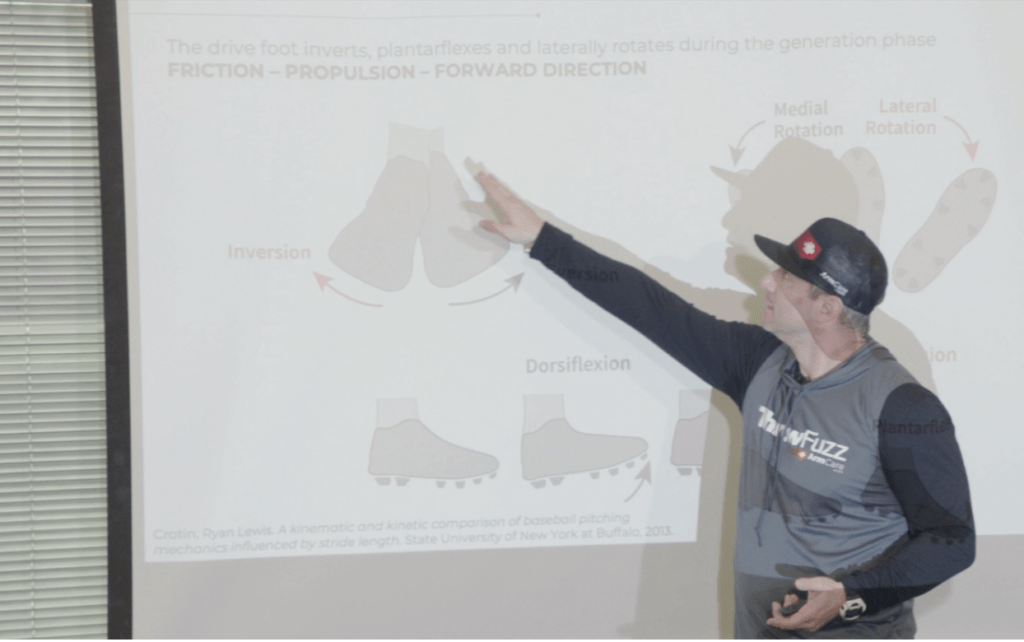
Now, back to the ankle. You can access this unique paper that we started with here, where it’s free to download and share.
You can share it with whomever you want. However, I suggest you start with pattern-based coaches who consider the ankle a simple hinge joint. Those individuals will be head and shoulders above where they are now when they understand what happens between the knees and toes.
You can become head and shoulders above everyone else by becoming an ArmCare Elite member in just one click. If you have intellectual curiosity, want to have deeper discussions, want to teach and be taught, and want a whole bunch of member benefits……
JOIN US IN ERADICATING ARM INJURIES AND DOMINATING PITCHING PERFORMANCE!