

Strength in Numbers #102 – The Great Debate Part I
I am generally not one to rock the boat on social media.
However, this past week, I saw another article added to the 100’s from the past 20 years saying that throwing velocity is the cause of injuries and that biomechanics is the cure.
So I stoked the fire on LinkedIn with points of contention going against this and several successful individuals in the industry who work with injured baseball pitchers.
As a throwing fatigue scientist with 10 years of professional baseball experience and 16 years of academic work dedicated to minimizing injury risks for throwing athletes, I would argue that biomechanics only cause injuries when compensating for fatigue due to overuse.
In this series, I’ll share my perspective, and you’ll get why I constantly say, “STRENGTH MATTERS MOST.”
HOLES IN THE BIOMECHANICAL RESEARCH AS IT RELATES TO PREVENTING INJURIES
The first research article on ulnar collateral ligament sprains was in 1946 (almost 80 years ago). In 80 years, the elbow injury epidemic has not improved, and it’s actually getting worse.
I looked up how many pitching biomechanics articles are available on Google Scholar. To date, there are almost 24,000 articles dedicated to the subject.
In all 24,000, only two biomechanics articles (here and here) were published prospectively on pitchers before an injury, and they were carried out by the same authors in the same study over a decade ago.
We do a deep dive into these studies in the Certified Pitching Biomechanist course, but here I’ll give you a quick synopsis.
After you look at the tables and my summary of the studies’ limitations, you should take the information with a grain of salt and a shot of vinegar in prioritizing biomechanics before throwing arm strength to prevent injury.
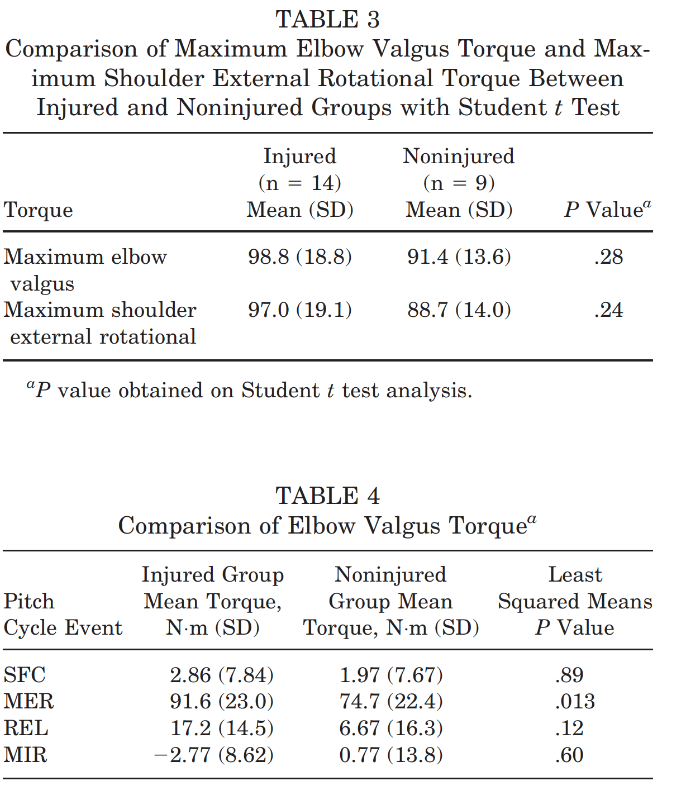
Study 1: Correlation of Torque and Elbow Injury in Baseball Pitchers
RESULTS
There were no statistically significant differences (need a p-value less than 0.05) between mean values for maximum joint torques between healthy and injured populations. When looking at time points in the delivery, maximum external rotation is the only event demonstrating significant differences in medial elbow loading.
LIMITATIONS
Higher elbow varus torque (a measure of medial elbow loading) seen in the injured pitchers in this study was based on a sample size of nine athletes using 2D video with hand digitization rather than the 3D technology used today.
Also, fewer than 10 subjects generally introduce too much individual variability and can cloud results.
Therefore, this study could be considered underpowered from a sample size standpoint to draw true conclusions.
Study 2: Association of maximum pitch velocity and elbow injury in professional baseball pitchers
RESULTS
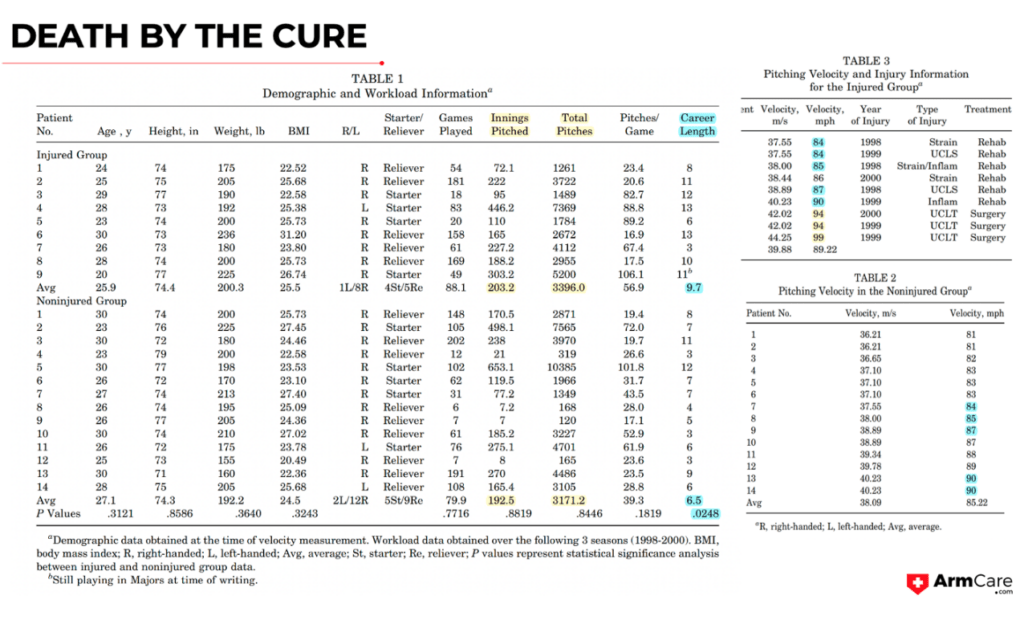
This one I dive into thoroughly in the course, but this is the jest. Pitchers who were injured statistically threw harder by 4 mph and played more seasons than healthy pitchers.
LIMITATIONS
The connection between elbow varus torque and velocity is drawn from this study is not generally accepted. You can have many pitchers throwing at the same velocity with different loading, but only velocity increases within an individual correlate almost at a 1 Nm to 1 MPH level (ref).
Therefore, you could throw 95 mph and have the same joint torques on your arm as pitchers throwing less than 90 miles per hour.
Note that I highlighted in yellow that only 3 pro-injured pitchers threw above 90 mph in this study, and they were the only 3 that had surgery (that’s right, this study shows that if you throw hard, you will get injured based on 3 people).
You will also note that I highlighted blue velocities in both groups, meaning that you will see healthy and injured athletes throwing the same velocities—more to the story and reaffirming that velocity does not dictate joint load unless it’s a velocity gain within an individual.
Pitching injuries are caused by pitching, but it does not overly emphasize the point that I think is most important.
The injured group had greater overuse exposure by throwing more years over their career, more average innings and more pitches are thrown.
Career length, highlighted in blue, was statistically significant, and you may also scratch your head thinking that the injured group were better players than the non-injured group based on career longevity alone.
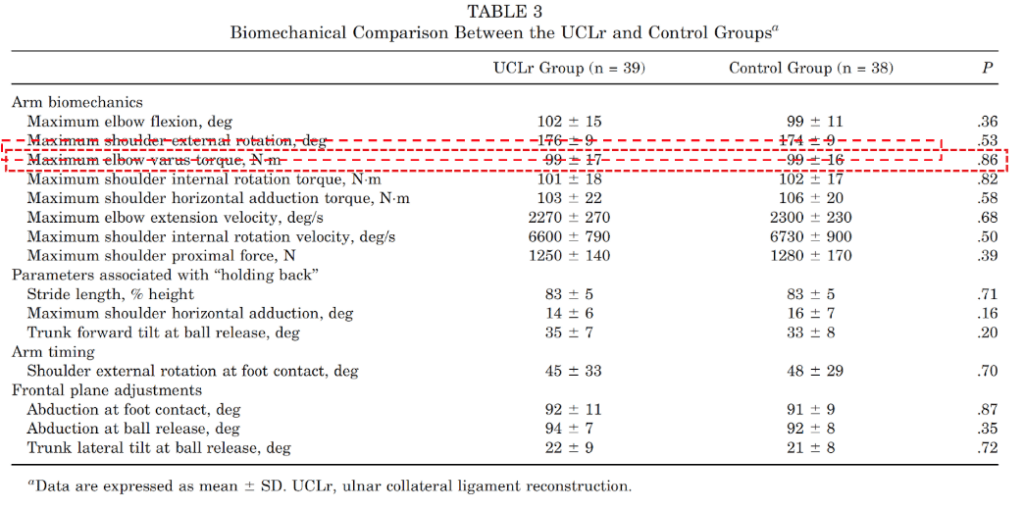
A FEW OTHER HEAD-SCRATCHERS – BIOMECHANICAL COMPARISONS BETWEEN PITCHERS WHO HAVE BEEN REHABILITATED POST TOMMY JOHN AND HEALTHY CONTROLS
Study 1: Biomechanical performance of baseball pitchers with a history of ulnar collateral ligament reconstruction
Study 2: Baseball Pitching Biomechanics Shortly After Ulnar Collateral Ligament Repair
(Fleisig et al., 2019)
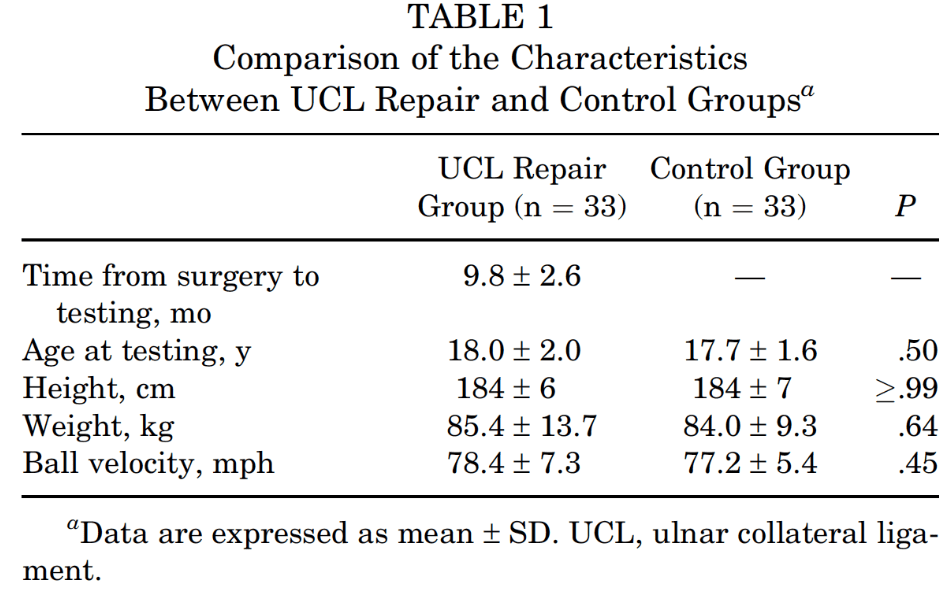
In this study, as soon as athletes could play games after TJ surgery, they were brought in to be analyzed and compared to healthy matched controls.
Again, there were no differences in elbow varus torque, a measure of how much loading is experienced by the medial elbow.
Yet, velocities were higher in the repaired group by 1 mph, yet not found to be statistically different.
This refutes the original study mentioning the connection that high-velocity pitchers are the ones who will be exposed to surgical risk, as this research was found statistically insignificant.
Similar to the original study connecting velocity performance to injury, the ball velocity average here is roughly the same level of a good middle school pitcher. These are not 100 mph arms which intuitively would have higher joint accelerations and could involve larger athletes with greater segment mass for the throwing arm.
It is hard to tell if velocities increased in the UCL repair group before injury, which may have increased loading beyond what they were able to tolerate, or if the velocities lowered after surgery, which is also a possibility.
Too many questions to clearly understand from a velocity or biomechanics capacity in terms of what happened.
Despite not finding a statistical connection to elbow joint loads or velocity, this recent study was very interesting and resonates “strongly” (no pun intended) with why our company continues to communicate that STRENGTH MATTERS MOST.
In this study, throwing arm speed for internal shoulder rotation and elbow extension was less in the surgical group, yet the velocity statistically stayed the same. Why do you think that is?
My belief is that the injured pitchers added strength during the rehabilitation process and potentially, in some form, contributed to ball flight aerodynamics, such as improving wrist co-contraction strength or pinch grip, because the rehabilitation process made up for the loss of throwing arm speed.
Pinch grip strength has been shown to influence ball flight characteristics, namely increasing spin rates, and that could be at play. Thankfully, we measure pinch grip (baseball grip) strength to not only prevent injuries but can help athletes improve velocity who may lack arm speed.
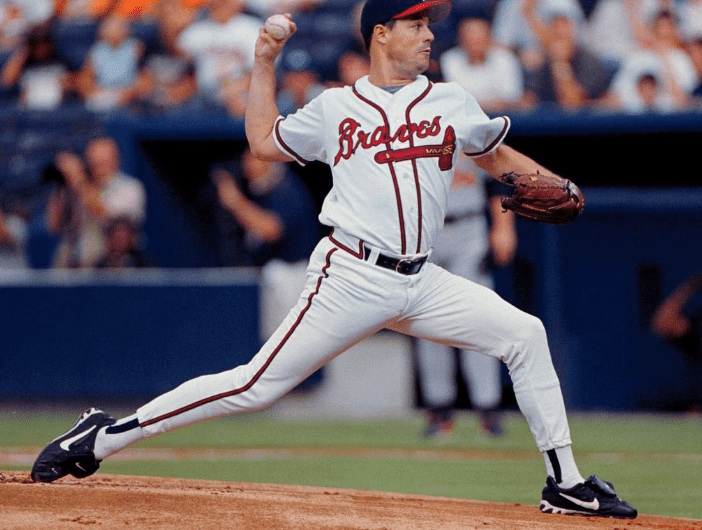
This saga will continue, but I want to end with an image that will lead us into our next segment – defining optimal mechanics. You hear the words “efficient,” “great mover,” “connected,” “smooth,” “clean,” and sometimes “perfect” when describing a player’s pitching delivery.
My question is, how do you define a delivery that reduces the risk of injury? Throwing hard is one thing. Throwing healthy is another.
You may reference Greg Maddux, who I believe is the only pitcher to throw past 20 years in the bigs without missing time.
His name was thrown out a few times on Linkedin and indicated how slow he threw. Tom House mentioned that Greg Maddux could bring the ball over 95 if he wanted and that the old radar guns that were used in his time were 6 miles per hour slower than today’s gun, so his 89 mph could have been 95 as the velocity was captured at the plate rather than out of the hand.
If you look at the picture of his delivery, it’s anything but “perfect,” we will get into the mechanical holy grail weeds next week on this and more.
The next time you read another MLB injury article on velocity and mechanics as the biggest predictor of injuries – will you look in the mirror and say, “I am ready for change ”, or will you continue to beat your head against the wall and read the same things, over, and over, and over again like had in the past 15 years.