Strength in Numbers #104 – The Great Debate Part III
In the Great Debate (check out Part 1 and Part 2 of the series,) we’ve covered how the baseball world tips the scales in favor of biomechanics and throwing velocity as the greatest contributors to injury. And among social media, academic research, and mainstream coaching. These two features are considered the apex focus in player wellness monitoring.
But I’ve argued that despite well-intentioned rationale, these aspects alone cannot achieve the Holy Grail of finding a means to lessen the risk of injury while pushing the boundaries of performance.
In the world we live in, there are too many technologies capturing 3D motion and modeling movement differently, which makes it hard to determine measures that can be consistently measured both on the field, in the lab, and in practice.
There’s also no consensus on what mechanics offer both the opportunity to deliver the baseball at high velocity with accuracy while mitigating injury risk.
In other words, there is no concept of “perfect” mechanics, and telling pitchers to throw slower to reduce the acceleration of their joints is also not a valid option as it will lead to lowered competitive performance.
What we need here is a lesson in optimization.
THE OPTIMIZATION FACTORS
The Strength and Coordination Decision Tree leads with something very intuitive but difficult to grasp for people to hinge their decisions on – does the athlete have pain or poor performance? Your mother probably said, if the door isn’t broken, don’t fix it, and she’s right.
If the athlete is pain-free, performing well, and you are monitoring joint strength and range of motion, and it all checks out, do not cause “death by the cure.”
However, when these things shift, the player is performing poorly or has pain; once you fix arm strength and range of motion, there are 4 critical optimization factors that you should assess in making a mechanical adjustment.
These factors must be evaluated consistently to know when an athlete is optimized.
1. Strength-Velocity Ratio
- Indicates how much arm strength an athlete has relative to their velocity capacity in LBS/MPH. We use 1.6 as our cutoff. Less than 1.6, the athlete has low relative strength to velocity, and therefore, they are using more passive stretching to create high arm speeds.
2. Pitch Efficiency Ratio
- Indicates how many pitches are thrown per inning. This is an indicator of accuracy but also overuse, as athletes who start to see greater pitches thrown per inning can increase their overuse injury risk. If accuracy is sacrificed for velocity enhancement, you may have an athlete who increases the torque on their throwing arm and throws more often, creating a dangerous compound effect.
3. Biomechanical Efficiency Ratio
- This was nailed in Part 2, but it is the relationship between fastball velocity and relative joint torque on the arm, primarily the elbow. Athletes who have greater biomechanical efficiency may be less at risk of injury given that they can throw at high velocity with lower relative joint loading
4. Stress-Shielding Ratio
- There’s more research coming out on this factor, but this is essentially the strength of the arm relative to the loads placed upon it in pitching. It is a solid blended metric between dynamometry and 3D motion capture. Essentially, we want our throwing arm strength to be beyond the force placed upon it. The ulnar collateral ligament (UCL) itself doesn’t take a lot of loading to bust it apart. Therefore, the muscular contributions to protect it are essential to prevent Tommy John surgery. In fact, the UCL is so weak that without the muscle contributions to shield the ligament, the UCL would snap in half on every single pitch thrown by a pitcher who can deliver the ball at 85mph and higher.
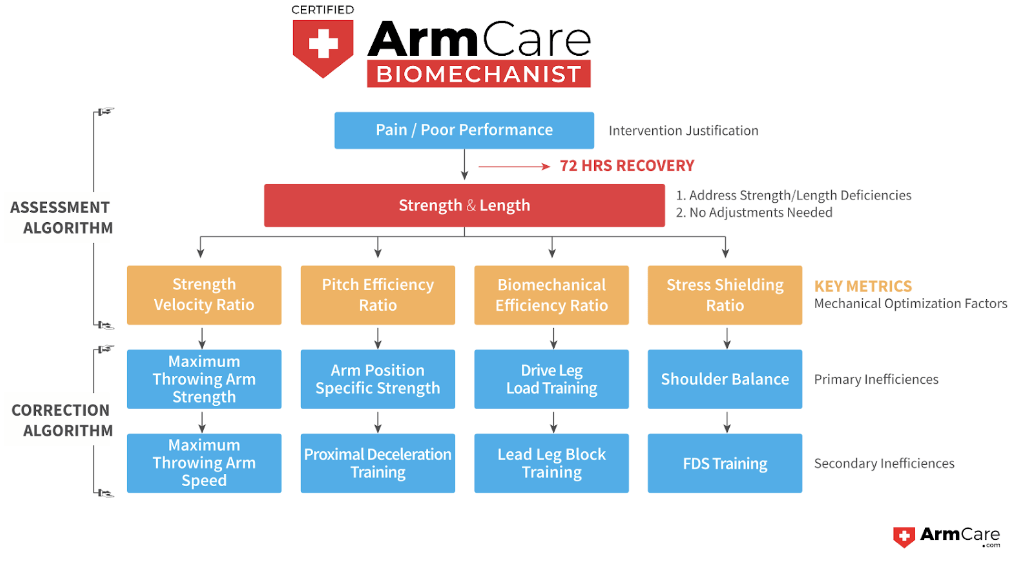
You will have to take the course to understand the correction algorithm better – we cannot fit 10 hours of education into an article, but you can see a clear sandwich formation happening.
The hierarchy is pain and poor performance, the first fix is strength and length (joint strength and range of motion), and then in making a mechanical decision, optimization factors must be reviewed.
If optimization needs to be improved, the correction algorithm will help you fix them.
The whole process significantly reduces “death by the cure.”
Mechanical changes won’t take place to increase velocity while arm strength is going down, they won’t lead to less accurate pitching, they won’t increase joint loading per unit of fastball velocity, and they won’t reduce throwing arm strength relative to the joint forces and torques applied.
The way out of this injury mess must be holistic, involving Strength and Coordination Training (SCT)
STRENGTH FIRST. MECHANICS SECOND.
As it relates to the throwing arm, focus on MAXES FIRST and MOVEMENT SECOND, as improving throwing arm strength and range of motion allows an athlete to accept greater mechanical demands, reinforce a more consistent release point, avoid biomechanical compensations that alter throwing arm positions, speeds, and accelerations, and allows for safe velocity enhancement by involving greater muscular contributions to arm speed.
To conclude this Great Debate Series, I am going to give you my honest opinion.
I studied long and hard to be both an exercise physiologist focused on fatigue impacts on throwing arm strength and a biomechanist focused on evaluating biomechanical compensations arising from pitching fatigue that can lead to injury and poor performance.
3D biomechanics has strong evidence to indicate what should be done to increase velocity and command. Still, it cannot dictate how to avoid the risk of injury simply through kinematic and kinetic analyses.
Throwing arm injuries happen because the arm is weakened; it literally does not have the strength to stop itself from straining and spraining. You need to evaluate throwing arm strength on the injury-prevention side of the spectrum.
I could go on and on, but I firmly believe that Strength and Coordination Training is the way.