Strength in Numbers #120
In the realm of sports science, there’s a scarcity of research based on throwing arm fatigue, which is at the intersection of physiology and biomechanics.
Physiology comes first as internal stress and reduced muscle contraction function, or changes in sensory motor responsiveness, lead to the biomechanical expression of a change in the delivery or slowed throwing velocity.
Right now, I am conducting a groundbreaking study on throwing arm fatigue and how industry-standard approaches to bullpens influence arm strength, lower body power, internal physiology, and competitive analytics across a variety of measures.
This area of research is a linchpin in the pursuit of enhancing both performance and health in baseball.
THE IMPORTANCE OF CONDUCTING SPORTS SCIENCE RESEARCH IN ARM STRENGTH TESTING
Optimizing Performance: Throwing arm fatigue research is not merely an academic exercise; it directly impacts an athlete’s ability to perform at their best. Scientists, coaches, and players can develop strategies to delay its onset by comprehending the factors contributing to arm fatigue. This leads to pitchers maintaining peak performance over longer stretches, a game-changer in a sport where endurance is essential.
Injury Prevention: The importance of reducing the risk of throwing-related injuries cannot be overstated. Research into arm fatigue aids in identifying the factors that increase susceptibility to injuries, such as ligament sprains or rotator cuff tears. With this knowledge, preventive measures can be implemented, safeguarding the longevity of a pitcher’s career.
Biomechanical and Neurological Efficiency: Throwing a baseball at high speeds involves a complex interplay of muscle, bone, and joint dynamics. Arm fatigue can disrupt this synergy, leading to inefficiencies in a pitcher’s mechanics. Similarly, athletes’ nervous systems can be evaluated by pre and post-pitching analyses to see how much their delivery taps into neurological resources. By understanding how fatigue affects these mechanics, researchers can recommend adjustments to enhance performance while minimizing fatigue-related strain.
Recovery Strategies: Research into arm fatigue also informs the development of effective recovery strategies. From specialized training regimens to rest and rehabilitation techniques, a deeper comprehension of arm fatigue guides athletes and their support teams in designing tailored recovery plans.
Player Education: Finally, research on throwing arm fatigue provides players with valuable insights into their bodies. Armed with this knowledge, pitchers can make real-time adjustments during games, self-monitor their fatigue levels, and communicate more effectively with coaches and trainers.
A SPECIAL SPORTS SCIENTIST IS AN ARMCARE ELITE DAD
People often think you need a PhD to conduct impactful sports science research. This cannot be further from the truth.
It takes standard practices that are inherent in our protocols and testing platform. It takes a significant amount of data to understand the trends fully integrated into the ArmCare App you receive by hitting the analytics tab and in the CSV download.
It also takes the love for the game and your players, which drives people like Lance Cullen to evaluate his son’s throwing arm health and performance. Lance has had his struggle with injuries as a pitcher, and that had led him to seek us out.
Lance is also an avid learner. Over a few years, we have communicated back and forth about various topics as it relates to throwing arm health and performance. He was bought in, attended our in-person filming of our Certified Pitching Biomechanist Course, and has taken the Certified ArmCare Specialist Course, making him an ArmCare Elite Member.
I have been coaching professional baseball players for 16 years, where I specialized in helping injured MLB pitchers. Rarely, if ever, do I personally coach athletes below the collegiate level. But in talking with Lance about his son’s shoulder balance, we decided it would be good to work with his son, who is 12. His son, Ryan, is not your typical kid. He is dogmatic in his approach to preparing his body and, in a little over a month, has gained 10 lbs and has improved body control.
At the apex of our process is the ArmCare platform. Ryan put down the baseball for the past six weeks. We focused on training and evaluating different preparation programs I designed for him to get his arm highly activated. It took us a month to get it right, meaning seeing the post-exam after warm-ups to be above 100%. If the warm-up degrades arm strength, it’s ineffective and could be dangerous. We are consistent now, and he has begun throwing programming.
Lance is not your typical parent because he charts trends, looks at progress, and keeps me informed on how Ryan responds to volume, intensity, and exercise technique. We have gone back and forth, video to video, to ensure Ryan is doing everything correctly. He has become a sports scientist and has provided me with tremendous data to be dynamic, player-led, and coach-informed.
In the graph below, you will see the onset of where we started and the trendlines building for shoulder balance, which was our biggest hurdle. You will also see how the comprehensive picture is created by a visual that incorporates raw strength, date, and percentage-based metrics.
This is high-level sports science and has kept us progressing well.
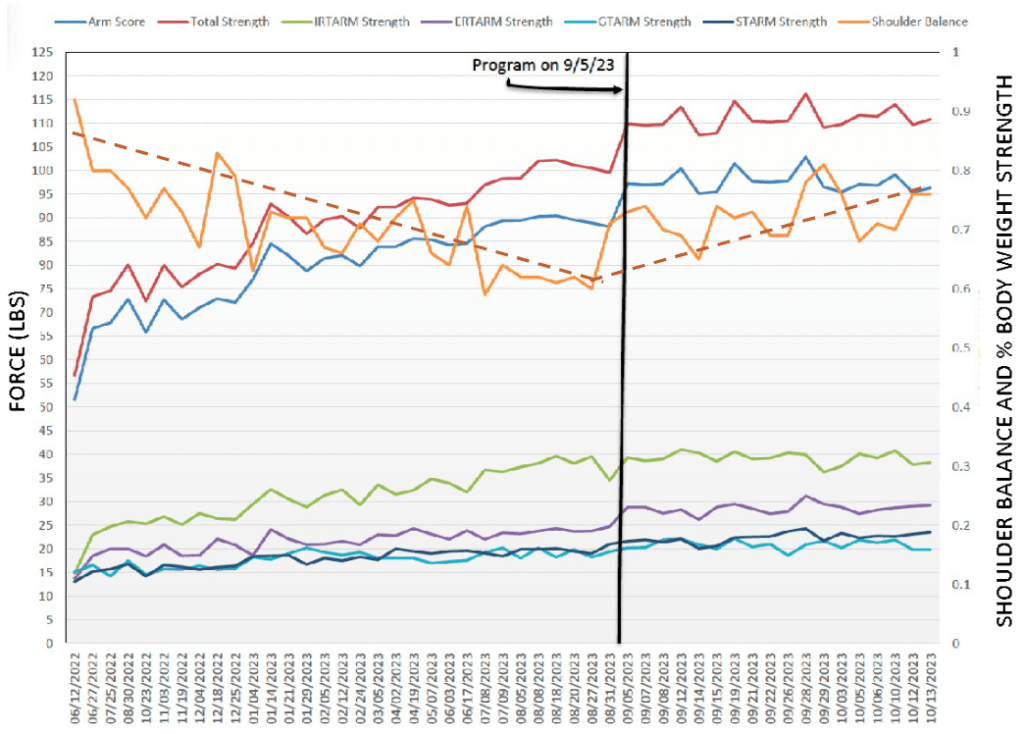

Post-exam trial and error. This is an essential part of coaching – prioritize activation and understand if what you prescribe either under-stimulates or overstimulates throwing arm strength. You don’t want to go to battle with a tired arm. We have taken almost five weeks to refine the process to see these consistent results.
The takeaway of this article is that Lance is truly an ArmCare Elite Member diving deep like this, and you can be too this offseason. You can see the future application of your learning and its impact on your athletes or yourself. For the sake of your child’s arm or your own, the time to be a dual expert is well worth the investment.
For most of you, you have started the offseason. You are ramping up training, but consider becoming a mad scientist and develop novel training, activation, and workload management concepts with every exam you or your athlete takes.