Strength in Numbers #148
In baseball, there is a paradoxical narrative surrounding pitching velocity.
While many voices within the sport claim to prioritize other aspects of pitchability over sheer blazing fastball speed, velocity holds undeniable allure for players, coaches, and teams alike, and with good reason.
In this landscape, individualized arm care training emerges as a critical factor in navigating the delicate balance between performance enhancement and injury prevention – both needed to exist as a high-velocity pitcher.
At its core, individualized arm care training acknowledges the unique needs and limitations of each athlete’s throwing arm.
It recognizes that the pursuit of velocity cannot come at the expense of arm health and longevity. Instead, it seeks to optimize performance while safeguarding against the inherent risks of high-intensity throwing, which requires significant education.
Education that we have recently released with our brand new Certified ArmCare Specialist Course.
Most people will not understand what to do with an athlete who shows this type of data below, and they also will not believe that true transformation is possible after understanding the throwing arm in great detail:

It should be obvious that the above athlete cannot engage in a high-intensity weighted ball program based on numerous strength alerts, shoulder imbalance alerts, and a very low Strength-Velocity Ratio (SVR), meaning his velocity overpowers his arm strength.
Millions of pitchers walk around this earth with metrics exactly like this in high-intensity weighted ball training programs.
People assume the velocity enhancement program or the velocity itself is associated with injury. But they truly do not understand the mechanism of injury until they see numbers like this and intuitively gulp.
It is obvious that the athlete has outgrown his or her arm strength and that the velocity achieved is well beyond the throwing arm’s strength capacity. Millions of arms like this will go under the knife until our platform and education break the cycle.
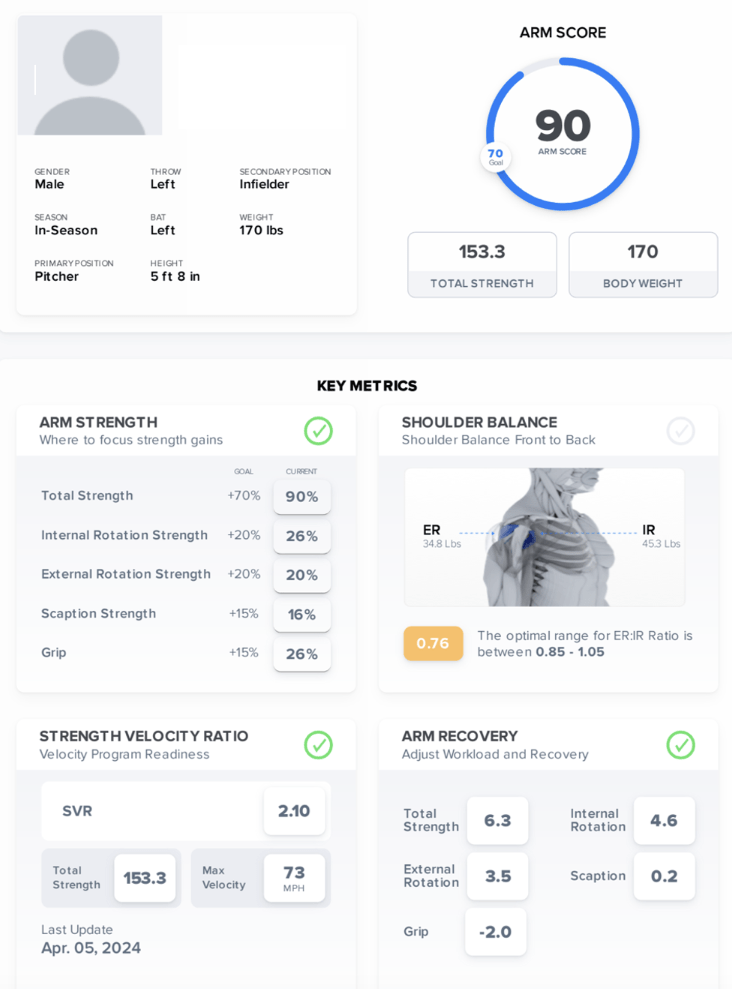
This is the same athlete who gained throwing arm strength in parallel to body weight increases.
According to the previous report, this athlete gained roughly 3 lbs of arm strength per pound of body weight, which translates to a higher ArmScore at 90 compared to 60 when he was 20 lbs lighter. He did not outgrow his arm strength. His SVR was below 1.4 LBS/MPH, but with increased throwing arm strength, it is now 2.1 LBS/MPH.
In both instances, he did not outgrow or outstretch his arm strength, which is why the velocity gains came with extreme safety. In the approach to throwing fuzz, there’s no guessing, only assessing.
HOW ARE TRANSFORMATIONS LIKE THIS POSSIBLE?
By tailoring arm care routines to address specific weaknesses, imbalances, and areas of fatigue, athletes can mitigate the risks associated with velocity enhancement.
This may involve a combination of mobility exercises, strength training, neuromuscular re-education, and recovery protocols designed to optimize throwing mechanics and promote tissue health.
The two-factor SPEAR algorithm is critical to the equation.
You learn how the algorithm works and how to apply it in the new Certified ArmCare Specialist Course.
SPEAR stands for
S- max STRENGTH,
P- POWER,
E- MAX STRENGTH ENDURANCE,
A- ASYMMETRY AND
R- RANGE OF MOTION
This hierarchy of training criteria assists the throwing arm in dominating on the field and gets us closer to eradicating throwing arm injury.
When individualizing arm care training by the Two-Factor SPEAR TRAINING ALGORITHM, Certified ArmCare Specialists acknowledge two critical training modifiers, important steps that, when missed, increase risks to the throwing arm by training in errors in programming.
- SCALE WORKLOAD BASED ON WEAKNESS, FATIGUE, AND POOR RECOVERY
- BALANCE ARM STRENGTH FOR GREATER STABILITY IN ACHIEVING MAX LAYBACK
Individualized arm care training abiding by the SPEAR ALGORITHM emphasizes the importance of proper recovery and workload management.
It recognizes that gains in velocity are not solely determined by the intensity of training but also by the body’s ability to adapt and recover from exertion, knowing when to upload, download, and de-load.
Without objective data, no one has x-ray eyes into the throwing arms neural drive. We need to be specific, or the generalized program paves the way to a hospitalized athlete.
In today’s collegiate and professional baseball landscape, where the pursuit of velocity is essential, individualized arm care training serves as the key to throwing fuzz without throwing in fear.
Empower our athletes to optimize their throwing arm strength, address weaknesses and fatiguability, and provide finite feedback to dial in recovery.
With individualized arm care training, athletes are offered the most direct pathway to sustainable velocity gains and long-term success on the mound by reducing the risk of outgrowing or out-throwing their arm strength.
In the Certified ArmCare Specialist Course, you will learn about muscle irradiation. We test with minimal lower body involvement, concentrating the neural effort by the throwing arm musculature to determine its functional status.
In this example, you will learn a knockout exercise, arm care training done in half kneeling to reduce contractile assistance by the lower body in increasing arm strength.
There are many tips and tricks, and the 10 hours are 100% worth being in a league of your own.
In this time of throwing in fear, we say optimize your arm strength, scale your workloads, and throw more fuzz, mother chucker.
Like I always say…Strength Matters Most,
Ryan