Strength in Numbers #152
In the world of baseball, velocity is a coveted attribute for pitchers.
The bottom line is throwing hard, swinging and missing, and sustaining velocity matters. Achieving higher throwing speeds often translates into greater performance and competitiveness on the field.
One athlete who has successfully increased his velocity did so by enhancing his relative arm strength to body weight ratio, which is shown in the app as the ArmScore.
This remarkable improvement, however, came with a cautionary note: any increase in strength can be risky without paying attention to shoulder balance, as this athlete sustained an elbow injury.
The story of this hero athlete will reveal to you that there is much more than what meets the eye.
JUST BECAUSE YOU ARE STRONG, THAT DOESN’T MEAN THAT YOU ARE NOT AT RISK. PR’S ARE GREAT, BUT HAVING NO ALERTS IS BETTER.
THE CASE
An email response from a parent after we reached out to learn more about an athlete who has made a significant velocity gain while using our product:
Last week, he complained of elbow pain for the first time since rehabbing from an injury two years ago. I was hoping there would’ve been warning signs in his ArmCare.com test results so his coaches could’ve shut him down to avoid injury, but his recent test results were at or near PR levels.
We plan to continue to use the program, but I wanted to make you aware of my concerns, especially around the use of the test as a barometer for potential overuse and injury, which is the aspect that I thought would be of the most value to us.
I learned more context about this injury as this athlete did not have his own device and was testing very infrequently, making trips into a facility to test and then hoping for the best.
Here are some critical messages to take to heart.
1. TESTING INFREQUENTLY LEADS TO MISSED OBSERVATIONS
During my time with the Angels, we had tremendous success creating individualized player development plans based on strength. There were no surgeries on our active MLB roster, a 65% reduction in throwing arm injuries, and our Tommy John cases were reduced to 6 from a running 5-year average of 11 per season.
That said, any throwing arm injuries we did experience generally happened on the road when we did not test strength. Not having your own dynamometer to test frequently causes you to miss observations. Seeing PRs and high arm scores, sometimes two weeks apart, misses the throwing and training responses between those tests, and one straw can break the camel’s back.
2. THE PR DELIMA – WHAT I CONSIDER PRE-CONCEIVED NOTION
So, this athlete has made tremendous gains in throwing arm strength. He went from alerts everywhere to a steady diet of alert-free strength, hitting personal record after personal record after personal record, which we call “PRs.”
His ArmScore climbed with the velocity, which is what we want to see that tool his Strength-Velocity Ratio (LBS/MPH) from 1.55, which is below our standard to 2.15.
Overall, he started with 121 lbs of strength, and most recently, he achieved 185 lbs of total strength, a nearly 65 lbs dumbbell increase in throwing arm strength, which is awesome.
However, as the PRs amassed and the alerts on strength went away, the shoulder balance ratios plummeted for many weeks and never became alert-free from the moment the athlete tested his strength.
THE AUTOPSY
Opening Exams
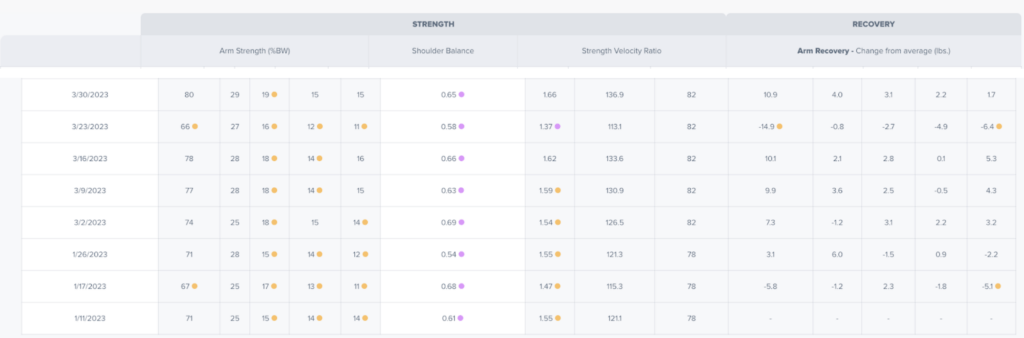
Here are the opening exams. Virtually everything had alerts. This athlete had a large body relative to throwing arm strength, and early on in the season, there is a great opportunity for microdamage to start if throwing programs don’t take a back seat to strength improvement.
MOST RECENT EXAMS
INJURY CONTRIBUTOR #1: UNRESOLVED SHOULDER BALANCE
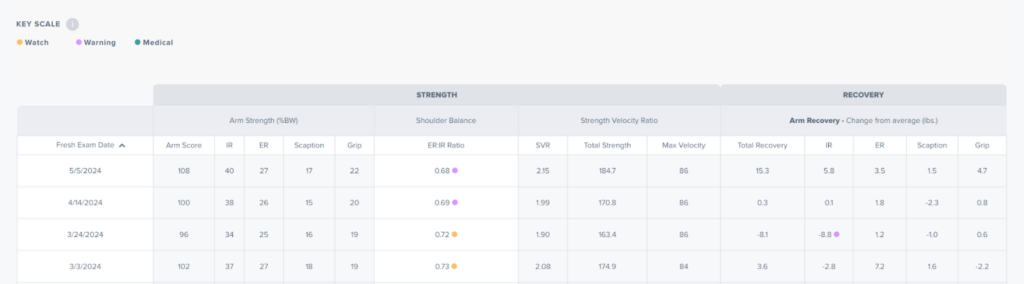
Here’s where the digging gets more concerning. There are no alerts on arm strength. You can see he hit a PR in his last exam before the injury but look at the dates.
Almost a month goes by between the March 24th and April exams and again on the May exams, which is too much time between missed observation and increased microdamage risks.
You will also notice a recovery alert in internal rotation strength, which is problematic for accelerating the arm forward and decelerating the throwing arm in layback. This can put more bend on the catapult’s hinge, heightening stress.
This athlete was in trouble from the beginning because his shoulder balance scores ranged from purple to amber.
The muscles on both sides were not in an optimal range of 0.85-1.05, as he was much stronger in IR relatively, which affects shoulder positioning, as muscles on either side cannot co-contract well, leading to increased elbow bending in maximum layback.
Alas, the shoulder imbalance reared its ugly head.
Check out this video for deeper perspectives on shoulder imbalance and injury risk.
INJURY CONTRIBUTOR #2: A MYSTERIOUS RECOVERY ALERT
Last week’s Strength in Numbers discussed stress-shielding issues for grip strength.
When you lose IR strength, the forearm has to handle more. There was a definite risk of injury when this athlete had a warning recovery alert on the IR strength exam on 3/24/24.
Note that this athlete lost almost 9 lbs. That is a significant amount of strength to lose, and remember, your throwing arm is a catapult, and the only muscle that controls the layback speed and helps decelerate the arm going back is your internal rotators.
If they are weakened, the grip strength has to do more to prevent overload on the hinge of the catapult, which is your ulnar collateral ligament.
Your forearm is the spring that stabilizes the hinge. If the arm speed going back increases, the springs have to work harder, and if they fatigue or get microdamaged, the hinge is at risk.
There’s no way to see what happened to grip during that time as there was more than a week between testing, so it’s possible that things started to take a downward turn.
Please see this video clip on layback position and arm speed from our ArmCare Elite Education, a specialized course offering for dual-certified members:
THE POST-EXAM OR LACK THEREOF
We are in trouble here. This athlete has no idea how his arm is responding to throwing workloads. He has no barometer regarding where to scale down or where to increase the workload to increase capacity.
It’s quite possible that the muscular imbalances are caused by the inability to recover the external rotator cuff, a muscle that may be more fatigued during throwing.
This perpetuates increased internal rotation strength until the internal rotator cuff strength becomes more fatigued and then shows up as a recovery warning.
THE SYNOPSIS
While it is awesome to see velocity and strength increases, we cannot overlook three major underlying factors involved in this injury that could have been prevented with more regular testing.
(I suggest at least twice weekly, as communicated in our courses on Data-Led throwing programs and pitching management).
Here are important take-home messages:
- DON’T MISS EXAMS. THAT MEANS TESTING REGULARLY EACH WEEK AND PERFORMING POST-EXAMS TO DETERMINE HOW FATIGUING YOUR THROWING PROGRAMMING IS SO THAT YOU CAN INCREASE STRENGTH AND REDUCE THE FORCE OVERLOAD RISK OF OVERUSE THAT IS PERPETUATED BY LOSS OF STRENGTH THAT INCREASES RISK TO MUSCLES, TENDONS, AND JOINTS. WHEN ATHLETE’S HAVE THEIR OWN DYNAMOMETER AND TEST REGULARLY, RISKS SIGNIFICANTLY REDUCE WITH LESS MISSED OBSERVATIONS.
- DON’T FALL IN LOVE WITH THE PR. YOU NEED ALL THE FACTS. BECAUSE THE THROWING ARM IS STRONG, IT DOESN’T MEAN IT’S NOT VULNERABLE OR SUSCEPTIBLE TO INJURY. AS YOU CAN SEE IN THIS CASE, THIS ATHLETE HAD A CHRONICALLY UNBALANCED SHOULDER, NO INFORMATION ON HOW THE THROWING ARM FATIGUES, OR WHAT MUSCLES ARE MOST EXPOSED TO FATIGUE. IN THE END, THE ARM WAS REVEALING IT WASN’T RECOVERING.
- TO DESIGN AN OPTIMAL PLAYER DEVELOPMENT PLAN, PROGRAMMING NEEDS TO BE INDIVIDUALIZED AND ADAPTIVE. FOR THIS PARTICULAR ATHLETE, THERE IS NO OPPORTUNITY TO PIVOT WHEN THE THROWING ARM IS FATIGUED OR NOT RECOVERING, AND THERE’S NO INFORMATION RELATED TO REDUCING THROWING VOLUME, COMPETITION, OR ALTERING TRAINING TO REBALANCE THE THROWING ARM. WITH ALL THE FACTS, ATHLETES WILL BE ABLE TO USE THE MONITORING DATA TO CUSTOMIZE THEIR THROWING PROGRAMS AND PITCHING APPROACHES WHILE TAKING ADVANTAGE OF DATA-LED ARMCARE TRAINING IN THE APP.
BOTTOM LINE – THIS ATHLETE DID NOT OUTGROW HIS ARM STRENGTH, AND HE DID NOT OUTTHROW HIS ARM STRENGTH, BUT HE DID OVERTHROW HIS ARM STRENGTH WITH MORE VOLUME ON AN ARM THAT IS IMBALANCED AND NOT RECOVERING TO THE BEST OF ITS ABILITY.
STRENGTH MATTERS MOST, AND MONITORING STRENGTH FREQUENTLY MATTERS MORE THAN ANYTHING.
Ryan