Strength in Numbers #179
With the successful launch of two of our new ArmCare Accelerators this weekend, skill coaches, strength coaches, athletes, athletic trainers, physical therapists, and baseball enthusiasts learned some new concepts, challenged beliefs, and were comfortable with being uncomfortable.
We contested conventional player development and injury prevention thought processes – shared facts, practical experience, and failures to substantiate these ideals:
- Generalized Pitch Counts are Pointless
- Poor Coaching Decisions and Missed Observations are the Root of All Injuries
- Athletes Can Throw More Than Ever, Faster Than Ever, and Longer Than Ever
- Maximum Arm Strength is More Important Than Range of Motion
- Incomplete Rehabilitation is Overcome by Early Maximum Strength Training
- Biomechanical Normative Ranges Make No Sense and Cause Injuries
- Velocity Is Not the Cause of Injuries – It is the Irresponsibility in Association
- Fatigue-Testing is Essential After High-Intensity Pitching and Throwing Bouts
- There’s Too Much Insanity as It Relates to the Term, “Efficient Delivery”
- Your Eyes are Lying to You and What You Feel Isn’t Real
Each of our Accelerator events is authentic. We continually expand our knowledge base. With each test and application, we identify better ways to execute actionable decisions and evaluate how approaches improve or reduce high performance using the ArmCare platform.
Getting ahead of the curve is all about receiving new information and applications. Learning from those who have tested theories to advance the game is a key element of our Accelerator education. Learn from our trial and error and big wins, and accelerate results with your players and teams.
In delivering new information, I have been working with a lot of two-way players lately, and Spring Training is right around the corner. This is a perfect time to share some interesting sports science perspectives in this week’s Strength in Numbers from the work of Jose Antonio Rodriguez Martinez – one of my doctoral students at Auckland University of Technology – Sport Performance Research Institute New Zealand and a thought leader on curvilinear sprinting.
Take a moment to read this article and get ahead of the curve on sprinting curves. The two-way player must score runs and cover bases. The fastest way from A to B is a straight line, but it’s not so straightforward when A and B are first and third base, or you need to cover first base on a ground ball to the first basemen.
ALWAYS START WITH A QUESTION
We asked a question – what are the differences in linear and curvilinear sprint abilities amongst baseball players?
The answer after scouring reams of Statcast data gave us a clue on how much time we should we spend on straightaway speed and linear acceleration in improving on competitive running performance.


When it comes to KPIs for scoring expectancy, Competitive Runs, is the process metric that is evaluated to determine the extent and number of times a sprinting event occurred that was high intensity and consequential for scoring runs for each player.
The definition is below:
Competitive Run: The speed range from 23 ft/second-1 as poor to 30 ft/second as elite and the base runner needs to run at least ten times within this range to be indexed in the dataset.
What was found interesting was that athletes with more competitive run totals were not the fastest. This means competitive baserunning is more skill than pure linear speed, and we cannot ignore the importance of integrating curvilinear sprinting into the mix of training for our athletes.

BASIC MECHANICS CONCEPTS ASSOCIATED WITH CURVILINEAR SPRINTING
Due to the curved trajectory, the body experiences unique physical forces in curvilinear sprinting. These forces influence body position, ground contact mechanics, and muscle activation patterns.
Key Features of Curvilinear Sprinting:
1. Centripetal Force: Athletes generate centripetal force to maintain their path along the curve. This force is produced primarily through the outside leg (the leg farther from the curve’s center), which applies more force during ground contact.
2. Body Lean: Runners adopt a slight inward lean to counteract the outward “pull” caused by centripetal acceleration. The degree of lean increases with tighter curves or faster speeds.
3. Asymmetrical Stride Lengths: The inside leg (closer to the curve’s center) covers a shorter distance than the outside leg, leading to asymmetrical strides.
4. Foot Placement: In curvilinear sprinting, the foot’s placement often shifts slightly inward relative to the body’s center of mass to maintain balance.
5. Muscle Activation and Joint Mechanics:
- The hip abductors and adductors play a larger role in stabilizing the body during curves, as they control lateral motion.
- Greater demands are placed on the outside leg’s glutes and quadriceps to produce force and maintain speed.
- Ankle and knee stabilization is critical, as uneven force distribution in the lower limbs can increase injury risk and direct the player off course.
Comparing Linear and Curvilinear Sprinting
Linear sprinting, as seen in 100m races, contrasts significantly with the mechanics of curvilinear sprinting, typical in 200m sprints or baseball base-running. Below is a theoretical breakdown of what is assumed to be seen among base runners:
| Feature | Linear Sprinting (H-1st Base) | Curvilinear Sprinting (1st – 3rd Base) |
|---|---|---|
| Trajectory | Straight line | Curved path |
| Stride Symmetry | Symmetrical stride length and force output | Asymmetrical stride length and force output |
| Force Application | Uniform across both legs | Greater force on the outside leg |
| Body Position | Upright with slight forward lean | Inward lean toward curve’s center |
| Muscle Activation | Balanced contribution from both sides | Greater lateral stabilization demands |
| Speed Loss | Minimal deceleration | Speed slightly reduced due to curve dynamics |
HOW TO IMPROVE CURVILINEAR SPRINT MECHANICS
To optimize curve-running performance, athletes should focus on targeted strength, technique, and coordination drills:
- Strength Training:
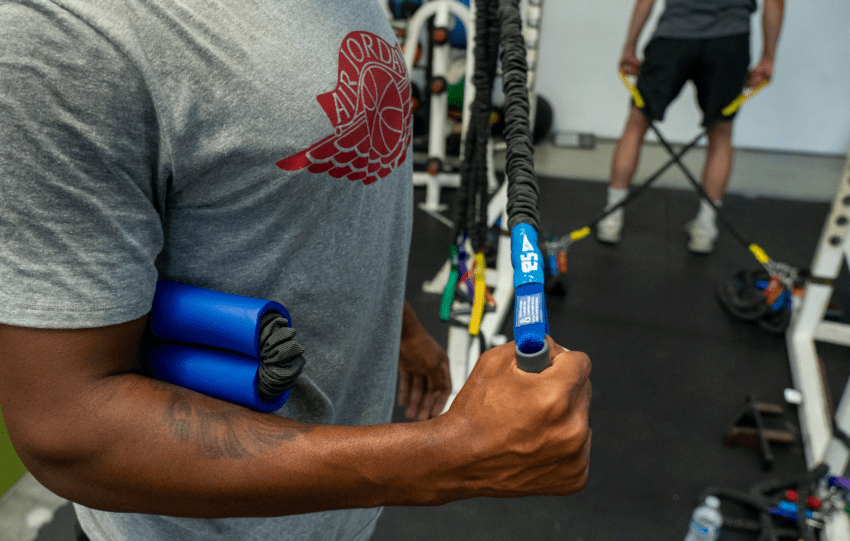
- Lateral Stability Exercises: Strengthen hip abductors and adductors with lateral lunges, single-leg squats, and side planks to improve balance and control during curves. The Hip and Core Band is perfect for this.
- Outside Leg Power: Train the outside leg to produce greater force using single-leg step-ups, sled pushes, and lateral bounds.
- Technique Work:
- Curve-Specific Sprint Drills: Practice running tight curves on a track or around cones, emphasizing smooth transitions and proper leaning.
- Foot Placement Drills: Train for precise foot placement by running figure-eight patterns or curved ladder drills.
- Single Leg Lateral Plyometrics:
- Incorporate plyometric drills with lateral body control elements with short ground contact times for proprioception and reflexive force applications.
/
Single Leg Lateral Line Hops Forward Video
OVERALL BENEFITS FOR IMPROVED CURVILINEAR SPRINT ABILITY
OVERALL BENEFITS FOR IMPROVED CURVILINEAR SPRINT ABILITY
In baseball, curvilinear sprinting is crucial in base running, outfield coverage, and defensive plays. Efficient curve-running mechanics can:
- Reduce time taken to round bases, improving scoring potential.
- Allow outfielders to cover ground quickly while maintaining balance.
- Minimize energy loss, allowing players to sustain high performance throughout a game.
- Cover first base for success on consequential plays that involve the pitcher as a fielder.
FINAL THOUGHTS
Curvilinear sprinting requires unique biomechanical adaptations that differ significantly from linear sprinting. By understanding the forces and muscle activation patterns involved in running curves, athletes can train more effectively and reduce injury risks.
Jose’s work will give more insights into the trainable aspects to help negotiate rounding the bases.
Mastering these mechanics is essential for baseball players to improve base-running efficiency and overall performance. With targeted strength and technique training, players can build the stability, power, and coordination necessary to excel in curved trajectories, enhancing both their athletic potential and durability on the field.
Stay tuned for more new insights as we go nationwide to educate and help the baseball community integrate a data-led approach that challenges the status quo.
Stay ahead of the curve or fall off it.
Strength Matters Most,
Ryan@armcare.com
Ryan