Strength in Numbers #218
Baseball performance is not just about how hard you can throw—it’s about how well your body coordinates force from the ground up and how strong your arm is to handle it.
An optimized delivery means it is efficient – you can do more with less. More velocity with less loading, more velocity with less stretching out of your tissues, more innings with fewer pitches because you have command, and more strength versus the loading placed on your arm.
But how do you get there?
In this week’s Strength in Numbers, we are going to share some important nuggets – first, how you can diagnose movement issues and strength measures, and some important nuggets on how to execute on programming.
The blend of strength assessment and motion analysis forms training that influences the delivery positively – BUT….you need to observe pain and poor performance in your athletes, or you could destabilize the natural delivery and cause more issues by taking a coaching direction that could lead to greater fatigue, loading that could impact velocity and command.
Enter more detailed information about strength and coordination training, the foundation for protecting athletes, promoting performance, and enhancing velocity without putting them at risk.
What is Strength and Coordination Training?
Strength and coordination training combines the development of contractile tissue capacity (your muscles’ ability to generate and absorb force) with the refinement of movement sequencing (the timing and rhythm of how your body delivers energy) and the kinetic chain (the transfer of forces from toes to fingertips).
The Certified Pitching Biomechanist Course is built around these concepts. You don’t need a PhD to master them—you’ll learn how to:
- Diagnose movement profiles using objective data.
- Identify compensations that arise from fatigue or poor mechanics.
- Adapt training to re-stabilize a player’s motion.
- Program throwing athletes based on metrics that signify delivery optimization.
This is coaching beyond guesswork. It’s using science to stop problems before they start.
In the electronic course, we delve into detailed analysis, connecting quantified data with what we can see in slow-motion video – the ability to visualize, actualize, and realize that you have the power to integrate strength monitoring with motion capture. We walk you through how to improve things like hip-shoulder separation and how to sync up the pelvis and trunk in a more optimized way.
First Optimization Factor: The Strength-Velocity Ratio
The Strength-Velocity Ratio (SVR) is the cornerstone of safe velocity development. SVR measures throwing arm strength (lbs) per miles per hour of velocity. If your strength-to-velocity is low, your body relies too heavily on the stretch-shortening cycle—stretching ligaments, tendons, and fascia (the connective casing around muscles) beyond their limits.
Without enough contractile strength:
- Pitchers lean excessively with their trunk.
- Trunk rotation accelerates too fast during the layback to release.
- The arm gets pulled back harder and faster, increasing torque on the elbow and shoulder.
This is why poorly designed velocity-enhancement programs are dangerous—they accelerate an athlete who simply doesn’t have the strength foundation to tolerate the forces.
Our benchmark is 1.6 pounds per mile per hour of throwing velocity. Given that you check out with our ThrowFuzz Checklist, you may be approved for high-intensity velocity enhancement training with weighted baseballs. Ideally, shoot for 2 lbs per mph of throwing velocity. At this threshold, athletes can withstand tension safely, explosively decelerate, and redirect energy efficiently.
Fascia is the web-like casing that surrounds muscles, transmitting force between body segments. When pitchers lack contractile strength, fascia and passive tissues, such as ligaments and joint capsules, absorb too much load, heightening the risk of breakdown. SVR ensures that dynamic tissues, not passive structures, bear the workload.
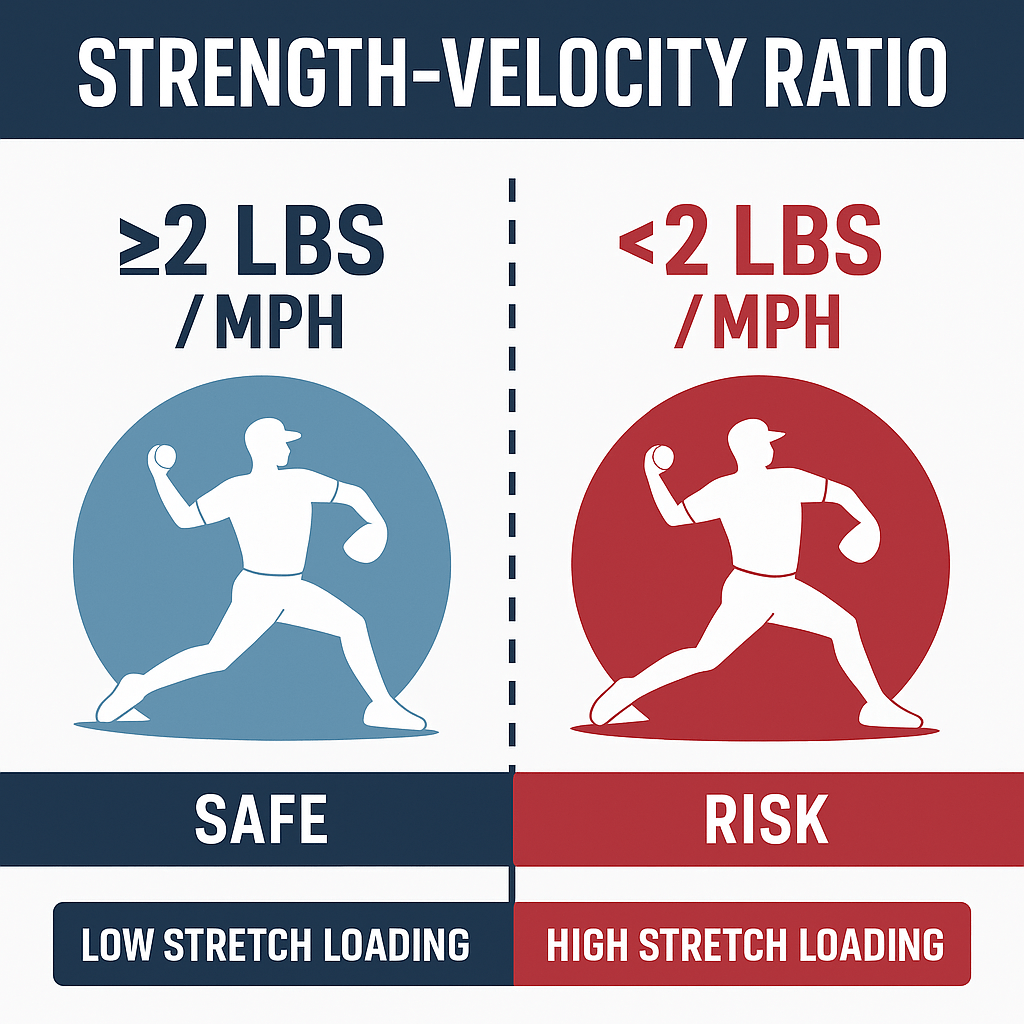
Download our Velo Checklist and make the apex measure for velocity enhancement to be the SVR. We can promote greater safety by raising it to 2.0 or higher. This reduces the loading on passive tissues, such as your UCL, and increases absorption from muscles and tendons that overlay these sensitive structures during high-velocity movements. Time to get on your max strength work for your arm.
The Dual Certification Advantage
Our education identifies key features associated with fatigue that can lead to pain and poor performance. Motion analysis, combined with an understanding of key arm strength analytics, enables coaches, parents, and players to be more detailed in their approach to player development and injury prevention.
Pairing the Certified Pitching Biomechanist Course with the Certified ArmCare Specialist Course is the ultimate way to elevate your coaching and uncover many insights. Together, these certifications allow you to:
- Measure objective strength data with precision.
- Understand movement compensations that destabilize mechanics.
- Individualize programs with scientific accuracy.
When you integrate both—strength analysis and biomechanical evaluation—you gain the ability to detect issues early, prescribe the right interventions, and lead athletes to safer, more explosive performance. You also become an ArmCare Elite Member, which gives you access to additional courses, totaling nearly 40 hours of education.
The information in this video emphasizes the importance of understanding key fatigue-induced compensations that drive increased loading to the throwing arm, potentially causing the pitcher to become too variable and leading to overuse and loss of command. Layer in the ArmScore, and you have a good understanding of how changes in the throwing arm or strength-to-body-weight ratio can alter movement patterns for pitchers.
Strength + Coordination = INDIVIDUALIZATION + OPTIMIZATION
The future of baseball development is hyper-personalized. With dual certifications, coaches, therapists, and players will have the tools to protect arms, optimize mechanics, and build careers that last.
Take advantage of our current offer, where you can receive two certifications, an ArmCare Elite Membership, and access to a variety of content for the price of one certification.
To get in on this offer, please reach out to Jordan Oseguera, our Director of Pitching Performance/Director of Sales at jordan@armcare.com.
Strength Matters Most, and there is STRENGTH IN NUMBERS.
Join Us this weekend!
Ryan
Ryan@armcare.com