Strength in Numbers #225
In last week’s Strength in Numbers, we went through the history of weighted ball training, the risk-reward aspects of it, and directed you to our Velocity Checklist. The big picture theme is that baseball players, regardless of whether they are a pitcher, catcher, or position player, must test their arm strength.
If you are considering velocity enhancement, you may be amazed at what strength gains can do, even before considering using underweight or overweight balls. Although we highlight the strength aspects, there’s also considerable room for improvement in delivery mechanics.
In our Certified Pitching Biomechanist Course, we indicate how to evaluate the delivery across various optimization factors – Strength-Velocity Ratios, Pitch Efficiency Ratios, Biomechanical Efficiency Ratios, and Stress-Shielding Ratios.
We need to start combining our understanding of strength and coordination, and learn how to make the right mechanical adjustments at the right time – we must recognize when pain and poor performance occur.
Be very careful about disrupting motor preferences – the preferred ways of moving. However, if you have an athlete who is not performing well or has consistent pain, you must start by addressing strength and length, as well as the balance between throwing arm force and range of motion.
After correcting the arm, target training will help establish new motor pathways, leading to greater success in making mechanical changes.
Let’s dive into mechanical features related to release speed, right here, right now.
Key Mechanics for Velocity Enhancement
Mechanical features are related to increased release speeds in baseball pitchers. It is essential to understand that any factor that increases throwing arm mass, acceleration, or both can increase loading on the shoulder and elbow.
Cannot stress enough that you must evaluate your pitchers’ arm strength, shoulder balance, recovery, and post-pitching fatigue when making mechanical changes. Adjust your programming strategy if you notice a decline in metrics.
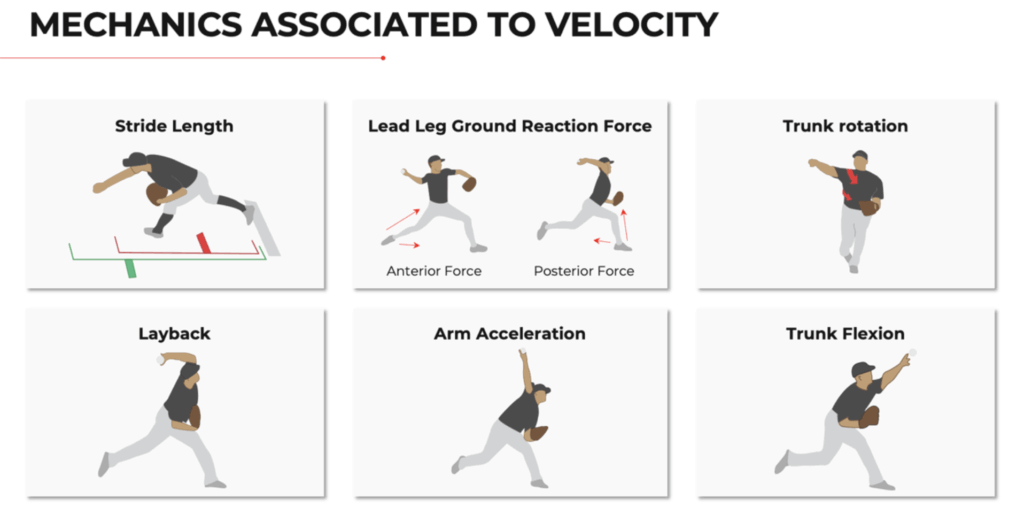
Key mechanical influences on throwing velocity. It is essential to note that with increased ball speeds resulting from enhanced movement properties, joint loading can also increase.
It’s always a good idea to test the throwing arm consistently throughout, making any necessary mechanical adjustments as needed. If the player is performing well and pain-free, reconsider making any mechanical changes to avoid disrupting motor preferences.
1. Stride Length & Lower Extremities
- Pitchers who stride ~80 %+ of body height tend to achieve higher velocity without increased elbow varus torque (ref).
- Absolute stride length correlates more with velocity than relative (% body height) length in collegiate pitchers (ref).
- Lower-extremity mechanics (hip, knee, ankle extension) set up both translational momentum and timing for rotation (ref).
- Be aware that pitchers are great compensators and may raise velo when strides shorten through accelerating rotation – DO NOT USE VELOCITY TO DETERMINE FATIGUE AS THE RADAR GUN LIES, BUT YOUR ARM WILL NOT (ref)
- Stride length may increase velocity, but changes in stride lower arm strength (ref)
Takeaway: Optimize a long, stable stride, but ensure that timing and lower-body strength (hip/knee/ankle extension) support the load. Integrate arm strength testing to denote a potential change in stride length.
Our unique course on Velocity Enhancement highlights key features related to stride length and throwing harder. A good goal is to have a stride length that is 80% of your height; however, this is not an absolute rule, and any changes should be individualized and monitored for adjustments in throwing arm strength.
2. Ground Reaction Force (GRF)
I often get questions about whether a pitcher jumps or not jump off the rubber, does the lead arm push, or pull from above? Research in this area using force plates is the way to go. Each pitcher is different, but the amount of force and its direction are crucial, and you do not have to be a “drop and drive” or “tall or fall” pitcher to effectively launch the center of mass forward or slam on the brakes with the lead leg.
Every pitcher is different, and each pitcher needs to be optimized for strength and coordination – we delve into this in depth in our certified courses.
- Research shows the lead (stride) leg braking forces are strongly predictive of ball velocity (r² ~ 0.45-0.61) in adult pitchers (ref).
- In one study, pitchers generated ~0.35 body-weight shear push-off force with the drive leg and ~0.72 body-weight braking force with the stride leg (ref).
- Effective GRF means the lower body initiates energy transfer; weak push or poor braking forces force the arm to compensate.
Takeaway: Train lower-body power and coordinate push-off and lead-leg braking to provide the arm with a stronger platform.
Our unique course on Velocity Enhancement highlights key features related to ground reaction force relationships for throwing faster.
3. Pelvis and Trunk Rotation
- A study examining pelvis velocity, trunk velocity, and hip-shoulder separation accounted for ~55% of trunk rotation variability, which in turn predicts ball velocity (ref).
- Proper “hip-shoulder separation” (torso still while pelvis rotates) builds elastic energy. Poor timing reduces arm efficiency (ref).
- Early trunk rotation (before efficient hip rotation) is linked to greater shoulder/elbow stress and may reduce performance (ref).
Take-away: Maximize pelvis rotation velocity, maintain hip-shoulder separation, and time trunk rotation correctly to free the arm’s speed. Again, if trunk rotational velocity goes up, there’s a tendency to raise elbow and shoulder forces, so boost arm strength and test for deficits.
4. Shoulder Mechanics
- The shoulder’s internal/external rotation and scapular mechanics are pivotal for translation of trunk energy into the arm.
- Late-cocking position (max external rotation) should coincide with proper trunk deceleration and arm acceleration; misalignment raises stress.
- Efficient scapular upward rotation and posterior cuff activation minimize wasted motion and preserve arm launch velocity.
Take-away: Strengthen and stabilize the shoulder complex (rotator cuff, scapula, posterior chain) so that the arm is ready to accept high velocity transfer from the trunk.
Increased trunk rotational speeds can increase throwing velocity but tend to increase joint loading. Similarly, you could have a significant problem if you crank back on the shoulder and make the joint hypermobile. The key is to match the strength and length of the tissues. When it comes to layback, focus on thoracic mobility and release restrictions in the pecs and latissimus dorsi to allow the arm to load more behind the pitcher.
5. Arm Acceleration – Elbow & Wrist/Hand Release
- The elbow must resist valgus/varus torque while the wrist and hand finish the whip of the kinetic chain. Higher wrist velocity correlates with higher pitch speed (ref).
- Skilled pitchers achieve high forearm supination speed and maintain stable elbow posture, minimizing wasted movement and reducing the load on passive tissues.
- Hand and wrist mechanics (release point, wrist snap) ultimately convert the kinetic chain’s energy into ball speed and spin.
- Biceps muscles have to be strong to handle higher elbow extension speeds
Take-away: Don’t neglect elbow and forearm strength, wrist-hand speed, and efficient release mechanics—they are the final link where all earlier energy gets converted into velocity. Otherwise, do not be afraid to do biceps curls if they are focused on lengthening and elevated to the shoulder.
This practical section from the Certified ArmCare Specialist Course demonstrates how and why biceps training in shoulder elevation is performed, as well as the importance of tempos in enhancing muscle contraction. Increase resistance by stepping further away from the attachment points.
6. Trunk Flexion
- More forward trunk flexion at ball release is linked to higher velocity. Studies show pitchers who achieve greater forward trunk tilt at release tend to throw harder, likely by shifting the COM forward and improving energy transfer to the arm (ref)
Take-away: Too slight, mistimed, or misdirected trunk flexion can elevate joint torques. Insufficient forward tilt at release—or trunk motions that peak too early—are associated with reduced velocity and higher shoulder/elbow kinetics, increasing injury risk.
Summing up The Velocity Chain
We often hear about the kinetic chain – an intersegmental transfer of forces from the ground to the fingertips. However, there is a velocity chain that is more telling, as the segments sum up to higher speeds when they move from heavier segments to the lightest segments. From the ground to the glove, velocity is generated by a sequence:
- Ground push-off & lead-leg braking create the initial force.
- Stride & hip-trunk rotation translate that into rotational speed.
- Shoulder & scapula mechanics redirect that rotation into the arm.
- Elbow, wrist, and hand convert that into ball speed.
- Trunk flexion allows the arm to move forward by taking the most significant mass in the body to the home plate.
Imbalances or timing mistakes in any link reduce velocity potential—or worse, shift load to weak links (e.g., elbow/shoulder), increasing injury risk.
For coaches and athletes serious about throwing harder, the focus must expand beyond movement mechanics and blend both strength assessment and coordination training so that timing, strength, and sequencing can produce elite velocity with less risk.
NEVER FORGET! THE AVERAGE PITCHER RAISES ELBOW JOINT LOADING BY 1 UNIT WITH EVERY 1 MPH INCREASE.
Test your athletes’ throwing arms routinely, and if velocity enhancement is on the radar, continue to monitor their strength to ensure that their throwing arm strength increases while their ball speed rises.
This is the beauty of the STRENGTH-VELOCITY RATIO – the key ratio that indicates an athlete’s pounds of throwing arm force relative to their miles per hour in throwing velocity. If you haven’t already, download our Velocity Checklist to understand better how to maximize velocity enhancement performance while minimizing risks.
Although mechanics are essential, when it comes to increasing velocity safely……
Strength Matters Most Folks!
Ryan
Ryan@armcare.com