Strength in Numbers #167
Return-to-Performance (RTP) is my forte, and I enjoy it.
I work with athletes of all ages, positions, competitive levels, multi-sport, and sport-specialized varieties. Still, the part that requires the most creativity, adaptability, and dynamic adjustments is when athletes have gone through hell with their arm and picked up the ball for the first time.
I like the complex cases and athletes with multiple surgeries, major pain, significant loss of finances, and opportunities that most drive me.
I like downright awful situations, the kind of cases that people do not want to touch. We fix these athletes by building a team around them and using a data-led process to be better than ever before.
In this newsletter, I will share a few of my best tips for getting guys on the right path and transitioning them from injury clearance to return to throw to the show.
I am also sharing the journey of a player who has overcome all odds and went from being unable to pick up 3 lbs (could not do the scaption test due to overhead pain) to producing over 300 lbs of arm strength.
Arm injuries held him out after three years and cost him two scholarships.
In 2023-2024, he worked hard and earned another collegiate opportunity, but he was stuck at the JV level for the season as there was still more work to be done on the mound.
That said, he did the unthinkable. Performance advisors in my firm taught him to play first base, helped him at the plate, improved his mechanics on the mound to be an LHP reliever, and, with his determination, he recently tried out for the Chicago Cubs. That fact alone is pretty remarkable.
YOU NEED TO SEE ALL BLUE
Our app is color-coded for a reason. Athletes need to be committed to the app even when cleared by a physical therapist or athletic trainer.
Players recovering from TJ surgery should be doing full Fresh Exams as soon as they are cleared to grip. However, we focus on the shoulder beforehand if that region is unaffected.
We need to fix throwing arm function before throwing arm form. In other words, mechanics are second to fixing weak links in the throwing arm.
Here’s where I am concerned…
I have worked with physical therapists from all over the country who serve our athletes. They are all very talented and not the norm. We prioritize strength, and some of them are very aggressive about training. Early on, they cause muscle damage before throwing to build tolerance.
Combined with their approaches and focused training that reduces muscle irradiation to the arm (other body parts assisting the arm in activating the rotator cuff and grip), as well as cross-education training (unilateral training focus for the arm initiated by glove arm training), the later stage in the rehabilitation has serious momentum.
It is fun to see strength numbers rise quickly and work collaboratively with people I trust and who trust in a data-led process.
However, a recent research study on baseball physical therapists has scared me to no end. As a sample, it reveals that physical therapists in baseball do not prioritize strength, meaning it does not matter most.
This is one of the factors associated with setbacks in rehabilitation (I know because I have seen many). The inability to develop capacity and stress tolerance before picking up a ball is 100% why we have re-injuries amongst pitchers during the first few months of competition. Read the interpretation of the graph below published on baseball physical therapists of all ages and competition levels.
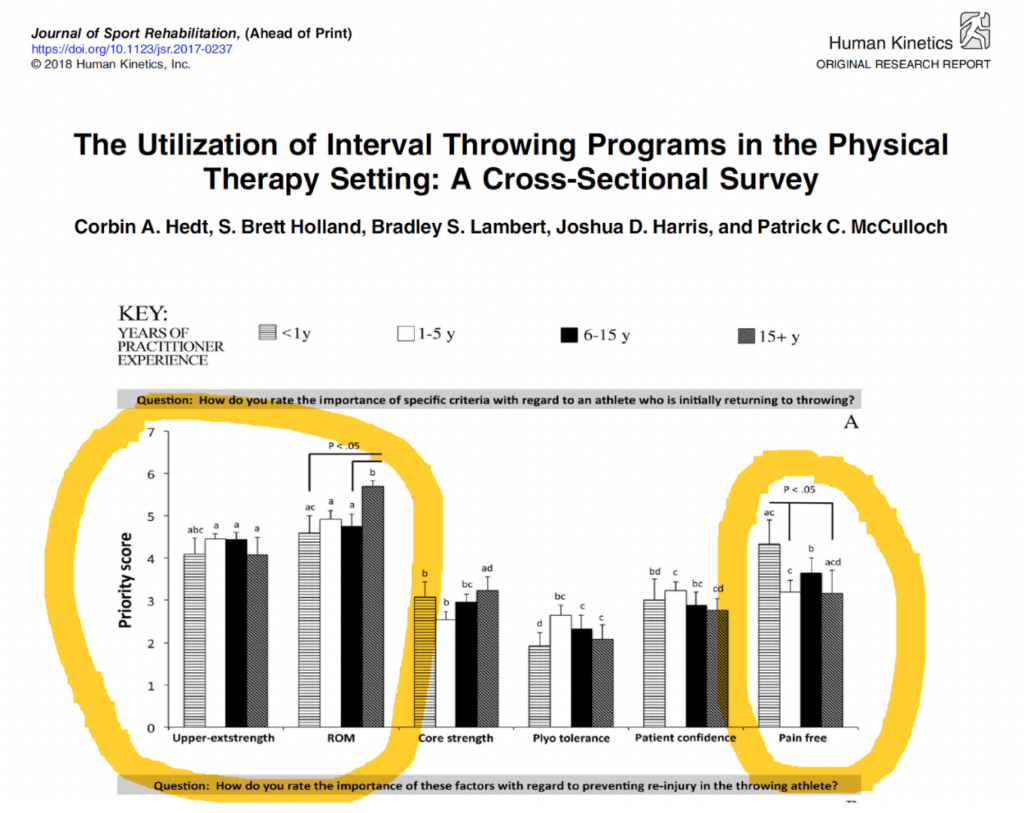
From looking at this data, we have a major problem—one that creates a vicious injury cycle when we overprioritize range of motion, undervalue strength, and send athletes back out throwing when they are in pain—a cause of altering the throwing motion and loading on the shoulder and elbow. WE NEED TO CHANGE THIS IMMEDIATELY.
MEET STAN THE MAN
Stan King is a player who came to me who could not lift his arm.
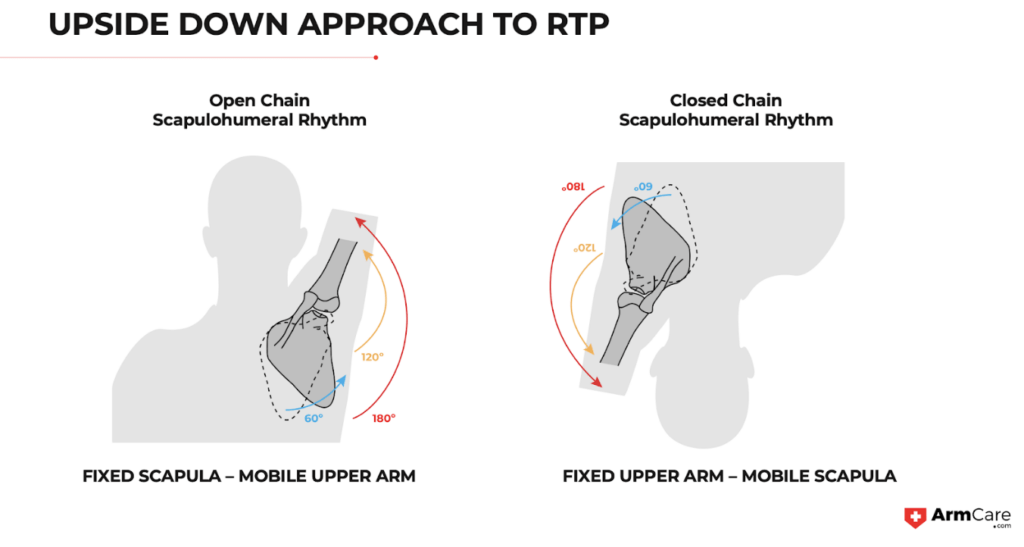
He had gone to multiple physical therapists, had plenty of imaging (to the point stating that MRIs make him feel cozy and can sleep through an MRI), and literally could not hold a 3lbs dumbbell over his head without pain (an indicator to me that could be scapulothoracic than scapulohumeral).
For me, this initially looked like a serratus-lower trap issue that we attacked with inverted co-contraction training. His wrists are not sensitive to extension, so we put his hands on the floor, and viola!
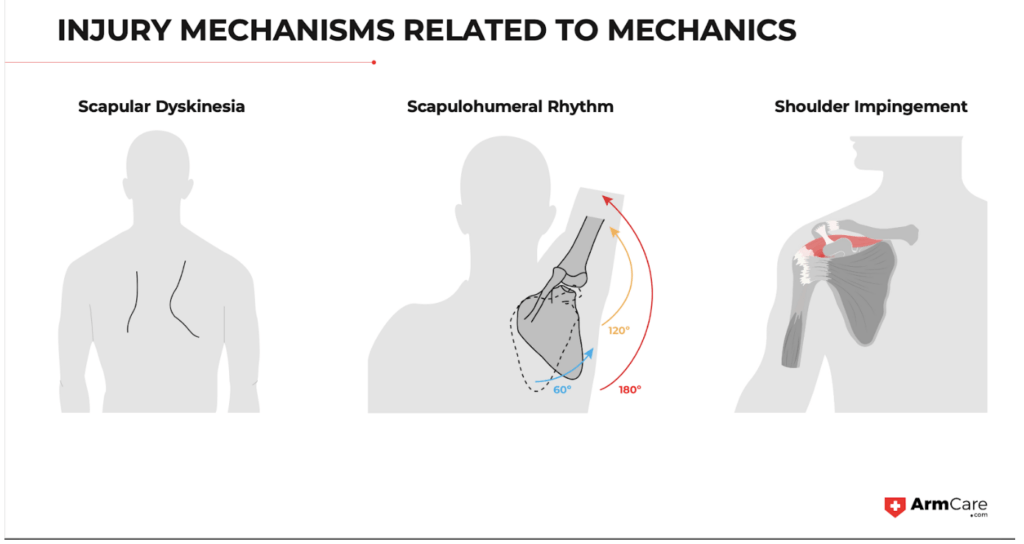
There are two types of actions for the upper and lower extremities. An open chain means that the segment is freely moving around in space. Throwing a baseball is an open-chain movement for the arm. Closed chain is when there’s ground contact, like a push-up, but in the case of Stan, in one session, we took him where he could tolerate by tricking his neuromuscular system into an improved scapulohumeral rhythm.
He cannot lift his arm in the air with force, so he’s open chain contraindicated, but if I thought if I tried to get his arm overhead on the floor, he might not be closed chain contraindicated, meaning he may not have pain with the activity.
Every case is different, but working with Stan, we found what worked for him in just one session to promote strength and re-educate his scapulohumeral rhythm.
4S ACTIVATION IS WHERE WE STARTED
If you do not have a good warm-up process, nothing else matters. Preparing the body for performance is the most important step. When designing an activation process, you can be creative, but it should involve these three elements:
- Squeezing (Isometrics)
- Skipping (Low Amplitude Plyometrics)
- Stretch (Active Muscle Spindle Stimulation for High-Speed Stretching)
- Starts (Horizontal Force Application with Longer Ground Contact)
By appreciating these components, the athlete powers up muscles, improves their dynamic stretch-shortening, and applies horizontal force vectors to the ground to go out there and shove.
If the warm-up process is lacking globally, it impedes the energy transfer, force absorption and stress-shielding regionally, and I mean the arm.
I need to stop here so you can see what I am talking about. We have an amazing course that features many variations of the 4S activation to keep things fresh.
Nothing sucks the life out of baseball players than a monotonous and unathletic dynamic warm-up. They will literally be on autopilot, and that is an entirely different story.
Long live the King, I mean Stan King.
One of the greatest teachers I have ever had.
Part 2 will be coming up next week as we dive into inverted co-contraction training and why we need to get our hands on the floor and feed our shoulders and elbows with safe, heavy co-contraction force.
STRENGTH MATTERS MOST folks because, without it, guys like Stan wouldn’t exist.
Ryan
Ryan@armcare.com