Strength in Numbers #169
You have learned a great deal about inverted closed-chain training from the previous two parts of this three-part series (Part 1 and Part 2)
Pitchers and position players throw with more speed, raising the joint loading for most players. The highest single force to the shoulder happens almost at the instant of ball release when all muscles around the shoulder are co-contracting to keep the shoulder in its socket, requiring serious strength.
One thing that helps in the process is expansion training.
Training with resistance away from the center of mass helps co-contract the proximal muscles, muscles that surround the center of the body, to be more reactive at the point of release and train scaption, a position that Stan was unable to provide force during strength testing when I first met him.
After inverted co-contraction training with handstand progressions, we could now handle weight in scaption-related elevation to start training open-chain strength for the throwing arm.
BE A ZOMBIE
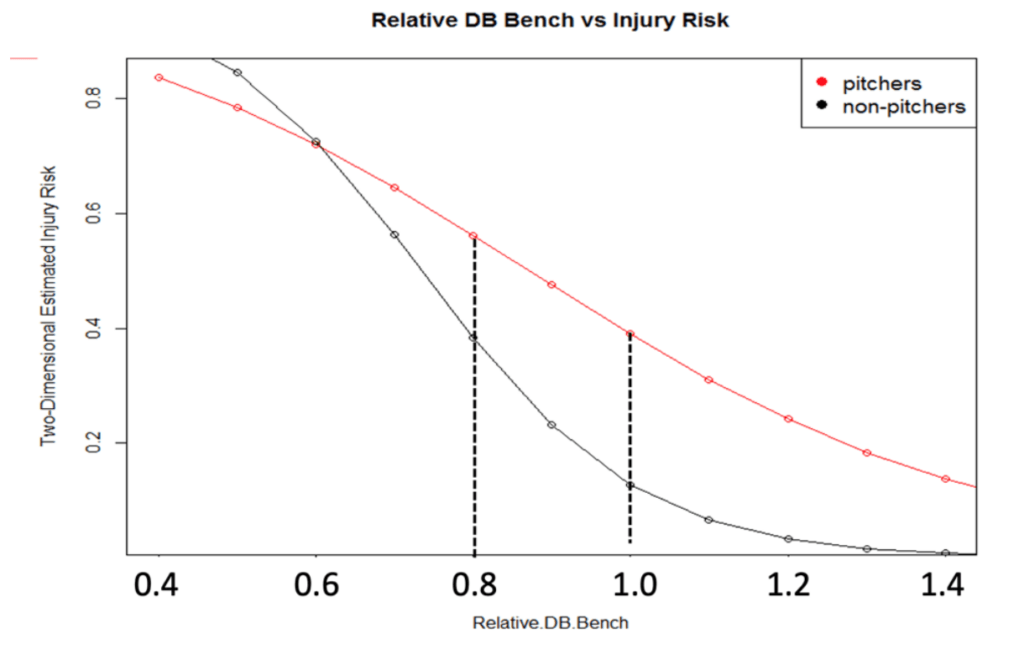
For most of my life, I trained the anterior upper body for the chest with bench pressing, laying the trunk horizontal. As I studied pitchers intently in the weight room, I found that when players can achieve 80% of their body weight in dumbbell pressing, their injury risk goes significantly down.
However, the returns on throwing velocity are minimal as they continue to chase maximum bench press strength—so what changes need to be made?
My first step is to get the trunk upright and develop pec strength, where the deltoid and supraspinatus must get into action and fight gravity.
This reduces overly activating the pecs, an important piece for athletes who are unbalanced, and attacks weakness in the throwing arm with a long lever position (elbows extended or moving to extension).
Not to mention, the core must be turned on, and you shouldn’t start with more than 5% body weight total when you begin.
With Stan, he has always been a strong bench presser, so we introduced expansion training from the beginning, especially after we could jump-start the serratus anterior and create some more scapular stability.
As we move, our ribcage moves, which requires the scapular stabilizers to adjust to vibration and slight changes in the position of the ribs, which has an added benefit.
This is very different from lying down and pressing, which does not activate antigravity strength with shoulder elevation. There is a high degree of co-contraction of the shoulder muscles (all firing at once) when you are holding weight away from the body and not changing arm position. The core is bracing against gravity and not letting the weight drop. It’s challenging.
WHAT YOU FIND WHEN YOU GRIND
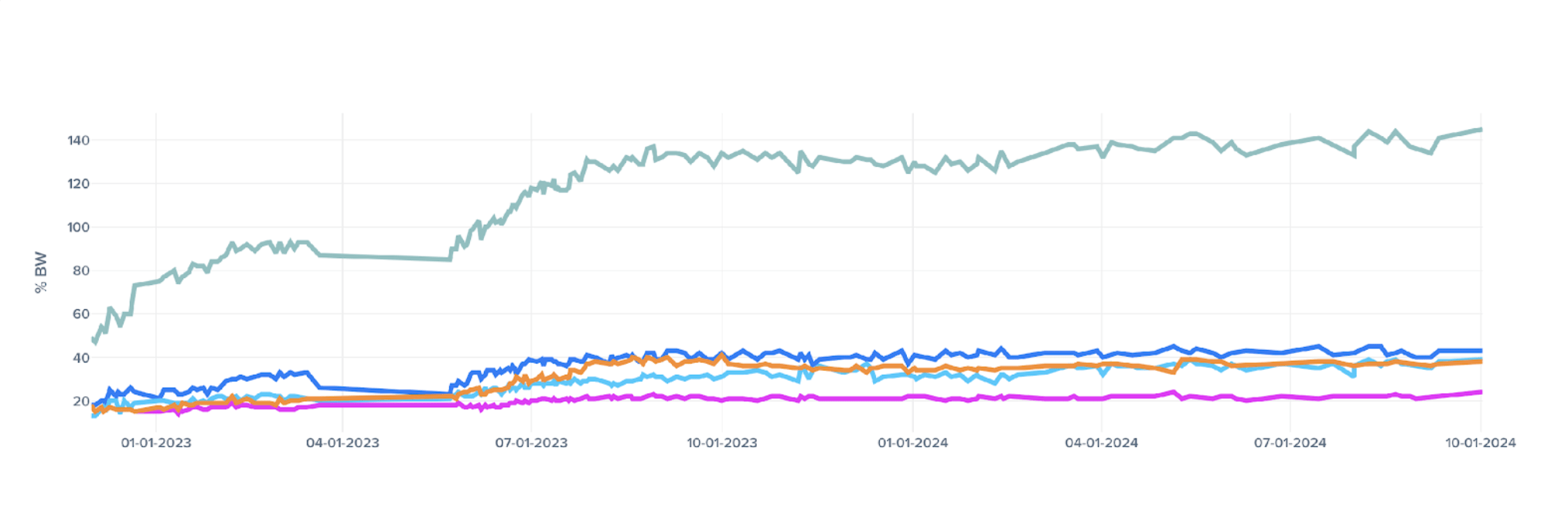
Stan is a tireless worker. Over a few years, he went from being unable to do the scaption test, barely lifting 3 lbs overhead, to having more than 300 pounds of force and a 145-degree arm score. Dedicated work and tireless effort to build a strong arm and get on the mound do it.
Another focus we had was re-establishing shoulder balance. It had taken us some time to restore the neurological activation of the posterior cuff and rear deltoid. Still, over time, he was able to balance the shoulder in the shoulder socket.
We identified a clearer path for the shoulder to work within, as a stronger and larger internal rotator cuff pulls the shoulder head forward, and he was having pinching on the posterior (back of the shoulder) side. When corrected, we found that the shoulder joint had better centration (maintaining the ball of the humerus in its socket and minimizing gliding during acceleration).

The old adage is, “You can only accelerate what you can decelerate,” and we built a braking system to prevent him from breaking.
Velocity built up, and it was time for him to showcase his ability on the mound while we taught him how to play first base. Putting MLB specialists around him, Stan was a natural at firstbase.
The defensive specialist working with him, who has had more than 30 years in the MLB game, said, “Right now, he is the third-best 1B in our organization.”
Stan continued to develop and was taken on by a solid Prospect League team and hit the ball a ton.
I know he can pitch, but was confident when he performed against one of the pitchers I advise who can top 97mph (more on this pitcher in the future). Stan had become a player who could swing it and was in the 90s on the mound.
After building an individualized process to strengthen Stan’s arm, he worked very hard to improve his physical skills and athletic qualities that serve him as a strong defensive prospect.
Now a student of the swing again, he signed with the Jackson Rockabillies, a solid team in the Prospect League, which is a partner league with ArmCare.com. He entered the season on a mission to get on the radar of MLB teams.
Alas, this Fall, Stan earned a pro tryout – an important step on his journey in becoming a professional baseball player.
From three lost scholarships, spending an entire college season in junior varsity upon his return to get his arm up to speed on the mound, having to learn an entirely new position, and being on the other side of home plate hitting tanks, he pounded the pavement and made the impossible become possible.
An incredible MLB organization with a strong data-driven player development model to maximize player health and performance extended a tryout to Stan.
All in all, Stan has an incredible family with a strong baseball pedigree, but now, he is a member of a family approaching 50,000 athletes – one that produces the strongest arms in baseball.
In closing, if you are on the fence about the “Strength Matters Most” movement, look at what Stan has been able to do and launch balls over them.
For those of you in the struggle, make your impossible possible – SMM.
Ryan
Ryan@armcare.com