Strength in Numbers #174
Carry exercises—movements in which athletes hold weights while walking or performing other actions—are fundamental for developing stability, strength, and endurance.
I see too many suitcase carries prescribed, heavy trapbar carries, and athletes wonder why their throwing arms continue to be unbalanced and how their grip strength becomes overly fatigued.
For baseball players, the focus on unilateral (single-arm) and overhead carries has distinct advantages. It aligns with the demands of throwing and rotational power in pitching and batting and has greater stabilizing requirements from the kinetic chain.
Single-arm carries, in particular, help enhance core stability, shoulder endurance, and the ability to resist rotation in all planes, all critical for baseball performance. Overhead carries also introduce an element of scapular stability and control, which directly benefits athletes who engage in high-velocity throwing and reduces the overactivity of the lats, a major culprit in the inability to get that Shoulder Balance Number between 0.85-1.05.

Getting in Your Single-Arm and Overhead Carries
Single-arm carries engage the core differently than bilateral holds (holding weights in both hands). When a baseball player holds a weight on one side, their body must resist lateral flexion, promoting core and hip stability on the opposite side.
This type of anti-lateral flexion is highly beneficial for baseball players, whose sport involves substantial unilateral movement (e.g., throwing and swinging).
Furthermore, integrating carries overhead engages the shoulder stabilizers and increases the demand on scapular muscles, which helps build the stability required for high-intensity throwing.
This video shows the progressions for executing a carry from low stabilization effort to higher-order stabilization that requires hip and intra-abdominal co-contraction for the highest level of dynamic stability.
Cross-Flexion Extension Reflex and Hip Stabilization
In baseball, the cross-flexion-extension reflex is integral to both running and throwing. This reflex involves the coordinated movement of opposite limbs, like the arms and legs, during walking, sprinting, and marching. In single-arm carry exercises, this reflex is activated as the athlete alternates steps, which enhances core stability and hip engagement.
As the carry movements progress from walking to marching—where the athlete momentarily balances on one leg—hip and core stability demands are increased. Marching challenges the stabilization of the pelvis and hips as the athlete repeatedly engages in single-leg support, which is essential for developing control during movements like pitching.
Note the dynamic stabilization differences between walking and marching. With young athletes, overhead carries must be light for safety as the core can be more fatiguing with single-leg stance instants versus continuous walking.
Benefits of Forward and Backward Carries
Muscle recruitment strategies in forward versus backward movement vary for lower limb forces. When athletes perform carries while moving backward, they typically experience increased recruitment of the posterior chain muscles, including the hamstrings and glutes.
Conversely, forward carries emphasize the quadriceps and hip flexors in forward propulsion. For baseball players, training in both directions is beneficial, as it balances lower-body musculature, enhances body awareness, and improves proprioception—critical elements for agility and reaction on the field.
Upper body musculature also responds differently during forward and backward walking. Backward carries increase shoulder and upper back activation to stabilize the weight so that it does not fall behind the body and moves against its natural directional preference.
This heightened upper-body recruitment contributes to greater overall shoulder stability and endurance, which is advantageous for baseball players who rely on shoulder strength for both throwing and batting. We compete overhead; we must train overhead.
One-Leg Stability and Co-Contraction Strength
Single-leg activities, such as marching with a weight, mimic the stance phase in pitching and batting, where one leg supports the body while the other transitions through a complex motion.
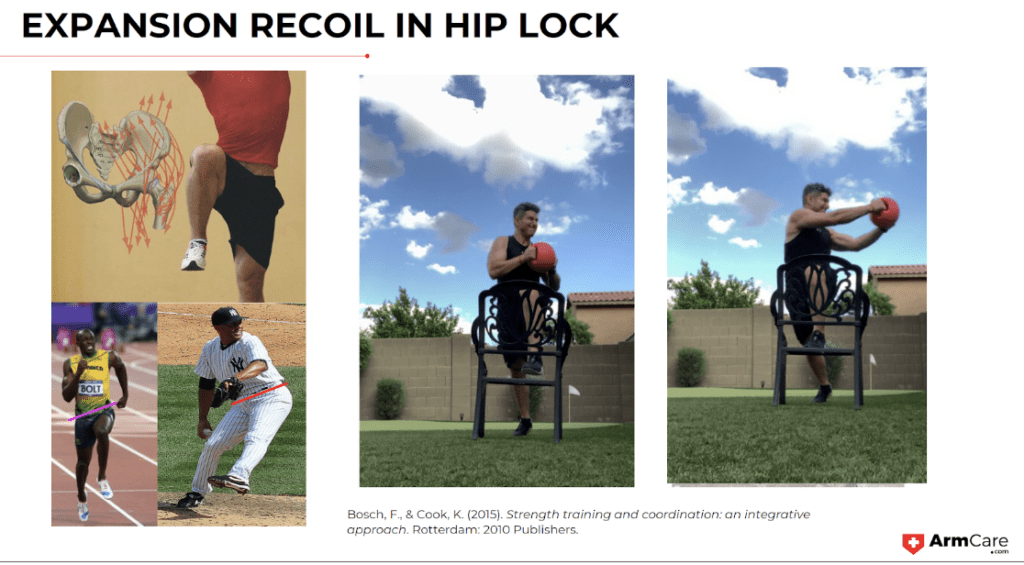
When an athlete is on one leg, as in marching or single-leg stance exercises, they achieve a “hip-locked” position that requires intense co-contraction of the hip, core, and stabilizing muscles.
This co-contraction strength is crucial for athletes because it improves balance and stability while facilitating rapid energy transfer from the lower to the upper body.
Building strength in this single-leg, hip-locked position translates well to baseball, where stability and rotation are key during batting and pitching. For pitchers, improved hip stability allows for better pelvic rotation while holding hip extension, a critical movement for delivering force to the upper body and, eventually, the baseball.
Enhanced stability and strength in these movements also contribute to a faster sprint speed by promoting optimal force application from the lower body through the pelvis to the upper body.
/
Practical Application: Incorporating Carries into Baseball Training
To effectively incorporate carries in a baseball strength and conditioning program, coaches can use various approaches:
1. Single-Arm Farmer’s Carries: Using a dumbbell or kettlebell, the athlete holds the weight on one side while maintaining an upright posture, walking forward for a set distance or time. This exercise improves anti-lateral flexion and core stability.
2. Overhead Carries: Holding a weight overhead engages shoulder stability, which is particularly beneficial for pitchers. The overhead carry also requires scapular control and endurance, directly translating to improved arm health.
3. Marching Carries: Progressing to marching with single-arm or overhead carries requires the athlete to stabilize while lifting one leg. This exercise enhances hip stability and co-contraction strength, which are crucial for one-leg stance control and energy transfer in pitching.
4. Backward Carries: Performing carries in reverse stimulates different muscle activation patterns, focusing on the posterior chain and providing balance to forward movement exercises. This exercise improves proprioception and strengthens stabilizing muscles, which supports agility on the field.
Tying It Altogether
Carries are essential to a baseball player’s training regimen due to their comprehensive benefits in core stability, shoulder endurance, and unilateral strength. Baseball athletes develop the control and stability required for high-level performance through single-arm and overhead variations.
When combined with cross-flexion-extension reflex patterns and advanced hip stabilization techniques by being on one leg for longer instants of time, carries support functional strength that translates to better pitching, hitting, and fielding. Incorporating forward and backward carries and leveraging tools like linear encoders ensures that baseball players optimize their performance while minimizing injury risk.
These exercises are fundamental to building strength and enhancing the movement qualities necessary for success on the diamond. By developing strength, stability, and coordination, baseball players have the physical foundation to perform at their best while reducing the likelihood of injury.
Carry the Message Forward and Backward!
Strength Matters Most,
Ryan
Ryan@armcare.com