

Strength in Numbers #223
In our last Strength in Numbers, we hit on the problems with focused training on boosting maximum strength. Showed evidence that the highest conversions are boosting lean mass, balancing the shoulder, and having greater contractile velocity.
However, in the high-performance world of baseball, throwing arm strength isn’t just about velocity — it’s about consistency, durability, and the ability to dominate late into games. While countless studies have explored biomechanics, pitch design, and workload management, only one landmark study to date has directly linked throwing arm strength to on-field performance metrics in NCAA Division I pitchers — and the results were game-changing.
When it comes to process metrics, velocity converts if it’s thrown for strikes, potentially more swing and miss, but you must have command as you move up in levels – you literally have to be a pitcher and not a thrower.
To accomplish goals on the field, you also need to understand what to train and how it translates to statistics—not just process metrics like speed, spin, and stuff grades.
The Power of Arm Strength: Fight Fatigue, Velocity, and Performance Decline
Pitchers with stronger arms can throw more pitches per outing and sustain their velocity deeper into games. Conversely, fatigue has a detrimental effect on fastball speed, spin rate, and command. As fatigue builds, velocity drops, and mechanics break down, leading to a higher risk of injury.
The ArmCare.com platform addresses this by continuously testing the throwing arm’s function to reveal early fatigue markers. Through individualized feedback, coaches can proactively scale workloads to protect players while maintaining their edge on the mound.
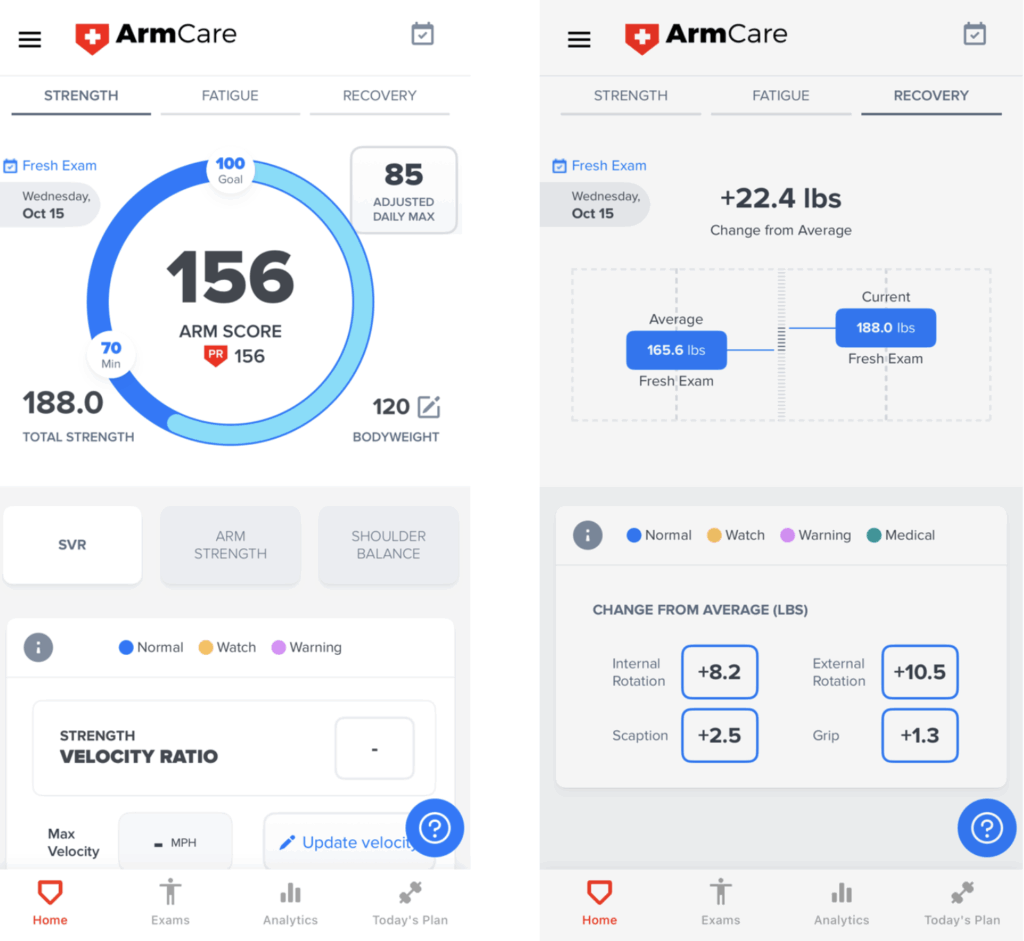
A young high school pitcher in Fall Ball is functioning at a high level. Strength capacity
improves the recoverability of the throwing arm, and that means more innings pitched per season, more availability all the way to the end. This athlete has 150% body weight strength for the throwing arm, and you can see he put a 25-pound dumbbell into his arm
A young high school pitcher in Fall Ball is functioning at a high level. Improved strength capacity enhances the recoverability of the throwing arm, leading to more innings pitched per season and greater availability all the way to the end.
This athlete has 150% body weight strength for the throwing arm, and you can see he put a 25 lbs dumbbell in it, indicating reduced disruption of his internal system—good measures to see in your players.
Why Traditional Training Misses the Mark
Many pitching development programs still neglect direct throwing arm strength training — or rely on repetitive, low-intensity routines that fail to develop true force production. Without a focus on time under tension or maximum isometric effort, the throwing arm simply doesn’t adapt to the demands of elite pitching.
The ArmCare.com system fills this gap. Even the testing process itself has been shown to increase strength through neural activation, priming the arm for greater recruitment. Over time, consistent testing, coupled with customized strength programs, builds durable, high-performing arms.
Yielding isometrics are one method to build maximum strength and increase time under tension. In our Certified ArmCare Specialist Course, you can see the key details of these high-threshold lifts for the throwing arm.
The Role of the Forearm and Shoulder Complex
ArmCare training bands—when used with intentional grip tension—develop the muscular endurance of the forearm and reduce overactivation of the upper traps and lats, two areas commonly linked to shoulder dysfunction. This improves activation of the lower traps and posterior rotator cuff, essential for maintaining shoulder stability and control throughout the throwing motion.
The result? A more balanced shoulder joint and reduced mechanical inefficiencies — allowing pitchers to throw harder, longer, and pain-free. If you want to improve your on-field performance, you need to focus on gripping the handles tightly.
Smart Pitch Counts, Stronger Performances
ArmCare.com doesn’t just measure strength — it translates it into customized pitch count recommendations based on a player’s arm health and recovery profile. These individualized pitch counts ensure athletes are working within a performance-safe range, optimizing success while mitigating the risk of overuse injuries.
By managing both external load (throws, innings) and internal load (functional arm capacity), the platform provides the most comprehensive, data-driven safeguard in modern baseball training.
In the top right corner of the homescreen, you can see the Adjusted Daily Max pitch count. Simply put, stronger arms handle more. This athlete has a strong arm, giving a limit of 140 pitches in a game. The analytics tab indicates consistency – weekly exams with blue dots.
Strength and Stats: Arm Strength Correlations to Performance Metrics
The table presents correlations between various measures of arm strength (including total strength, isolated muscle group strength, and grip metrics) and key baseball performance outcomes. The findings highlight how throwing arm strength, particularly in the rotator cuff and scapular stabilizers, as well as forearm grip strength, relate to game performance and durability indicators.

We dive into this unique research in our Return Beyond Performance Courses, as well as our Remote Accelerator Education for teams. Not only does strength convert on the field, but we will also show you how to promote it and what to do.
Key Findings: Positive Correlations with Performance
- Total Arm Strength and IR/ER/Scapular Arm Strength (IRTARM, STARTM):
Strong positive correlations exist between these strength measures and Wins (r = 0.68–0.66), Strikeouts (r = 0.53–0.62), and Innings Pitched (r = 0.53–0.66).
➜ This suggests that pitchers with greater total and overall shoulder strength perform at higher levels and sustain greater workloads.
- Forearm Grip (FBG) Strength:
Grip strength metrics correlate strongly with Wins (r = 0.57–0.67), Strikeouts (r = 0.58–0.64), and Innings Pitched (r = 0.56–0.66).
➜ Grip strength serves as a reliable indicator of overall arm health and neuromuscular readiness that translates to greater win expectancy
- Fastball Top Spin:
Moderate positive correlations (r = 0.30–0.65) suggest that stronger arms and hands contribute to more efficient spin generation, an essential determinant of fastball quality. ➜Greater backspin on the baseball increases the potential to increase induced vertical break and allows all pitchers to have better control of their fastball and reduce its downward fall.
Key Findings: Negative Correlations with Inefficiency Metrics
- Walks and Walks per Inning Pitched (BB/IP):
These measures show strong negative correlations with Total Arm Strength (r = –0.59 to –0.65).
➜ This indicates that pitchers with higher arm strength demonstrate greater control and fewer command inefficiencies, walking fewer batters
- Losses:
Weak-to-moderate negative relationships (r = –0.24 to –0.43) further reinforce that strength metrics are protective against poor outcomes. ➜ This indicates that greater strength metrics can not only increase wins, but can also reduce the probability of losing.
Key Findings: Intermediate Findings
- Breaking Ball and Change-Up Velocity:
Negative or weak associations with arm strength (r = –0.34 to –0.45) may suggest that these pitches depend more on fine motor control and spin manipulation rather than raw strength. More research is needed on secondary pitch types.
Stress Shielding – An Added Benefit
A stronger arm creates a more competitive pitcher — one who can:
- Sustain velocity deeper into games
- Command pitches with precision
- Recover faster between outings
- Reduce injury risk and extend career longevity
My favorite aspect is that arm strength gains serve a dual purpose: advancing performance and protecting arm health. This pattern supports the concept of “stress-shielding,” where stronger arm segments distribute mechanical loads more effectively across the kinetic chain, reducing inefficiency, fatigue, and command variability over time.
We go into stress-shielding training with examples like this in our Certified Pitching Biomechanist Course. We recommend taking the course to understand how to safely integrate this type of high contractile training to shield stress away from the UCL and prevent Tommy John Surgery.
Key Takeaway
Through data-driven insights, targeted strength training, and individualized pitch management, ArmCare.com continues to redefine what’s possible in player performance and durability. Boost your players’ performance, advance the system by gaining deeper insights that you can apply every day with our certification courses and ArmCareU.
The next generation of elite pitchers won’t just throw hard — they’ll throw smart, strong, and statistically dominate.
Strength Matters Most,
Ryan
Ryan@armcare.com