

Strength in Numbers #222
I often write articles connected to my athlete cases.
I have to say, at times, I experience frustration when our college pitchers are dominating, pain-free after years and years of arm pain, in a groove, throwing harder and smarter than ever, the arm strength is skyrocketing, shoulder balanced, recovery like an X-Men character, and do not fatigue more than 5% on each muscle.
Then, when you think you are on the hockey stick trajectory to domination, all hell breaks loose with a change of heart in the school training philosophy.
Not only do we focus on helping our athletes, but also school programs by offering time to speak to coaches about new forms of training, key metrics from the ArmCare platform, and deeper details concerning the strength and coordination approach.
We coach our athletes in alignment with principles taught in our Certified Pitching Biomechanist Course – we focus on how athletes develop, absorb, transfer, and shield force. No word of a lie, arm strength work is the first thing that is done in the weight room and NEVER A FINISHER.
We make the main thing the main thing for pitchers and position players, as an arm injury, especially when it comes to a client who has already had surgery, is a potential career and season-ender.
In most cases with college and pro athletes, I do an inventory of their training history, and many have a powerlifting background.
They wonder where their training approaches may have failed them, how they reached a breaking point, as their arms are never healthy. Their spines are virtually inflexible from all the years of heavy Valsalva maneuvers (holding their breath to increase spinal stiffness), slow contraction speeds with 1-3 rep maxes, weight belt dependency, safety bar squatters pulling everything down and in, and way too high on the bilateral strength, lower body compensation, and power scale.
Huge engines with horsepower and throwing arms that cannot brake end up breaking.
There are times in collegiate baseball, and I am guilty of it as a former D1 assistant football and baseball strength coach, when the weight room is filled with Bigger Faster Stronger benchmarks, similar to those used in football, which is an impact sport.
I even had that mentality in the early years of pro baseball—experience and research changed my thinking significantly, especially when peer-reviewed research didn’t show strong correlations with being powerlifting strong.
We must treat each athlete as an individual, but more research is needed on how baseball players are trained off the field.
There’s a persistent myth that boosting powerlifting stats in elite athletes —bench press, squats, or deadlifts—automatically leads to higher fastball velocity. The truth is, while absolute strength matters for general athletic development, throwing velocity is governed more by relative force of the arm, shoulder balance, arm speed, and inter-joint coordination than by maximal load capacity.
Stiff versus stretchy? Strength and conditioning versus strength and coordination? Unilateral versus bilateral exercise? Single plane versus multiplane training? Rotation versus spending more time in hip and trunk flexion-extension – these are all questions I have had, and many of them have been answered through failure.
Scientists work hard to teach people a better path by disproving themselves, not conforming to their own ideals. With our accredited certifications out there, backed by peer-reviewed research, I still see the industry in a constant state of confusion.
I am hoping this article can shed more light – the BFS training model (Bigger-Faster-Stronger) is BS if you have no concept of throwing arm BFS (Balance, Force-to-Body Weight + Fatigue Resistance, and Strength-Velocity Ratio) metrics.
Absolute vs. Relative Force
Absolute force is the total amount of force an athlete can produce, like lifting a heavy barbell. Relative force, however, refers to how much force you can apply relative to your body weight and speed of movement.
We are going to get into the Force-Velocity Curve, the relationship between strength and speed. Throwing a baseball involves extremely low resistance and very high velocity—meaning it lives on the far right of the force–velocity curve, where movement is fast, and the resistance is not heavy. For a max effort squat, it’s at the complete opposite end of the spectrum, moving a resistance that is so heavy that the body moves like a snail.
When pitchers chase strength numbers in the weight room without corresponding speed and coordination, they risk reducing arm quickness and flexibility. A 400-pound squat doesn’t automatically translate into a faster fastball—it only improves potential if it’s paired with specific, speed-based training that enhances movement efficiency.
Everyone is different, but we are going to dive into a study on D1 collegiate baseball players by Myles Fish, an athletic trainer with the Kansas City Royals and a graduate student of ours at Louisiana Tech University. His work should influence us to think more critically about how much we should have our athletes strain, and how heavy is too heavy, or how slow is too slow to throw fast.
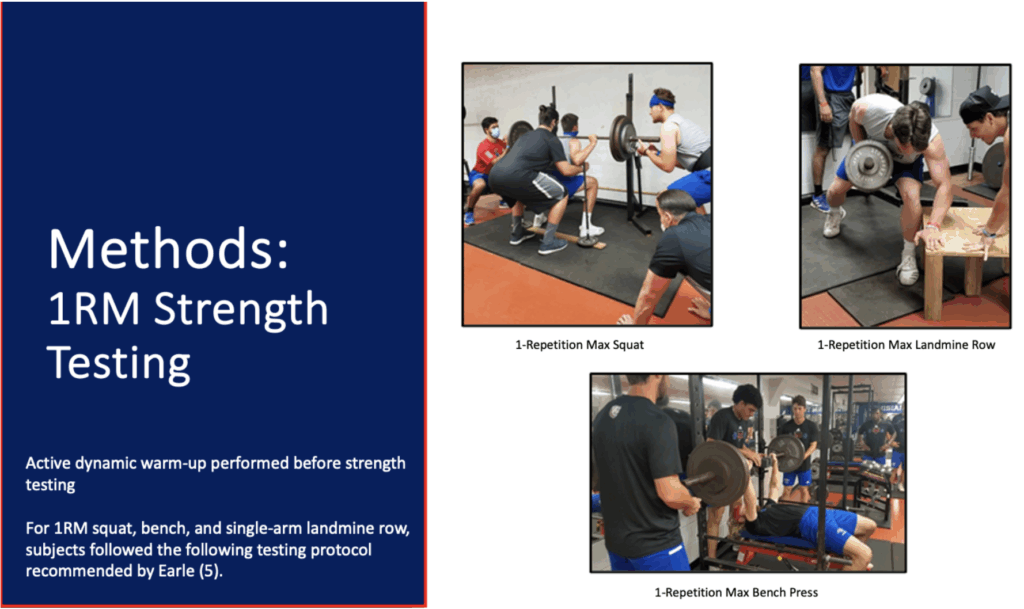
Research methods displaying how we collected key One-Repetition Max Effort Strength variables at Louisiana Tech University, where I am a research associate. We wanted to understand the relationships between Maxes Versus Maxes (Compound Lifting versus Throwing Arm Driven) and throwing velocity.
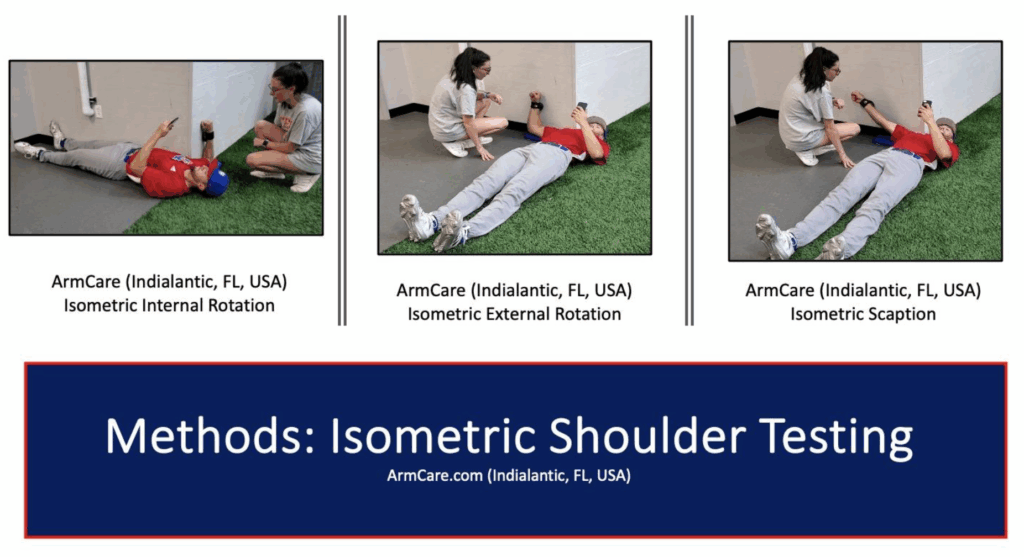
Shoulder strength testing at Louisiana Tech University is integrating the ArmCare platform. Maximum arm strength was tested across internal and external rotation, scaption, and grip strength – key strength attributes that offer joint strength for durability and performance.
The Force–Velocity Curve: Where Throwing Lives
On the force–velocity curve, heavy lifts like deadlifts and squats sit on the high-force, low-speed end. As resistance decreases, contractile velocity increases. Throwing a baseball sits at the lowest force and highest velocity end, meaning the body must generate power explosively and efficiently rather than under load.
Eccentric and isometric training play a crucial role here.
- Eccentric training (lengthening under tension) builds elastic energy and improves braking ability, allowing the arm to decelerate safely at high speeds.
- Isometric training strengthens joint stabilization and promotes co-contraction, where opposing muscles contract simultaneously to protect the joint and enhance control during explosive movements.
Improved co-contraction contributes to a higher early rate of force development (RFD)—the ability to produce force quickly in less than 50 milliseconds. This is a key factor in fast, reactive sports like baseball, as it helps take slack out of muscles and tendons, preparing them to recoil in the opposite direction.
We go into deep detail about the force-velocity curve in this video, which includes visualized differences in training methodologies focused on joint stabilization, loading, and deceleration approaches. You can learn way more on this subject and apply 100s of new strength and coordination exercises featured in our Certified ArmCare Specialist and Certified Pitching Biomechanist Courses.
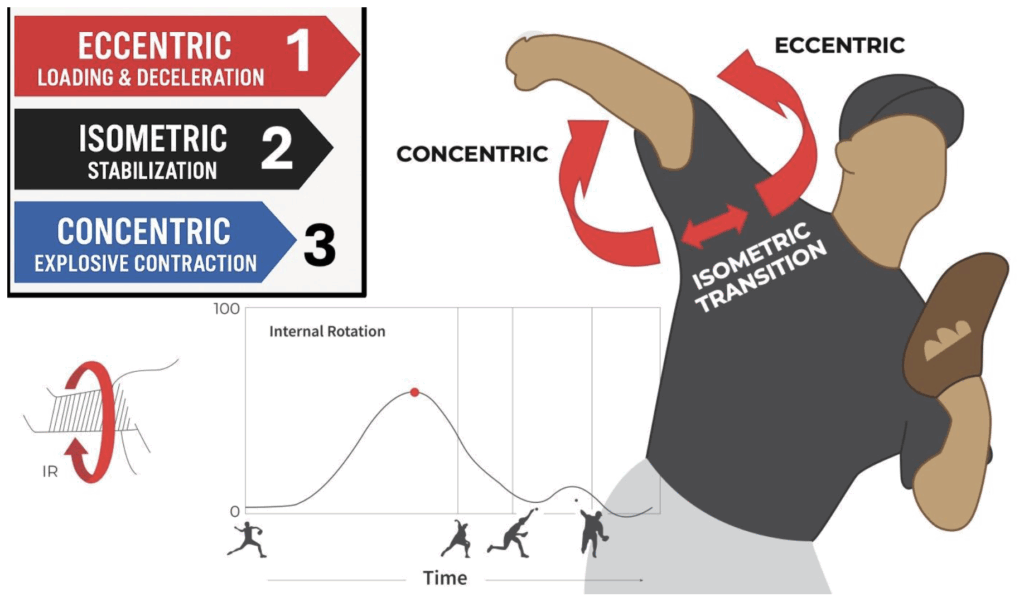
Prioritized muscle contraction actions as they relate to the force-velocity curve and overlaid the internal rotation torque graph of the shoulder. When you look at the peak in the graph of the internal rotation torque curve, you can see its highest point before layback (the peak comes before the layback silhouette at the bottom of the graph timeline).
This highlights the importance of eccentric internal rotation strength, indicating that the muscles need to be strong to decelerate layback, and that the internal rotation torque is significantly lower after the maximum layback position.
Contrary to an industry belief that the shoulder’s internal rotation strength must be most forceful in the acceleration phase, the throwing arm applies its most significant internal rotation force in loading the arm, not in recoil. A STRONG MUSCLE SHOULD BE A LONG MUSCLE.
The number system on each of the three contractile properties indicates a more effective training model. If we cannot decelerate, we cannot stretch-load or absorb. If we are not strong isometrically, we will not stabilize our joints.
Isometric strength is the most important transition state between loading a joint and then exploding after stretch. The third priority is the concentric shortening of muscles to generate power. Still, power generation is the intersection of pre-stretch, recoil force, contractile speed, and the early rate of torque/force development (RTD/RFD).
A sharp rise in the speed of application of force indicates RTD/RFD. Early rate RTD/RFD comes from the ability to co-contract the muscles and rapidly take out slack in the muscle-tendon component on the front and backside of the shoulder. This is only improved by raising eccentric and isometric strength in both directions (ER and IR) and with an outstretched arm (scaption).
Bottom line, lacking a braking system increases your vulnerability to breaking.
Also, if a player cannot stop joint motion well, the gas pedal may not go down all the way, or worse, you might get ejected from your seat because your arm crashes.
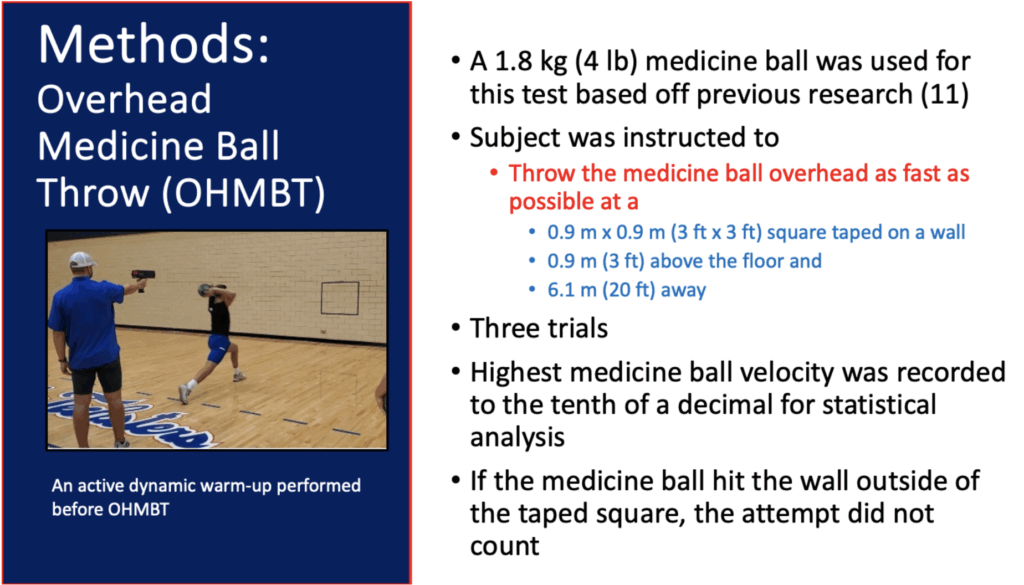
On the opposite end of the force-velocity curve are throwing and sprinting – high-speed actions under light or no resistance. A target 20 feet away was positioned to hurl a light medball as fast as possible overhead while capturing ball speed on a radar gun.
This may have a greater impact on throwing velocity, as the actions are similar in body orientation, direction, and joint speed. Strength and coordination features are higher with this test— posture, force, speed, and power are directed and integrated in a more throwing-like fashion.
Strength, Power, and Throwing Velocity Correlation vs. Causation
There is a lack of research in baseball on max strength in weight room exercises and their influence on max velocity.
Contrary to popular belief, what we found was that maximum strength in pressing, squatting, and rowing did not correlate with throwing velocity among Division 1 pitchers. In simple terms, raising absolute strength in these exercises didn’t cause higher velocity.
This continues to build the case of our Strength and Coordination Training Approach featured in our Certified Pitching Biomechanics Course. Intuitively, if powerlifters were the model players, they would not compete in the deadlift, squat, and bench. The league would see the strongest humans on earth pitching at the highest level, which is not a physiological, anatomical, or biomechanical reality.
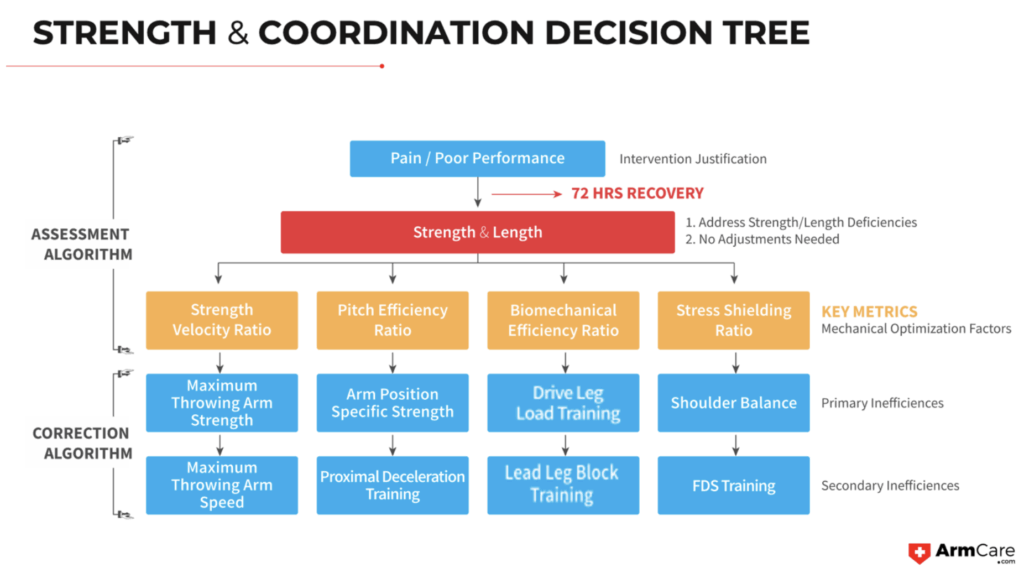
The Strength & Coordination Decision Tree (Mechanics Decision Tree) systematically provides an approach to evaluate delivery for optimization. It incorporates critical training pathways to reduce joint loading, optimize motion sequencing, develop high strength capacity, and enhance player durability. Most importantly, the key focus is to achieve better on-field outcomes related to sustaining velocity and command, rather than accomplishing Powerlifting PRs that may not correlate with on-field performance in these college players.
So, let’s dive into the study a little more.
1. We found an association that really does support training the brakes, as higher internal rotation force actually hurts throwing velocity.
This is likely because it disrupted the balance between acceleration and deceleration from maximum layback to ball release.
You can only accelerate what you can decelerate. If you keep pumping IR strength and are already imbalanced, your arm doesn’t want to rip apart. Your muscles’ internal control will attempt to slow down to prevent tearing the backside of your shoulder with each throw.
Simple terms – focus on getting your shoulder strength balanced between 0.85-1.05 so it can accelerate and decelerate in both directions.
Speed up the layback to stretch and stabilize the shoulder at maximum layback, allowing it to recoil when the internal rotator cuff muscles contract. This will reactively decelerate high arm speed at the back of the shoulder after the ball leaves the hand and moves toward the plate.
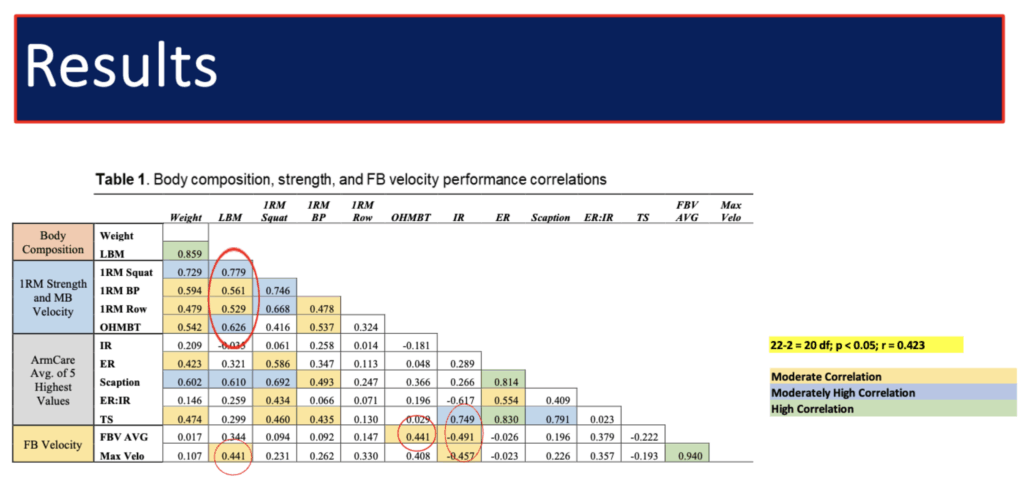
The correlation matrix is not causation. The matrix shows association – if you increase in one variable, it can either increase, decrease, or have no relationship to another. A higher number that is highlighted is a stronger association based on the numbers. The closer you are to 1.0, the stronger the relationship.
FB is the lowest row, and when you run across the matrix to the right, you can see that very few measures correlate. Metrics in the correlation matrix are as follows; LBM – lean body mass; 1 RM Squat – max squat; 1 RM BP – max bench press; 1 RM Row – max row; OHMBT – Overhead MedBall Throw Velocity; IR – ArmCare IR Test Max; ER – ArmCare ER Test Max; TS – Total Strength of the Shoulder; FBV Average – Average Fastball Velocity; Max Velo – Maximum Fastball Velocity.
Regarding contractile speed, overhead throws with a 4-pound ball moderately correlated with fastball velocity, aligning closely with the throwing action on the force–velocity curve. Additionally, lean body mass is associated with maximum throwing velocity, as it contributes to muscle cross-sectional area and the potential for power output.
However, its impact was greater on scaption strength and overhead medicine ball throws—key elements for arm positioning, potential arm speed, and release point consistency. Lean mass is also integrated in momentum-associated performance. Momentum is mathematically mass x velocity – when a larger body can move faster, the result is greater momentum that can be exchanged from larger segments to the smaller segments of the throwing arm.
Lastly, and perhaps most interestingly, bench press max strength showed some association with scaption strength, suggesting a connection with end-range joint positions when the arm is outstretched. However, a bigger bench did not show any association with rotator cuff strength (internal or external rotation).
For short lever strength in ER and IR, non-upper-body influences stole the show. Weight and 1RM squat had a moderate association with raising ER strength.
I believe this finding is the first to show a maximum strength lower body influence on posterior rotator cuff strength in pitchers. Bottom line – this indicates that most powerlifting movements alone can’t protect the throwing arm—in fact, overemphasis on them may worsen shoulder imbalances, increasing injury risk, especially if the athlete is super strong in IR. You keep feeding the player more pressing and lat-focused training.
Even after 10 years of research and collegiate and professional baseball coaching involving skilled pitchers, the correlations between max strength and fastball velocity remain weak. In real-world terms, you might find a Latin American pitcher who can’t squat his body weight, throwing 97 mph, while an SEC-trained pitcher who deadlifts 500 lbs tops out at 92.
In baseball training, there’s a persistent myth that lifting heavier weights—bench presses, squats, or deadlifts—automatically leads to higher fastball velocity. The truth is, while absolute strength is important for general athletic development, once an athlete becomes more skilled, throwing velocity is influenced more by the characteristics of throwing arm force, speed, and coordination than by maximal press, squat, and pull force.
In the next Strength in Numbers, we’ll dive deeper into throwing arm strength correlations to on-field metrics and explain why deeper knowledge of arm-specific strength data is one of the missing links to optimizing velocity, command, and durability.
Strength Matters Most – But maybe not as much when it comes to lifting a barbell.
Ryan
Ryan@armcare.com