Strength in Numbers – 267
In studying the pitching delivery, most players who throw 90mph or faster release the ball in under 150 milliseconds after the foot hits the ground. That means a pitcher has only a fraction of a second to produce and control force.
It’s a very different conversation than just asking “How strong is your arm?”
For performance, a better question is typically, “How quickly can your arm produce that strength?”
This is where Rate of Force Development—or RFD— or Rate of Torque Development (rotational force) -or RTD comes into the picture.
Imagine two athletes who can eventually push with the same amount of force.
Athlete A gets there almost immediately.
Athlete B takes considerably longer.
They have the same maximum force, but not the same rate of force development.
Maximum Force (Fmax) = the greatest force you can produce.
Rate of Force Development (RFD) = how rapidly you can develop force after you begin producing it.
Maximum force is important, but the type of contraction really matters to pitching performance. Check the video out to learn what types of muscle contraction you need to concentrate on in your training.
In simple terms:
Fmax asks: What is the maximum strength of your throwing arm?
RFD asks: How fast can you get to maximum strength?
That distinction matters in baseball because the arm is moving extraordinarily fast. Shoulder internal rotation velocity during pitching can exceed 6,500° per second, while the external rotators and posterior shoulder must subsequently help dissipate very large forces during deceleration.
There isn’t much time to create—or control—force.
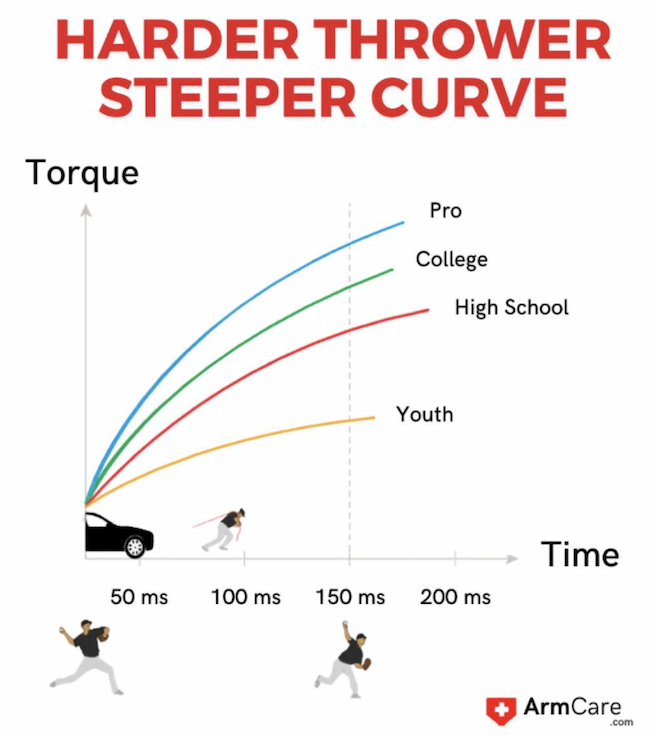
From foot contact to ball release, a pitcher has 150ms to develop significant shoulder internal rotation torque.
One thing that helps is the strength to stop your arm from going backward and redirect it forward. Think of your forearm laying back like a car moving in reverse; the muscles at the front of the shoulder act like a rope that needs to be pulled taut to send the forearm forward.
That’s where strength comes into the equation – you must put on the brakes (arm going backward) to step on the gas.
The combination of braking loads the arm, and the deceleration creates the stretch-and-contract cycle that accelerates the arm forward in the shortest time. The key is maximizing throwing arm power (force x velocity) toward the target.
How Do Max Force and Rate of Force Build Velo?
Think about maximum strength as the ceiling for force production.
RFD describes how quickly an athlete can climb toward that ceiling.
If your maximum force ceiling is low, there is only so much force available to express quickly.
That helps explain why maximal strength has traditionally been considered a foundation, with explosive strength layered on afterward.
Get strong! Then get better at accessing that strength quickly.
Accelerators Need Brakes
In research and in my coaching experience, I see two things: pitchers with stronger internal rotators—the accelerators—also tend to have strong external rotators—the decelerators—yet may not be fully balanced from front to back.
That relationship makes intuitive sense.
Undeniably, if you’re building a bigger engine, you’d better build the brakes with it.
The external rotators and posterior shoulder play an important role in dissipating force after ball release, and the authors point out that preseason ER weakness and imbalanced ER:IR strength relationships have previously been associated with throwing-arm injuries requiring surgery.
That’s why developing a throwing arm isn’t simply about making one muscle stronger.
It’s about developing the force-producing and force-absorbing system together – and you need to evaluate the shoulder balance score.
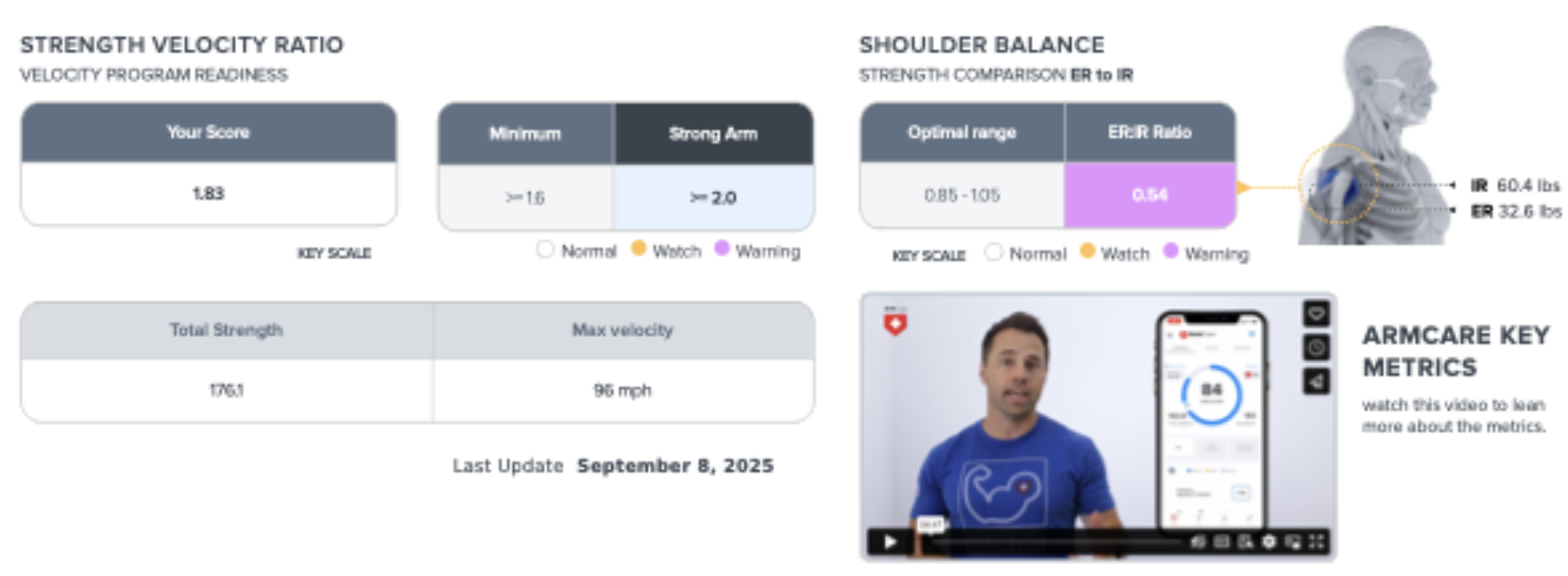
A high SVR and a balanced shoulder are ideal, but if you are unbalanced, keep that measure stable and continue. To boost SVR, increase throwing arm velocity, but don’t increase it beyond your force capacity.
Takeaway Message
Don’t chase “explosiveness” while ignoring your strength ceiling.
Don’t assume throwing harder automatically means your arm has become stronger.
And don’t develop the muscles that accelerate the arm without developing the muscles that control and decelerate it.
Maximum strength tells us how much force your arm has available.
RFD tells us how rapidly you can access that force.
IR and ER testing tells us whether the accelerators and decelerators are developing.
But the moral of the story is still the same in velocity enhancement….
Strength Matters Most.
Ryan