Strength in Numbers – 279
We pulled 22,272 data sets from youth pitchers who had three specific measurements:
- Fresh Exam (pre-pitching)
- Post Exam (after-pitching)
- Fresh Exam (the following day)
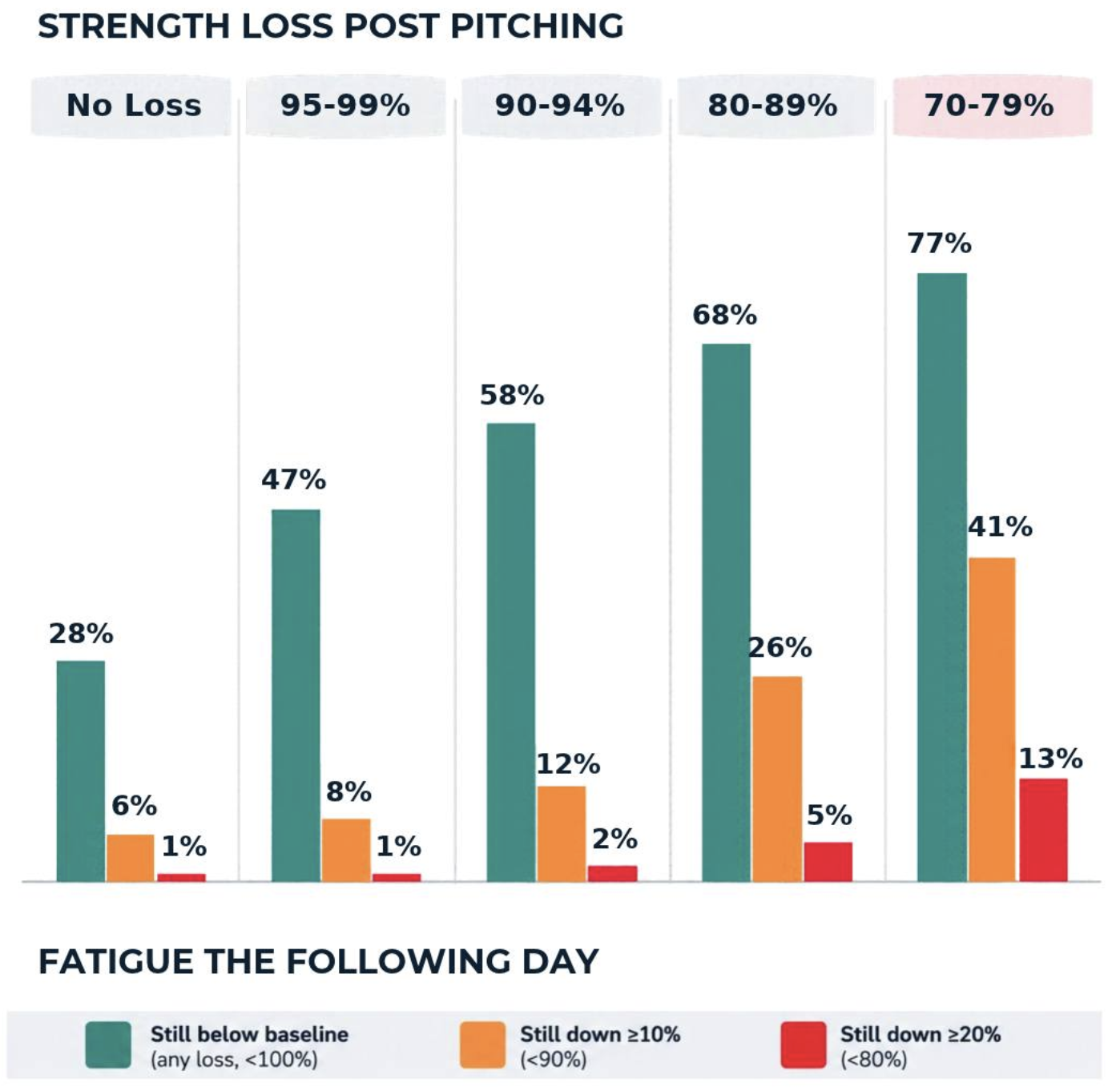
We grouped them by how much strength the pitcher lost right after throwing, then checked where each group stood the following day.
What Stands Out
1. What Pitch Counts Don’t Tell Us
The more strength a pitcher lost after an outing, the more likely they were to remain below their baseline strength the next day. They were also much more likely to have “caution” or “warning” level fatigue the following day.
This probably isn’t too surprising.
If a pitcher has a massive fatigue score immediately after throwing, you’d expect some of that strength loss to carry into the next day.
But notice that these groups weren’t based on pitch counts. Some pitchers had high fatigue after fewer than 30 pitches, while others threw over 90.
That’s the advantage of strength testing. It measures how the arm responded to the work.
Fatigue can vary drastically between pitchers, and even the same pitcher can have different responses to a similar pitch count.
So we can’t assume how much recovery an arm needs based on pitch counts alone.
2. The Arm’s Response Continues After Throwing Stops
Some pitchers showed no immediate strength loss but measured below their baseline the following day. Others had a small initial drop that became larger overnight.
How does that happen?
The processes that turn a nerve signal into muscle force can remain impaired after demanding exercise. Soreness and stiffness can also develop over the following hours and affect strength output.
There’s also the adrenaline and competitive drive that can linger after pitching. That heightened state may temporarily boost strength output and mask some of the fatigue that becomes apparent the following day.
We can’t pinpoint the cause of each decline from these exams alone. But they show why we need to check again.
A good post-exam doesn’t guarantee a good Fresh Exam the next day.
3. Big Drops Are Most Impactful
Among pitchers who lost 20–30% of their strength after throwing, 77% were still below their starting strength the next day.
And 41% were still down more than 10% the following day.
That’s about 4 in 10 carrying a substantial strength deficit into another day of potential throwing.
Eligible Isn’t Recovered
Pitch-count and rest rules account for how many pitches were thrown, but they don’t measure how the arm handled them.
Two pitchers can throw the same number of pitches, but one finishes near their starting strength while the other loses a quarter of it.
And between two pitchers with the same fatigue post-outing, one could be back to baseline the following day, while the other is in the “warning” range.
However, they have the same required rest, despite very different responses to the outing.
So follow the pitch-count rules. But don’t assume that being eligible to pitch means the arm has recovered.
What to Do With This
- Know the baseline. You can’t tell whether strength has returned without a measurement from before the pitcher threw.
- Test right after the outing. The size of the drop gives you an early warning. The bigger it is, the less likely strength will be back the next day. We can also adjust future workloads based on this.
- Check again before the next throwing day. Use the Fresh Exam, along with symptoms and required rest, to guide how much and how hard the pitcher throws.
- Adjust when strength is still down. Reduce the throwing workload or allow more recovery time instead of pushing ahead simply because the pitcher is eligible.
Strength Matters Most
-The ArmCare Team