

Strength in Numbers – 264
Every coach wants to help athletes throw harder, stay healthier, and perform more consistently. While every athlete wants the next drill, the next exercise, or the next mechanical adjustment that will unlock another level of performance.
But after spending years in professional baseball, working with 1000s of players, one lesson continues to stand out to me…
The best development programs rarely begin by changing the athlete. They begin by understanding the athlete. I always say that it’s important to learn your learner.
The theme of this week’s More Than Velocity conversation with Patrick Stanley, founder of Complete Game, was his perspective on building athletes, developing facilities, and helping coaches create environments where players can thrive for the long term.
That’s what it’s all about.
No flash in the pan, but a system that establishes sustainable performance.
Better Information Doesn’t Automatically Create Better Decisions
Baseball has never had more technology. Force plates measure how we produce power. Motion capture analyzes movement. TrackMan measures pitch characteristics. ArmCare measures shoulder strength and recovery.
So many metrics are available, and players are monitored in ways that simply weren’t possible twenty years ago.
Yet despite all these advances, one question remains:
Are we understanding the athlete better, or are we simply collecting more numbers?
Technology should never become the destination.
Its purpose is to reduce uncertainty and remove your own opinions from the mix, as you cannot train one player like another.
I have been blessed to work with these two athletes:
Both are extremely powerful, could have played in the NFL, and are incredibly forceful.
Chris Davis was unstoppable in 2013, hitting 53 homers, and Trout has had some years with 40+ homers. Given their similar strength profiles, they could not be trained the same way – your mind has to process that one is not like the other.
But the roadmaps for both of these players took terrible twists and turns when health was compromised – so finding what is best for the athlete requires a level of knowledge of how they function.
You must constantly ask yourself, “What’s the next best decision for this athlete?”
That’s where great coaching begins.
The Goal Isn’t to Find Problems. It’s to Find Priorities.
Many athletes walk into a facility believing they have one issue. They question themselves in ways such as, “I need more velocity.” “My mechanics are off.”, “I need to get stronger.”
Sometimes they’re right but may only be seeing the symptom. Velocity may be limited by lower-body power. Mechanical inconsistency may originate from fatigue.
Poor command may reflect recovery and a low scaption strength rather than mechanics.
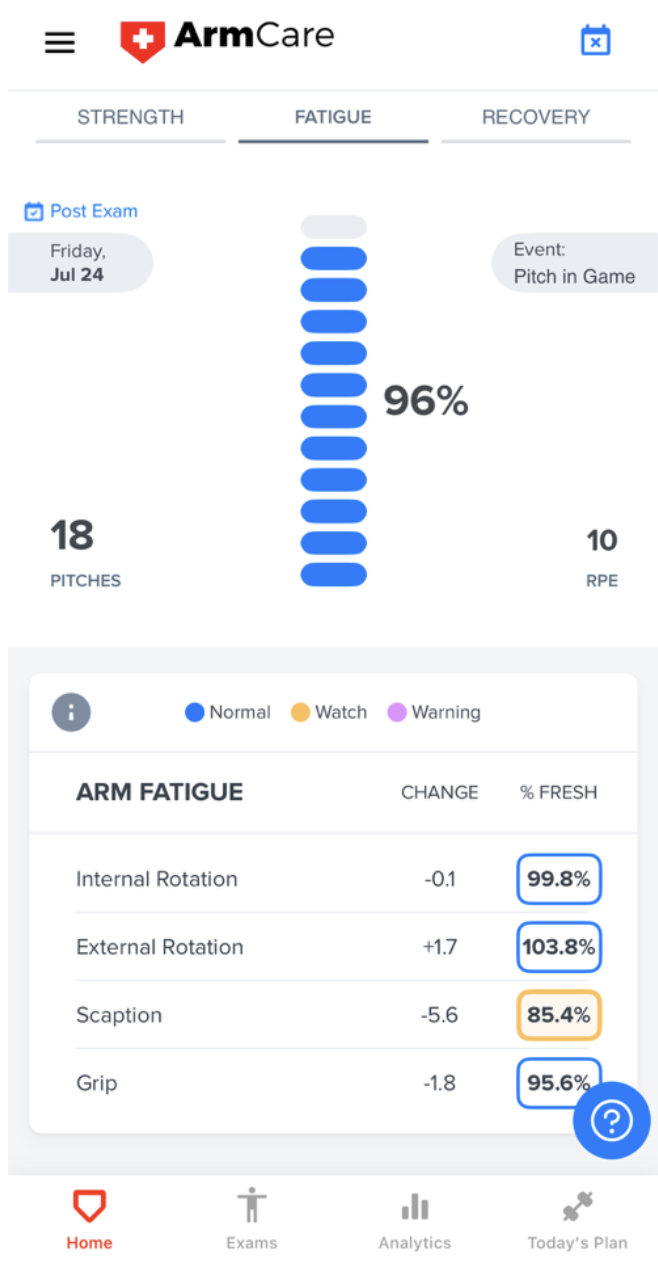
Real data from a college reliever showing significant scapular fatigue that tends to follow a change in command, mostly arm-side run, as the athlete tilts to maintain the release point.
Here’s the thing…
When coaches immediately prescribe solutions before understanding the underlying problem, they often spend months improving the wrong thing.
The most successful development environments don’t rush toward answers.
They organize information so the highest-priority questions can be answered.
Questions like “What is limiting my velocity?” lead us to explore foundational aspects such as lower-body power and arm strength before arm speed.
Individualization Isn’t About Making Every Workout Different
One word gets used constantly in player development, but few have mastered the principle of individualization.
It does not have to be about giving every athlete a completely different training program.
It’s about understanding why two athletes may require different solutions to reach the same goal, and making the tweaks for them.
In the example above, two priorities stand out: strengthening the shoulder in an extended-arm position and improving lateral trunk control to reduce fatigue at the end of the delivery.
Takeaway
The future of player development won’t belong to the coaches with the most technology.
It will belong to the coaches who use information to ask better questions, prioritize the right problems, and build individualized roadmaps for every athlete they serve.
Because when coaching becomes more intentional, development becomes more predictable.
And that’s where lasting performance begins.
Check out this podcast with Patrick Stanley speaking about the Blueprint for Building Elite Baseball Systems.
Strength Matters Most.
Ryan