Strength in Numbers – 265
When I say strength matters most, it’s not just a catchy phrase but scientifically true, and I have seen so many careers be demolished because of a lack of it or an imbalance.
When I was with the Angels, I put a lot of planning into customized arm-training programs, monitored athletes stringently, and also had opportunities to publish data on large populations of MLB and Minor League athletes.
One of my favorite experiences was contributing to offseason research with Dr. Lori Michener, a brilliant clinical scientist in physical therapy, along with her staff at USC. I still believe our research is the largest study in history to evaluate strength metrics in professional baseball players.
The findings were frightening. Every year, pitchers are getting bigger, stronger, and throwing harder.
Logic would suggest that larger athletes should have stronger throwing arms and be better protected from injury. However, the research says otherwise.
A Landmark Study
A landmark study of 242 professional baseball players compared shoulder strength among pitchers, position players, and players from North America and Latin America.
The findings challenged one of baseball’s biggest assumptions…
Pitchers (the athletes who place the greatest stress on their throwing arms) were actually weaker than position players.
This hypothesis was found to be accurate.
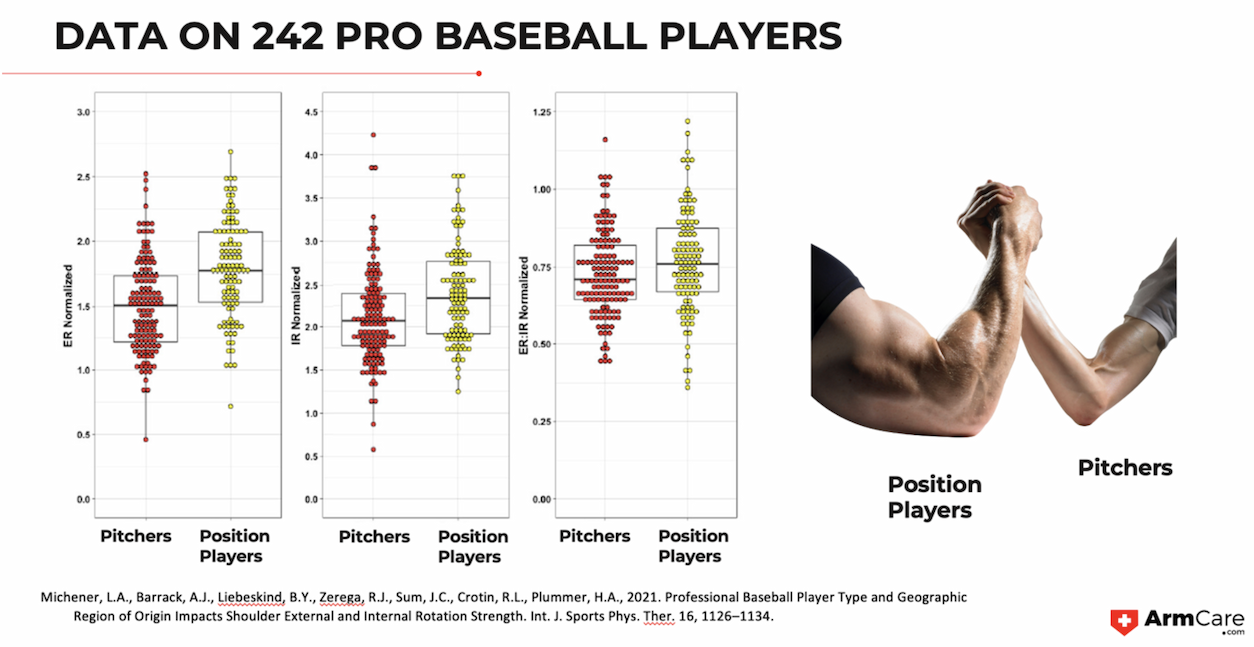
In the box plots, you can see that the horizontal lines are higher for position players, indicating greater ER and IR strength-to-body-weight ratios and more balanced throwing arms.
It is little wonder that pitchers face a higher risk.
Strength Matters More Than Size
Our research team measured shoulder external rotation and internal rotation strength using a highly reliable, fixed, and standardized handheld dynamometer protocol and normalized strength to body weight.
This allowed us to compare athletes of different sizes on an equal playing field rather than simply looking at absolute force production.
Our ArmScore has evolved from this research and other benchmarks studied in athletes over 10 years in MLB, as well as throughout my doctoral studies.
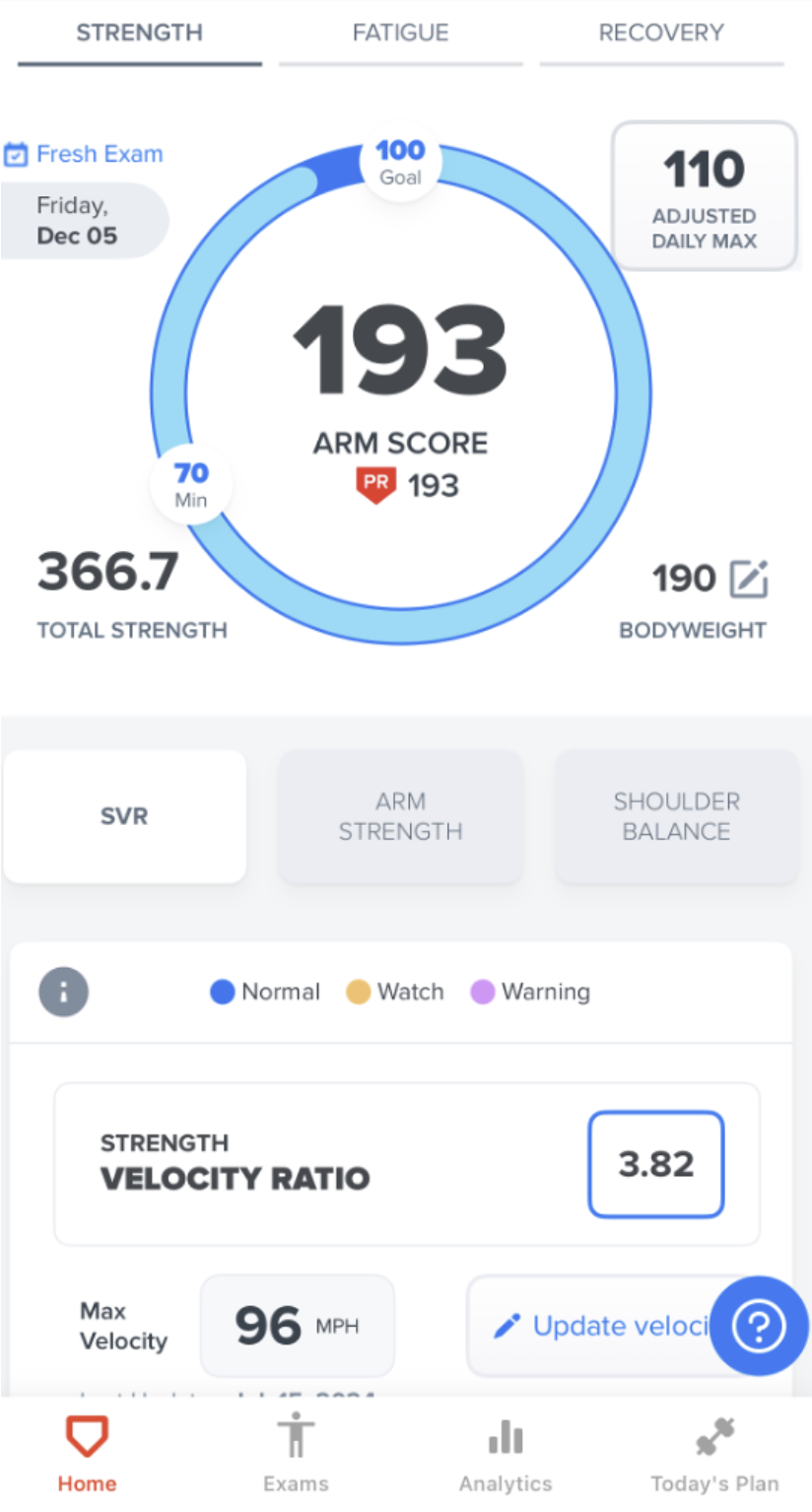
The ArmScore shown in this image indicates that the athlete has almost 2x body weight in arm strength. I personally advise this college player who has reached 98mph across the diamond from shortstop. This is a unique expression of relative throwing arm strength.
Our findings truly point to a major problem in baseball and one that the data above really sheds light upon:
Position players demonstrated 14–20% greater shoulder strength than pitchers, despite pitchers being larger athletes who generate the highest throwing velocities and shoulder loads in baseball.
There’s no wonder why they are at greater risk – a weaker arm that throws faster on average, more often, and with different grips has greater risk.
Even more interesting, Latin American pitchers demonstrated approximately 12% greater external rotation strength and 17% greater internal rotation strength than North American pitchers. That means we also have a geographical problem in the sport.
In other words…
Being bigger did not mean being stronger where it mattered most.
What This Means for Coaches and Parents
Pitching velocity continues to increase throughout professional baseball.
So do the forces placed on the shoulder and elbow.
If body size and ball velocity rise faster than the muscles responsible for stabilizing the throwing arm, the tissues that absorb those forces must work harder every pitch.
That’s an important concept because relative strength—not just absolute strength—may determine whether an athlete can tolerate the demands created by greater size and velocity. Not to mention, research has shown that predicting Tommy John surgery is better with players’ body weight than with velocity alone.
The strongest athletes aren’t simply those who lift the most weight.
They’re the athletes whose throwing-arm strength keeps pace with their body size, workload, and performance.
Key Takeaway
This study wasn’t designed to predict injury.
It was designed to establish normative strength values in healthy professional baseball players.
But it provides an important lesson:
Don’t assume a pitcher has a strong arm simply because they throw hard or have an impressive physique.
When an athlete gains 15 pounds, adds 3 mph, or dramatically increases their workload, one question should always be asked…
Did their throwing-arm strength improve too?
It may be the most important question to ask to build a pitcher that can withstand the demands of today’s game.
Strength Matters Most.
Ryan