Strength in Numbers #64
Last week I talked about a multi-dimensional approach to integrating ArmCare technology, creating customized training, and throwing programs across multiple sports.
Our last stop at UCONN was impressive, to say the least, and we had just about every athletic therapist and strength coach they have in the school, along with baseball coaches Josh MacDonald, Jeff Hourigan, and the Head Coach, Jim Penders.
We were brought in by a forward-thinking high-performance coach in Senior Associate Director of Olympic Sports performance, Joel Demarco. As an aside, he is producing some of the fastest players in the game, with indoor 60s approaching 6 seconds. No joke, I asked another coach to verify it, and it was correct.
They have an incredibly dynamic training process, and it was fun to come in and teach. I learned that almost all the javelin throwers at the school had TJ surgery, so the timing was of the essence as revision surgeries are more often career-ending (if you know javelin coaches, please send them our way!)
The excitement came when we discussed the sharing of data with players. What to say, what not to say, and man, the room erupted amongst the baseball team. If you have met Coach MacDonald, he is an impressive human being. He was named last year’s Assistant Coach of the Year and is not afraid to speak his mind.
My kind of person and I watched the inter-team dynamics between the coaches on how they foresee communicating about the new technology and analytics ArmCare delivers to coaches, clinicians, and especially the players. We were at a crossroads between loss aversion and rewards-seeking communication.
Coach MacDonald is not wrong in that players must be fully aware of their deficiencies. However, coach Penders was more concerned with the individualization of the information to temper what insights could be delivered to players without hurting their psychology.
And since they have been together for 12 years—yes, that is right, 12 years—the freedom of speech was uncanny.
We discovered that starting with performance-driven outcomes before risk-driven outcomes is a strong way to connect with players. However, if players are not showing ultimate engagement in their work, then loss aversion may be the best direction to take with the athlete.
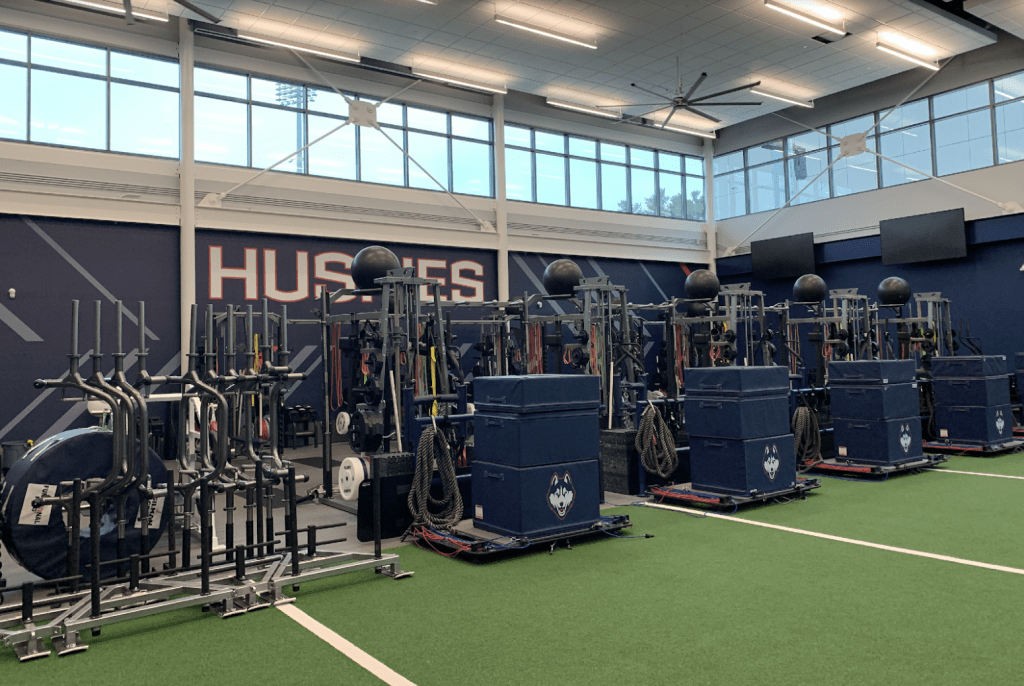
We went to the weight room to show some advanced training concepts and found the interchange between coaches and medical staff strong. They have excellent communication skills and voiced that they all suffer like many teams.
They are hampered by having limited time with athletes, and alas, our app was the best solution where athletes can be led on their own.
Therefore, they are self-sufficient in their arm care process and can maximize their competition and training weeks to attain high performance. With ArmCare, they’ve achieved more focused work, athlete ownership, strength improvement, and desirable competitive outcomes.
We were onsite for roughly 8 hours with fun-filled conversations and laughter that provided comfort. I say “comfort” because Coach MacDonald mentioned that he has felt responsible for pitching injuries in the past. He truly takes them to heart which is why I greatly respect him.
No excuses and blames himself. But the harsh reality is that he’s not the only college pitching coach to get blown up in the media over throwing arm injuries, especially when it affects draft outcomes.
It was good to hear that he felt comforted by our technology and education in that players, staff and the administration have a process in place to deeply monitor the throwing arms of athletes and that he can feel that he is giving even more to them through this process.
It felt good knowing that our technology and education have somewhat lessened his stress level and that multiple stakeholders can observe the data and assist him in making workload and training adjustments. If you are a college pitching coach feeling the heat, please reach out to us. We will help you and serve you in reallocating focus from loss aversion thinking to a rewards-seeking mentality.
If you want to know more about this dichotomous way of communicating with players and staff, please see the enclosed segment of ArmCareFX.
We also have a full player-onboarding video as well, to get the key insights and heuristics to use in communication with your team. This concludes our series on our first-ever ArmCare Road Show.
If your athletic department wants to be on the map for our future ArmCare Road Shows, please reach out to me. We will customize the education, including 12.5 hours of instruction for each attendee, onsite training, discussion around your team’s needs, and many key insights cultivated inside the walls of Major League Stadiums for the past nine years.
Related Content
-
ArmCare FX 8 I Creating Cultural Buy-IN
In this ArmCare FX, we cover how to create cultural buy-in across multiple stakeholders. This section is an excerpt from our full player onboarding video which be seen here.