Strength in Numbers #248
One of the biggest contributors to velocity and arm speed is the latissimus dorsi…which is better known as your lats.
If you’re not training them correctly, you’re likely compensating and pulling your arm through with your pecs and asking your rotator cuff to do more than it should.
That’s where problems start.
There’s always concern that lat training can create shoulder tightness or limit overhead motion.
But the issue isn’t the muscle… It’s how you train it.
Why the Lats Matter for Throwing
The lat muscles are among the largest and most powerful muscles in the upper body.
In throwing, they play a major role in:
- Transferring energy from the trunk to the arm
- Internal rotation strength of the shoulder
- Accelerating the arm into release
Think of the lats as a power bridge—linking your lower body and trunk to your arm.
When athletes are strong behind them (posterior chain), the lats help pull the arm through faster—and that shows up as velocity.
But There’s a Catch
An overactive lat can actually work against you.
If shoulder balance is off—especially if you’re already dominant in internal rotation—adding more lat strength can further the imbalance, causing greater compensations and restricting movement.
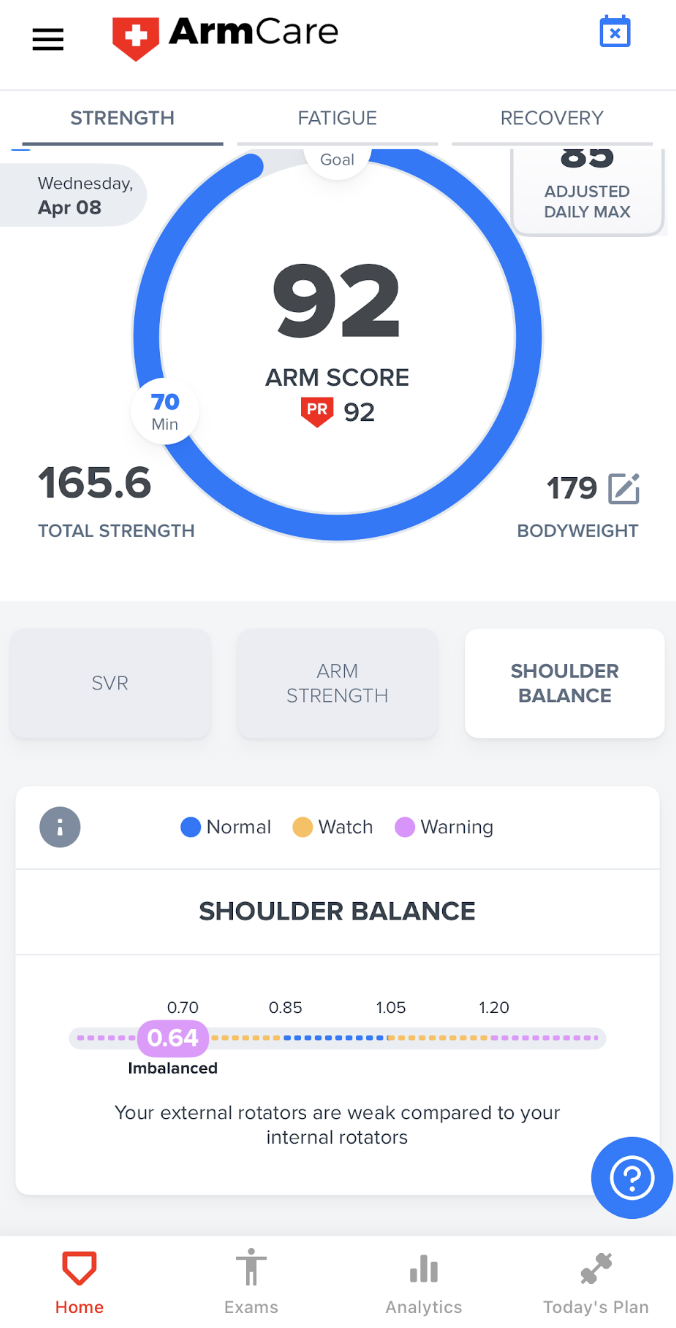
As a general rule, if your shoulder balance is below 0.85, prioritize external rotation strength before diving into a bunch of lat training exercises.
The best results come from athletes who are either balanced or working toward balance.
When integrating lat training, start with a low dose, a single exercise, and focus on one arm pulling at a time.
The Problem with Traditional Lat Training
For lat training, most athletes rely on:
- Pull-ups
- Lat pulldowns
- Seated rows
These aren’t bad, but they’re limited.
They’re typically done in fixed positions that don’t reflect how the body moves during throwing. Over time, this can reinforce poor patterns and imbalances.
Mixing in horizontal rowing can help shift activation toward the scapular stabilizers and posterior deltoid—but that’s still just part of the equation.
Train the Lats Like You Throw
To actually improve throwing performance, lat training needs to include:
1. Overhead Positioning – Train in positions that reflect the arm path during throwing
2. Core Integration – The lats don’t work alone—they connect with the trunk and pelvis
3. Stability Under Movement – The arm must accelerate while the body stays controlled
A Simple Progression
Build strength and coordination together:
- Quadruped (all fours) → control and alignment
- Bird Dog → adds stability
- Plank variations → full-body integration
- Single-arm rowing (overhead angles) → sport-specific transfer
These positions teach the lats to produce force while stabilizing the body—just like in throwing.
Why Position Matters
It’s common to see with lat training that an athlete gets overextended (arching the lower back). And if your position is off, your lats can’t do their job.
“Bring your belt buckle toward your belly button.”
“Stack wrist, elbow, shoulder.”
These put you in a position where the lats can create force—without compensation.
The Takeaway
Strong lats matter—but how you train them matters more.
If you want to throw harder, train your lats to accelerate the arm, not just move weight.
Because in high-velocity throwing…power behind you only matters if you can transfer it forward.
Train your lats the way elite throwers do.
Check out the video below—and get ready to light up the radar gun.
Strength Matters Most.
Ryan
Ryan@armcare.com