The red arrow in the image below offers the simplest explanation for the elbow injury epidemic in baseball. It shows a critical force exerted on the inner elbow during the pitching motion.
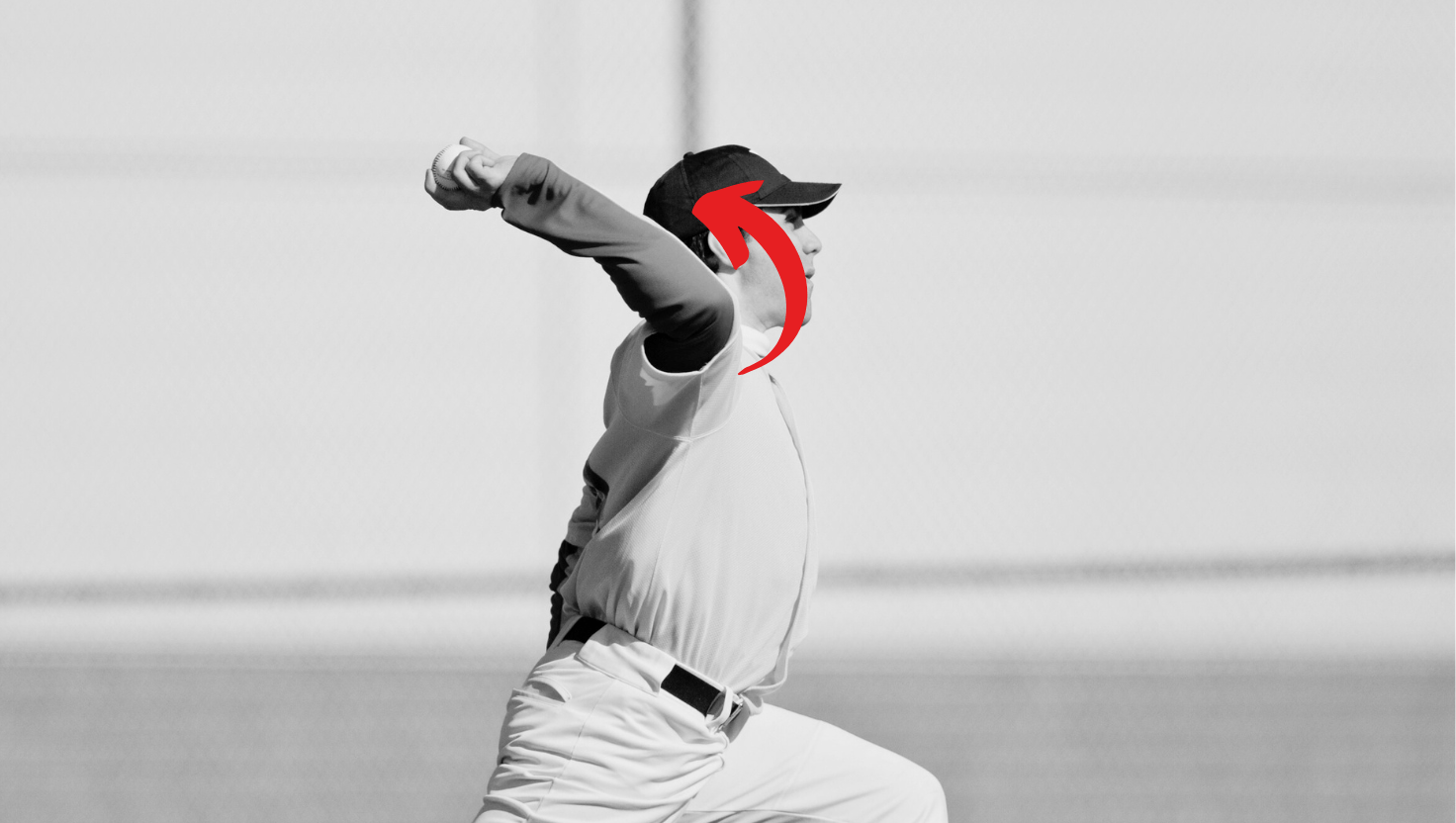
But images are easy to ignore.
So instead, get into your throwing position, but grab a 65lb dumbbell instead of your typical baseball.
Now, as you’re uncomfortably holding this weight in full layback, consider that this is a similar elbow load as a pitcher throwing around 85 mph (ref).
The ulnar collateral ligament, better known as the UCL, absorbs a portion of the force to prevent the arm from snapping backward uncontrollably in this position. When subjected to excessive stress over time, the UCL can weaken and eventually tear, making it a serious injury threat for pitchers.
Fortunately, as many players know, Tommy John surgery—named after the first baseball player to undergo it—can reconstruct the ligament and restore function. However, avoiding Tommy John surgery is in a player’s best interest because it has significant drawbacks.
The recovery process is long—typically 12 to 18 months—meaning a player could miss an entire season or more. Then, even after rehab, not all players return to their previous level of performance. Some experience reduced velocity, lingering discomfort, and changes in mechanics, and some require revision surgeries, which can further weaken the overall integrity of the elbow.
Given these risks, many experts fall back on the same familiar recommendations:
- Pitch Less
- Don’t Throw as Hard
But these so-called solutions fail to address the real issue. Restricting workload and velocity may seem like a safe bet, but if this approach truly worked, why are injury rates still climbing?
The reality is that these limitations contradict the very nature of competition. It’s like telling a sprinter to slow down to avoid pulling a hamstring. It might reduce strain, but it completely undermines performance and the psychology of those aiming to excel at the sport.
Fortunately, this myopic mechanical focus, which views the body like a machine, is flawed.
Sure, reducing how much or fast you drive will prolong the life of your car. But the human body isn’t a piece of equipment; it’s an adaptable system capable of adjusting to increased workloads.
Take Nolan Ryan, for example. He pitched for 27 seasons, setting records for strikeouts and longevity. His success wasn’t just about raw talent—it was built on durability, strength, and an unwavering commitment to training.
Ryan’s rigorous conditioning routine helped him maintain elite performance deep into his career, highlighting that proper preparation, not velocity or workload restriction, is the key to health and longevity for pitchers.
The Major Factors for Protecting the UCL
Instead of waving warning flags about reducing stress, the real solution is strengthening the body to handle the demands of pitching more effectively.
However, our premise that strength is the key to injury prevention is often misunderstood. Strength training for pitchers extends far beyond just hitting the gym or some pre-practice light band work. It has specific requirements to enhance resilience, endurance, and longevity on the mound.
The following shows the benefits of a true arm training program—an approach that goes beyond what most players do to protect their arms.
1. Stronger Forearm Muscles Defend the UCL
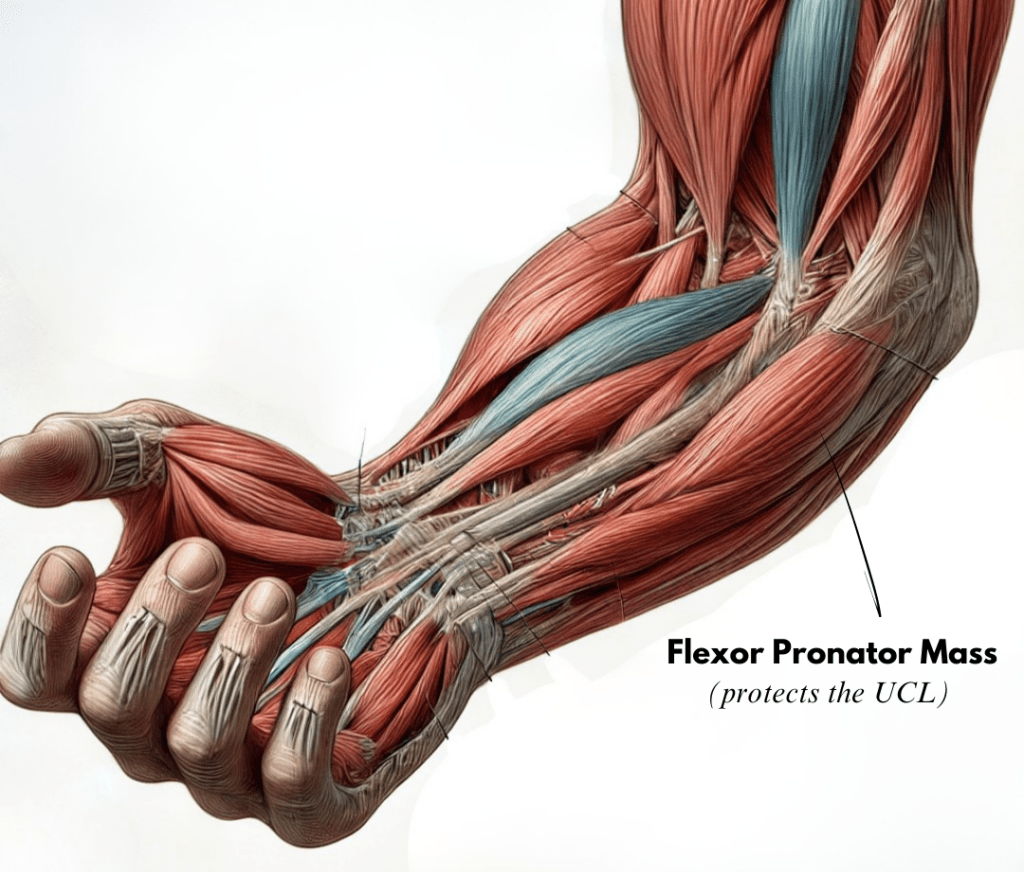
It’s important to understand that the UCL isn’t the only structure stabilizing the elbow during layback. The forearm muscles also act as restraints against the forces pulling at the elbow and, therefore, play a crucial role in reducing strain on the ligament.
A stronger forearm means less reliance on the ligament, lowering the risk of injury.
Research from ASMI indicates that two pitchers throwing at the same velocity can experience significantly different levels of UCL stress, depending on their forearm strength.
By strengthening these muscles with targeted exercises you can protect the elbow and prevent overuse injuries.
2. The UCL Itself Can Get Stronger
Just like muscles adapt to stress by getting stronger, ligaments like the UCL can also become more resilient through progressive loading.
Throwing itself, when done with the right progression, strengthens the UCL over time, but resistance training, particularly eccentric and isometric exercises, can also help promote ligament durability and improve overall arm strength.
3. Full-Body Strength Enhances Performance Without Adding Stress to the Elbow
True durability doesn’t come from focusing on the elbow alone—it requires training the entire kinetic chain because, as we like to say, “the body throws, the arm delivers.“
A pitcher’s power starts from the ground up, and any weakness in the chain forces compensations that put excess stress on the elbow. By building leg strength, core stability, and shoulder mechanics, pitchers can generate more power efficiently.
A stronger, well-conditioned body doesn’t just prevent injuries—it allows pitchers to throw harder, sustain performance longer, and recover faster.
4. The Fight Against Fatigue
Building strength is only part of the equation. According to 2006 ASMI research, pitching while fatigued increases the injury risk by 36 times. Therefore, pitchers must develop endurance to resist fatigue throughout a game and season to truly protect the elbow and sustain high performance.
Because as a pitcher becomes fatigued, their strength drops. More recent studies on grip strength loss show that all pitchers experience some strength decline as they throw, but those who sustain injuries tend to lose strength at a faster rate per inning.

Fatigue also affects mechanics. The image below shows how pitchers leave their arms behind their bodies for longer as they fatigue, which can add further stress to the elbow.

Overall, pitchers with better muscle endurance can sustain performance longer, while those who fatigue more quickly place additional stress on the elbow and increase their injury risk.
5. Adds Stability with Increased Layback
When a pitcher gains range of motion—especially external rotation in the shoulder—without a corresponding increase in strength, the added mobility creates more stress on the UCL.
This is because greater external rotation allows for a more layback during the throwing motion, increasing the stretch and velocity of the arm as it accelerates forward. Without the strength to control this increased range, the ligaments in the elbow take on more of the load, leading to excessive strain.
Over the course of a season, pitchers naturally gain range due to repetitive throwing, which is why velocity often increases. However, if strength doesn’t keep pace with mobility gains, the arm becomes more vulnerable to injury.
This concept also explains why weighted ball programs, which can quickly expand range of motion, often work well but at the expense of arm health.
Throw Harder While Protecting Your Arm
The path to protecting a pitcher’s elbow isn’t about throwing less or limiting velocity—it’s about preparing the body to handle the demands of high-velocity throwing. Strength, endurance, and proper conditioning are the real solutions to reducing injury risk, with the added bonus of boosting performance.
This is where the ArmCare App makes a difference.
The app helps pitchers develop the resilience they need to stay healthy and perform at their best by providing individualized strength assessments, real-time fatigue monitoring, and targeted training programs.
Through science-backed strategies, pitchers can build the strength to protect their UCL, the endurance to sustain performance, and the awareness to prevent overuse injuries before they happen.
Rather than guessing about arm health, the ArmCare App provides the tools to take control of it—ensuring that pitchers can train smarter, throw harder, and stay on the mound longer.


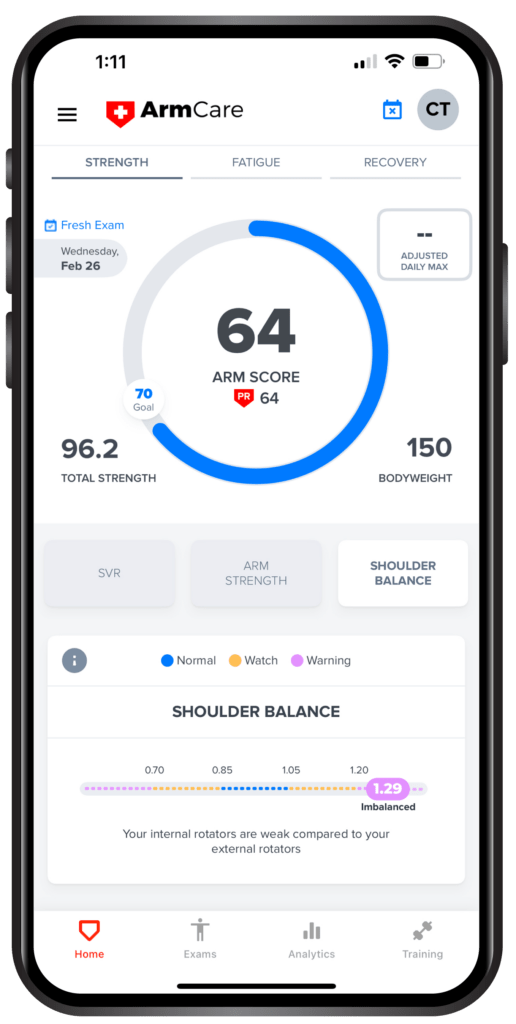
Through science-backed strategies, pitchers can build the strength to protect their UCL, the endurance to sustain performance, and the awareness to prevent overuse injuries before they happen.
Rather than guessing about arm health, the ArmCare App provides the tools to take control of it—ensuring that pitchers can train smarter, throw harder, and stay on the mound longer.