Strength in Numbers #101
In my previous article, I shared a video of athletes moving at a remarkable speed as they completed more towel throws than I have ever witnessed while I was at the National Pitching Association clinic in Houston, Texas.
This week I want to close out my experience with the NPA and how they fine-tune players and their training.
I especially want to dive deeper into towel throws because some athletes accumulated over 250 throwing reps without touching a baseball.
For more on Towel Throws, be sure to check out our latest article: The Value of Towel Drills in a Throwing Program.
It’s not a sexy training tool, but it presents real value because the remarkable thing about this group is that only 25% had deficient strength levels, which is significantly less than in the rest of the baseball world. There was also less throwing arm weakness compared to the glove side, which tends to run rampant amongst amateurs and is something I noticed in most pitchers in professional baseball.
What I truly value about the NPA high-performance model is how they continue to push the boundaries of throwing arm capacity and are seeing ways to integrate strength testing to determine how each individual responds to training demands.
We’re finding that athletes can individualize their preparation and be highly specific by using the ArmCare App, even for drills like towel throws.
It’s now possible to grade the training effect by assessing the Arm Readiness, ArmScore, Shoulder Balance, Strength-Velocity Ratio, Recovery, and Arm Fatigue metrics provided by the app.
DIALING IN YOUR REPS
I loved the mix of players at the NPA clinic. There were some as young as 9 years old, maybe even younger, alongside seniors in high school and potentially some gap-year collegiate pitchers, as some of the teenagers attending looked like men.
As part of the event, I presented data from two very different pitchers of the forty who went through our Fresh Exam.
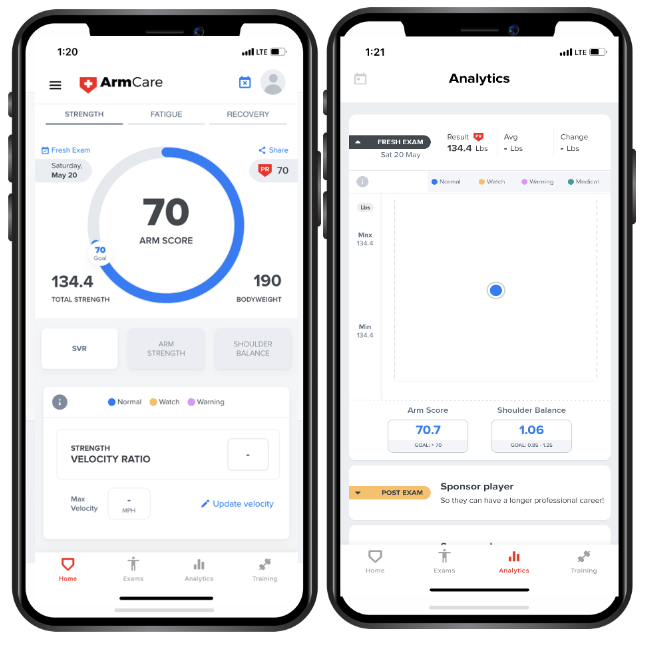
The first player was much more physical and could handle greater workloads. You can tell by the data that he has a high-conditioned throwing arm.
As you can see below, this athlete produced an impressive ArmScore even after high-volume towel throws. The data indicates that he meets our cutoff for minimum strength requirements to reduce the risk of injury and maintain high performance.
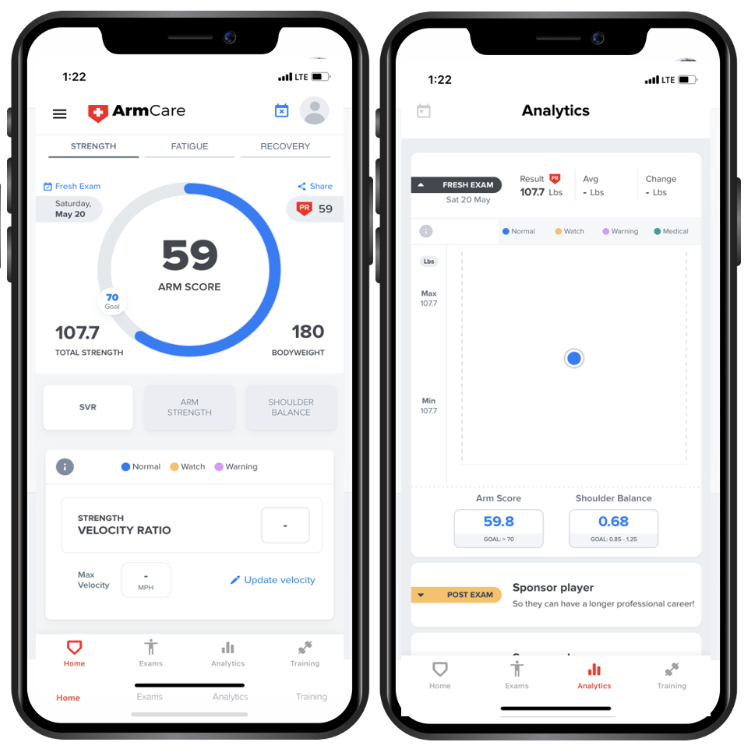
The second athlete I presented had lower strength qualities.
It doesn’t mean he’s less of an athlete or doesn’t have great potential. However, this information means there needs to be heightened attention to detail, and significant work is necessary to prepare his arm if he wants to pursue baseball at higher levels.
FATIGUE IS THE ENEMY, YET WITH FREQUENT MONITORING, FATIGUE ADAPTATIONS ARE ESSENTIAL FOR CAPACITY
In our education, we often mention that “Fatigue is the Enemy” based on research that showed a 36x increase in surgical risk amongst pitchers when pitching while fatigued.
However, at certain times during the year—such as the offseason—it’s a time to build capacity, and we expect to see temporary deficits in strength. In other words, you must fatigue the arm strategically to build capacity.
The ArmCare Platform helps players decide when to increase or deload to allow their arm to build back up based on the total effect of their training. With objective strength numbers, the additive effect of practice, strength training, other sports and activities, and accessory throwing like towel drills is now possible to evaluate.
Whatever you wish to incorporate into your training methods, take a page from the NPA’s book and use a data-led approach to your player development approaches.
As I close out this 3-part series, I am so excited to be a part of more clinics from the NPA.
The coaches prioritize and lead the way with throwing arm health as the apex focus for their athletes. There’s more talk of pitching than throwing hard, which is a breath of fresh air. The organization has a beautiful way of calculating training workloads from weekly pitch volumes and throwing velocity.
I cannot wait to see further adjustments they make using the ArmCare Key Metrics in the equations that the organization has created over years of evaluation and observation.
Go here if you want more information on the National Pitching Association and want to attend a clinic in your region, see how they train their athletes, and get a good taste of ArmCare.com.
Keep your learning valve on, folks, and have a great rest of the weekend!